


Correlations of Cognitive Impairment with Circadian Blood Pressure Pattern and Intima-Media Thickness in Hypertensive Patients
- PMID: 28465733
- PMCID: PMC5394449
Correlations of Cognitive Impairment with Circadian Blood Pressure Pattern and Intima-Media Thickness in Hypertensive Patients
Abstract
Introduction: Cognitive impairment is strongly associated with arterial hypertension and might be associated also with certain circadian blood pressure patterns. Ambulatory blood pressure monitoring (ABPM) represents a very useful tool in the evaluation of patients with hypertension. Intima-media thickness (IMT), a marker of subclinical organ damage in hypertensive patients is associated with the progression of cognitive impairment. The aim of our study was to correlate the cognitive impairment with the hypertension pattern found with ABPM, IMT, lipid profile and inflammatory syndrome.
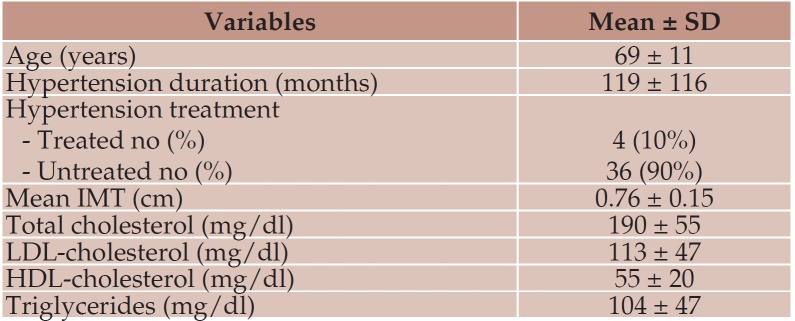
Materials and methods: We enrolled 40 patients aged between 47 and 88 years (69±11 years) with medical history of essential hypertension and cognitive impairment. All patients underwent neuropsychological examination, ABPM, and B-mode ultrasound of the carotid arteries.
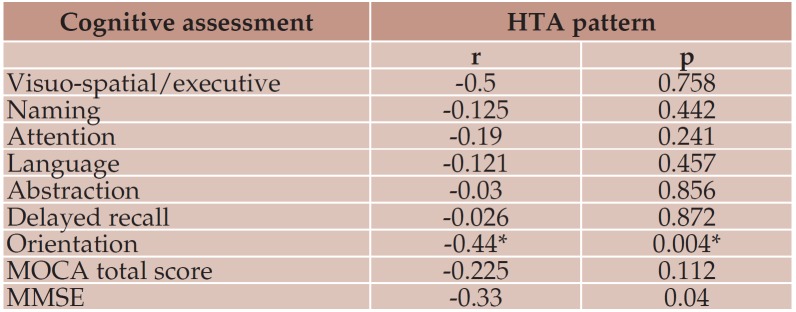
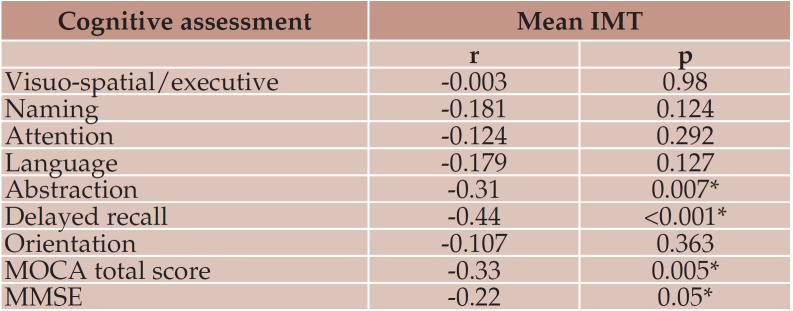
Results: 57% of the patients had a nondipping pattern. The blood pressure pattern inversely correlated with the results of MMSE (r=-0.33; p=0.04), patients with nondipping patterns having lower scores than the ones with dipper pattern. Increased IMT was associated with poorer performance on MoCA test (r=-0.33; p=0.005). MoCA and MMSE scores were inversely correlated with the total cholesterol (r=-0.31; p=0.04; and r=0.38; p=0.01 respectively) and with the LDL-cholesterol (r=-0.32; p=0.04; and r=-0.41; p=0.009 respectively). Patients with low scores on MMSE also had high serum levels of C reactive protein (r=-0.33; p=0.045).
Conclusion: Patients with cognitive impairment and hypertension have vascular changes characterized by increased carotid IMT, alteration of the dipping phenomenon, increased total and LDL-cholesterol, and increased C reactive protein, all related to the degree of cognitive dysfunction.
Figures
References
-
- Nagai M, Hoshide S, Kario K - Hypertension and dementia. Am J Hypertens. 2010;23:116–24. - PubMed
-
- Spence JD - Carotid intima-media thickness and cognitive decline: what does it mean for prevention of dementia? J Neurol Sci. 2004;223:103–5. - PubMed
-
- Mancia G, De Backer G, Dominiczak A, et al. - 2007 Guidelines for the Management of Arterial Hypertension: The Task Force for the Management of Arterial Hypertension of the European Society of Hypertension (ESH) and of the European Society of Cardiology (ESC). J Hypertens. 2007;25:1105–87. - PubMed
LinkOut - more resources
Full Text Sources
Research Materials