. 2017 Dec;7(1):48.
doi: 10.1186/s13613-017-0272-7. Epub 2017 May 2.

Circulating bile acids predict outcome in critically ill patients

Affiliations

Circulating bile acids predict outcome in critically ill patients

Thomas Horvatits et al. Ann Intensive Care. 2017 Dec.

Abstract

Background: Jaundice and cholestatic hepatic dysfunction are frequent findings in critically ill patients associated with increased mortality. Cholestasis in critically ill patients is closely associated with stimulation of pro-inflammatory cytokines resulting in impaired bile secretion and subsequent accumulation of bile acids. Aim of this study was to evaluate the clinical role of circulating bile acids in critically ill patients.

Methods: Total and individual serum bile acids were assessed via high-performance liquid chromatography in 320 critically ill patients and 19 controls.

Results: Total serum bile acids were threefold higher in septic than cardiogenic shock patients and sixfold higher than in post-surgical patients or controls (p < 0.001). Elevated bile acid levels correlated with severity of illness, renal dysfunction and inflammation (p < 0.05). Total bile acids predicted 28-day mortality independently of sex, age, serum bilirubin and severity of illness (HR 1.041, 95% CI 1.013-1.071, p < 0.005). Best prediction of mortality of total bile acids was seen in patients suffering from septic shock.

Conclusions: Individual and total BAs are elevated by various degrees in different shock conditions. BAs represent an early predictor of short-term survival in a mixed cohort of ICU patients and may serve as marker for early risk stratification in critically ill patients. Future studies should elucidate whether modulation of BA metabolism and signalling influences the clinical course and outcome in critically ill patients.

Keywords: Bile acids; Cardiogenic shock; Cholestasis; Critically ill patients; ICU; Septic shock.


Figures

Fig. 1
Fig. 1
Correlation of serum bile acids and bilirubin. Correlation Log-TC and Log-bilirubin in all patients on admission (a); in all patients 48 h after admission (b); in cardiogenic shock patients on admission (c); in cardiogenic shock patients 48 h after admission (d); in septic patients on admission (e); in septic patients 48 h after admission (f)
Fig. 2
Fig. 2
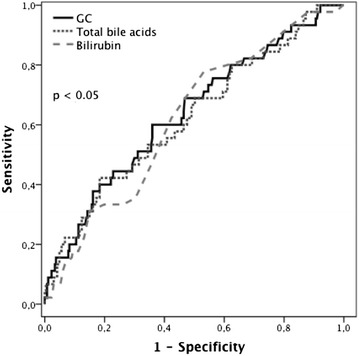
Total and individual serum bile acids predicting 28-day mortality. ROC analysis for prediction of 28-day mortality of TBA (total bile acids), GC (glycocholic acid) and serum bilirubin on admission. AUROC of GC: 0.64, p = 0.005; TBA: 0.62, p < 0.05; bilirubin: 0.61, p < 0.05
Fig. 3
Fig. 3
Kaplan–Meier’s plot of 28-day survival. 28-day survival rate was significantly lower in patients with TBA (total bile acids) on admission ≥ 5.2 μmol/l compared to patients < 5.2 μmol/l (72 vs. 89%, p < 0.001)

References

    1. Kramer L, Jordan B, Druml W, Bauer P, Metnitz PG. Incidence and prognosis of early hepatic dysfunction in critically ill patients—a prospective multicenter study. Crit Care Med. 2007;35(4):1099–1104. doi: 10.1097/01.CCM.0000259462.97164.A0. - DOI - PubMed
    1. Vanwijngaerden YM, Wauters J, Langouche L, Vander Perre S, Liddle C, Coulter S, et al. Critical illness evokes elevated circulating bile acids related to altered hepatic transporter and nuclear receptor expression. Hepatology. 2011;54(5):1741–1752. doi: 10.1002/hep.24582. - DOI - PubMed
    1. Recknagel P, Gonnert FA, Westermann M, Lambeck S, Lupp A, Rudiger A, et al. Liver dysfunction and phosphatidylinositol-3-kinase signalling in early sepsis: experimental studies in rodent models of peritonitis. PLoS Med. 2012;9(11):e1001338. doi: 10.1371/journal.pmed.1001338. - DOI - PMC - PubMed
    1. Mesotten D, Wauters J, Van den Berghe G, Wouters PJ, Milants I, Wilmer A. The effect of strict blood glucose control on biliary sludge and cholestasis in critically ill patients. J Clin Endocrinol Metab. 2009;94(7):2345–2352. doi: 10.1210/jc.2008-2579. - DOI - PubMed
    1. Jager B, Drolz A, Michl B, Schellongowski P, Bojic A, Nikfardjam M, et al. Jaundice increases the rate of complications and one-year mortality in patients with hypoxic hepatitis. Hepatology. 2012;56(6):2297–2304. doi: 10.1002/hep.25896. - DOI - PubMed