


Low mean perfusion pressure is a risk factor for progression of acute kidney injury in critically ill patients - A retrospective analysis
- PMID: 28468613
- PMCID: PMC5415805
- DOI: 10.1186/s12882-017-0568-8
Low mean perfusion pressure is a risk factor for progression of acute kidney injury in critically ill patients - A retrospective analysis
Abstract
Background: The aim was to investigate whether mean perfusion pressure (MPP) calculated as the difference between mean arterial pressure (MAP) and central venous pressure (CVP) was associated with risk of progression from AKI I to AKI III in critically ill patients.
Methods: Retrospective analysis of adult patients admitted to a multi-disciplinary adult intensive care unit (ICU) between July 2007 and June 2009 who developed AKI I and in whom advanced haemodynamic monitoring was initiated within 12 h of diagnosis of AKI I. We compared patients with a MPP above and below the median value in the first 12 h of diagnosis of AKI. Multivariable logistic regression analyses were performed to identify independent risk factors for progression to AKI III, to explore the impact of MAP and CVP separately, and to investigate the impact of MPP in pre-defined sub-groups.
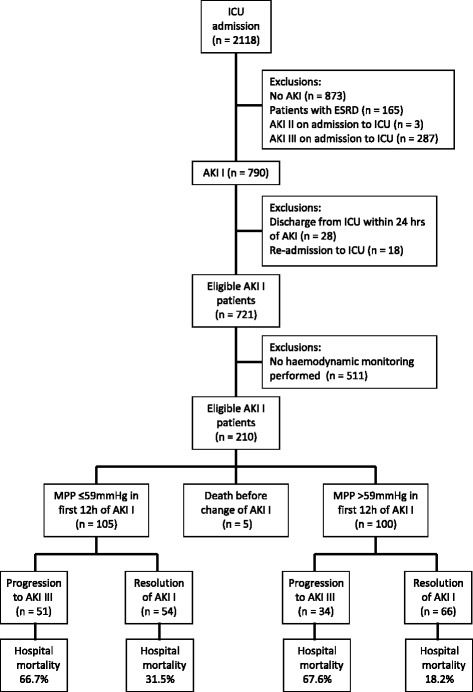
Results: Among 2118 ICU patients, 790 patients (37%) developed AKI I of whom 205 underwent advanced haemodynamic monitoring within 12 h of AKI stage I. Their median MPP was 59 mmHg. AKI I patients with a MPP ≤59 mmHg had a significantly higher risk of progressing to AKI stage III (48.6% versus 34%, respectively; p = 0.0034). This association was stronger in patients with ischemic heart disease, congestive cardiac failure or without pre-existing hypertension and in patients with a MAP <65 mmHg for >1 h. As individual components, a raised CVP was independently associated with progression to AKI stage III but MAP alone was not an independent risk factor for AKI progression.
Conclusion: MPP <60 mmHg was independently associated with AKI progression. CVP was the key component of MPP.
Keywords: Acute kidney injury; Central venous pressure; Haemodynamics; Mean perfusion pressure; Risk of progression.
Figures
References
-
- Mehta R, Cerdá J, Burdmann E, Tonelli M, Garcia-Carcia G, Jha V, et al. International Society of Nephrology's 0by25 initiative for acute kidney injury (zero preventable deaths by 2025): a human rights case for nephrology. Lancet. 2015;385(9987):2616–2643. doi: 10.1016/S0140-6736(15)60126-X. - DOI - PubMed
MeSH terms
LinkOut - more resources
Full Text Sources
Other Literature Sources
Research Materials
