


Peripheral Artery Disease Prevalence and Incidence Estimated From Both Outpatient and Inpatient Settings Among Medicare Fee-for-Service Beneficiaries in the Atherosclerosis Risk in Communities (ARIC) Study
- PMID: 28468784
- PMCID: PMC5524052
- DOI: 10.1161/JAHA.116.003796
Peripheral Artery Disease Prevalence and Incidence Estimated From Both Outpatient and Inpatient Settings Among Medicare Fee-for-Service Beneficiaries in the Atherosclerosis Risk in Communities (ARIC) Study
Abstract
Background: Outpatient ascertainment of peripheral artery disease (PAD) is rarely considered in the measurement of PAD clinical burden; therefore, the clinical burden of PAD likely has been underestimated while contributing to a decreased awareness of PAD in comparison to other circulatory system disorders.
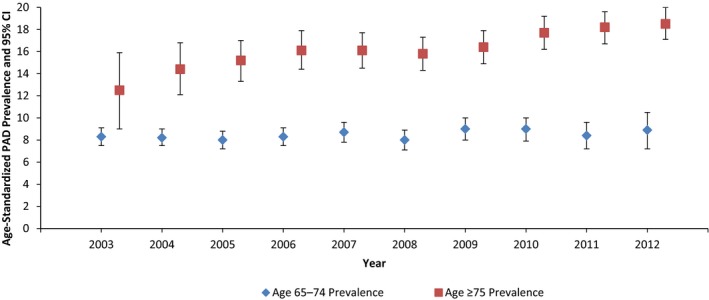
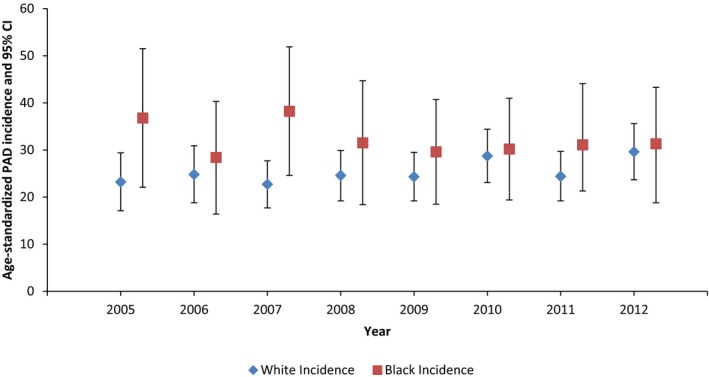
Methods and results: The purpose of this study was to estimate the age-standardized annual period prevalence and incidence of PAD in the outpatient and inpatient settings using data from the Atherosclerosis Risk in Communities (ARIC) study linked with Centers for Medicare and Medicaid Services claims. The majority (>70%) of all PAD encounters occurred in the outpatient setting. The weighted mean age-standardized prevalence and incidence of outpatient PAD was 11.8% (95% CI 11.5-12.1) and 22.4 per 1000 person-years (95% CI 20.8-24.0), respectively. Black patients had higher weighted mean age-standardized prevalence (15.6%; 95% CI 14.6-16.4) compared with white patients (11.4%; 95% CI 11.1-11.7). Black women had the highest weighted mean age-standardized prevalence (16.9%; 95% CI 16.0-17.8). Black patients also had a higher incidence rate of PAD (31.3 per 1000 person-years; 95% CI 27.3-35.4) compared with white patients (25.4 per 1000 person-years; 95% CI 23.5-27.3). PAD prevalence and incidence did not differ by sex alone.
Conclusions: This study provides comprehensive estimates of PAD in the inpatient and outpatient settings where the majority of PAD burden was found. PAD is an important circulatory system disorder similar in prevalence to stroke and coronary heart disease.
Keywords: Atherosclerosis Risk in Communities; Medicare; aging; claims; epidemiology; peripheral artery disease; population science.
© 2017 The Authors. Published on behalf of the American Heart Association, Inc., by Wiley.
Figures


References
-
- McDermott M. The magnitude of the problem of peripheral arterial disease: epidemiology and clinical significance. Cleve Clin J Med. 2006;73:S1–S6. - PubMed
-
- Criqui MH, Langer RD, Fronek A, Feigelson HS, Klauber MR, McCann TJ, Browner D. Mortality over a period of 10 years in patients with peripheral arterial disease. N Engl J Med. 1992;326:381–386. - PubMed
-
- Dormandy JA, Rutherford RB. Management of peripheral arterial disease (PAD). TASC Working Group. Transatlantic Inter‐Society Consensus. J Vasc Surg. 2000;31:S1–S296. - PubMed
-
- Mahoney EM, Wang K, Keo HH, Duval S, Smolderen KG, Cohen DJ, Steg G, Bhatt DL, Hirsch AT. Vascular hospitalization rates and costs in patients with peripheral artery disease in the United States. Circ Cardiovasc Qual Outcomes. 2010;3:642–651. - PubMed
Publication types
MeSH terms
Grants and funding
LinkOut - more resources
Full Text Sources
Other Literature Sources
Medical
