


Dietary intake of α-linolenic acid and risk of age-related macular degeneration
- PMID: 28468892
- PMCID: PMC5445670
- DOI: 10.3945/ajcn.116.143453
Dietary intake of α-linolenic acid and risk of age-related macular degeneration
Abstract
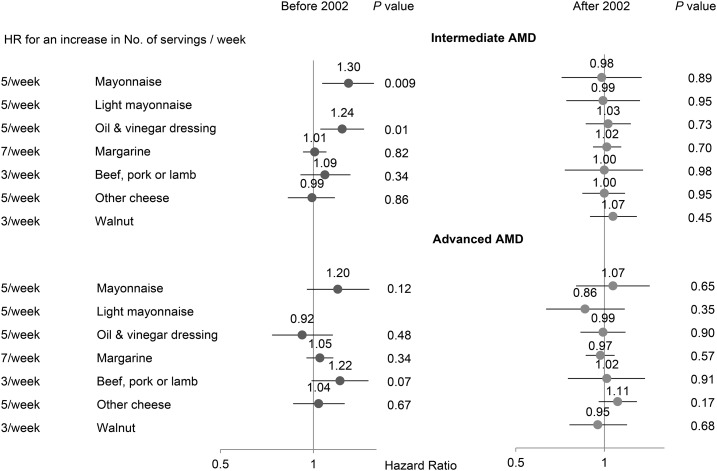
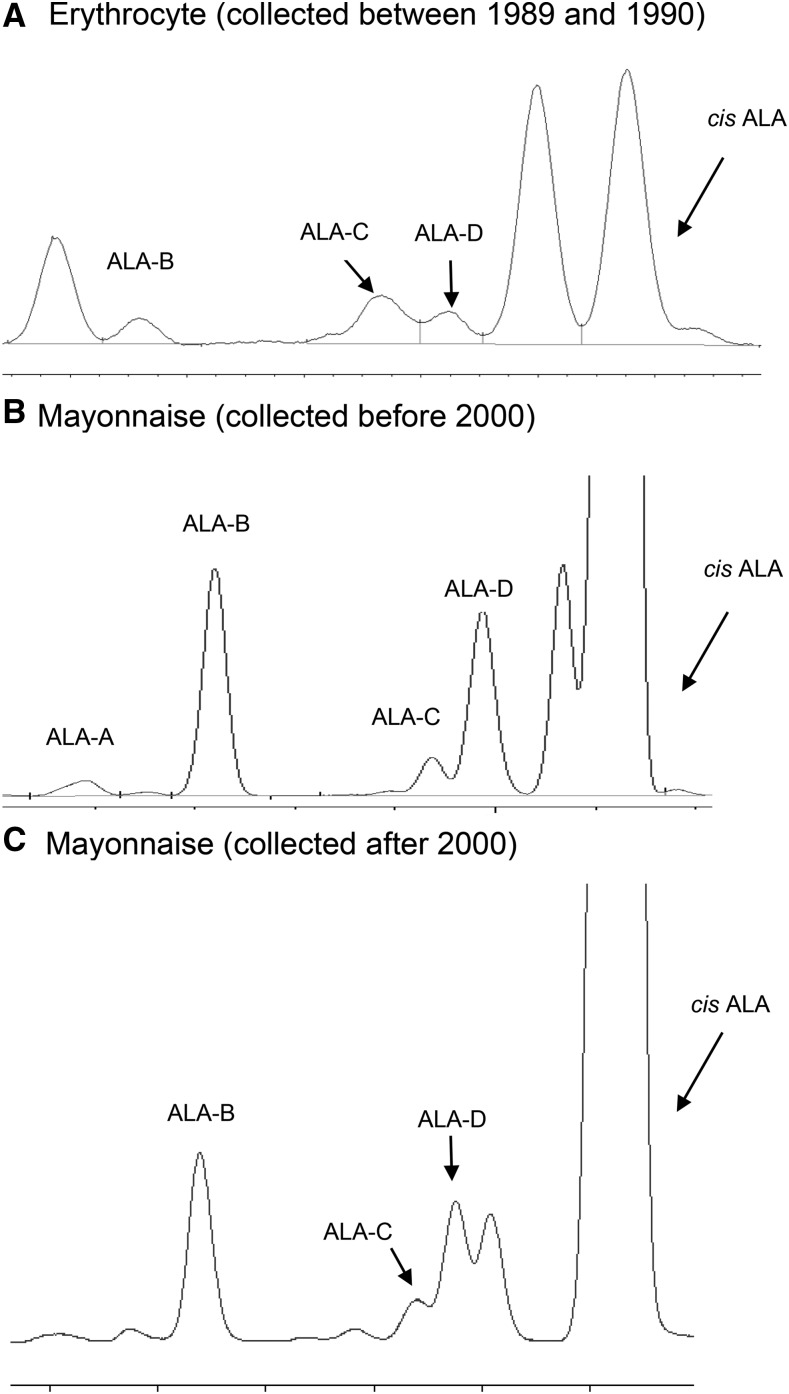
Background: The relation between α-linolenic acid (ALA), a plant-derived omega-3 (n-3) fatty acid, and age-related macular degeneration (AMD) is unclear. European researchers reported that ≤40% of ALA can be present as trans forms.Objective: We aimed to evaluate the associations between intake of ALA and intermediate and advanced AMD.Design: Seventy-five thousand eight hundred eighty-nine women from the Nurses' Health Study and 38,961 men from Health Professionals Follow-Up Study were followed up from 1984 to 2012 and from 1986 to 2010, respectively. We assessed dietary intake by a validated food-frequency questionnaire at baseline and every 4 y thereafter. One thousand five hundred eighty-nine incident intermediate and 1356 advanced AMD cases (primarily neovascular AMD) were confirmed by medical record review.Results: The multivariable-adjusted HR for intermediate AMD comparing ALA intake at the top quintile to the bottom quintile was 1.28 (95% CI: 1.05, 1.56; P-trend = 0.01) in the analyses combining 2 cohorts. The HR in each cohort was in the positive direction but reached statistical significance only in the women. However, the positive association was apparent only in the pre-2002 era in each cohort and not afterward (P-time interaction = 0.003). ALA intake was not associated with advanced AMD in either time period. Using gas-liquid chromatography, we identified both cis ALA (mean ± SD: 0.13% ± 0.04%) and trans ALA isomers (0.05% ± 0.01%) in 395 erythrocyte samples collected in 1989-1990. In stepwise regression models, mayonnaise was the leading predictor of erythrocyte concentrations of cis ALA and one isomer of trans ALA. We also found trans ALA in mayonnaise samples.Conclusions: A high intake of ALA was associated with an increased risk of intermediate AMD before 2002 but not afterward. The period before 2002 coincides with the same time period when trans ALA was found in food and participants' blood; this finding deserves further study.
Keywords: age-related macular degeneration; food-frequency questionnaire; omega-3 fatty acids; prospective cohort study; trans fat; α-linolenic acid.
© 2017 American Society for Nutrition.
Figures
References
-
- Klein R, Chou CF, Klein BE, Zhang X, Meuer SM, Saaddine JB. Prevalence of age-related macular degeneration in the US population. Arch Ophthalmol 2011;129:75–80. - PubMed
-
- Friedman DS, O’Colmain BJ, Munoz B, Tomany SC, McCarty C, de Jong PT, Nemesure B, Mitchell P, Kempen J. Prevalence of age-related macular degeneration in the United States. Arch Ophthalmol 2004;122:564–72. - PubMed
-
- Wong WL, Su X, Li X, Cheung CM, Klein R, Cheng CY, Wong TY. Global prevalence of age-related macular degeneration and disease burden projection for 2020 and 2040: a systematic review and meta-analysis. Lancet Glob Health 2014;2:e106–16. - PubMed
-
- Rein DB, Wittenborn JS, Zhang X, Honeycutt AA, Lesesne SB, Saaddine J. Forecasting age-related macular degeneration through the year 2050: the potential impact of new treatments. Arch Ophthalmol 2009;127:533–40. - PubMed
Publication types
MeSH terms
Substances
LinkOut - more resources
Full Text Sources
Other Literature Sources
Medical
