


Prospective Evaluation of the Relationship Between Mechanical Stability and Response to Palliative Radiotherapy for Symptomatic Spinal Metastases
- PMID: 28469043
- PMCID: PMC5553957
- DOI: 10.1634/theoncologist.2016-0356
Prospective Evaluation of the Relationship Between Mechanical Stability and Response to Palliative Radiotherapy for Symptomatic Spinal Metastases
Abstract
Background: A substantial number of patients with spinal metastases experience no treatment effect from palliative radiotherapy. Mechanical spinal instability, due to metastatic disease, could be associated with failed pain control following radiotherapy. This study investigates the relationship between the degree of spinal instability, as defined by the Spinal Instability Neoplastic Score (SINS), and response to radiotherapy in patients with symptomatic spinal metastases in a multi-institutional cohort.
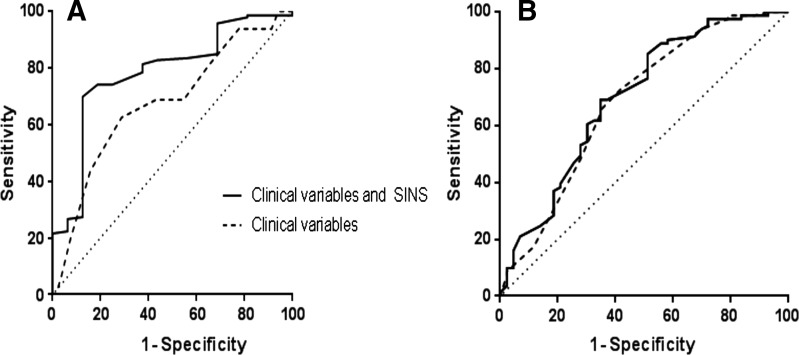
Methods and materials: The SINS of 155 patients with painful thoracic, lumbar, or lumbosacral metastases from two tertiary hospitals was calculated using images from radiotherapy planning CT scans. Patient-reported pain response, available for 124 patients, was prospectively assessed. Pain response was categorized, according to international guidelines, as complete, partial, indeterminate, or progression of pain. The association between SINS and pain response was estimated by multivariable logistic regression analysis, correcting for predetermined clinical variables.
Results: Of the 124 patients, 16 patients experienced a complete response and 65 patients experienced a partial response. Spinal Instability Neoplastic Score was associated with a complete pain response (adjusted odds-radio [ORadj] 0.78; 95% confidence interval [CI] 0.62-0.98), but not with an overall pain response (ORadj 0.94; 95% CI 0.81-1.10).
Conclusions: A lower SINS, indicating spinal stability, is associated with a complete pain response to radiotherapy. This supports the hypothesis that pain resulting from mechanical spinal instability responds less well to radiotherapy compared with pain from local tumor activity. No association could be determined between SINS and an overall pain response, which might indicate that this referral tool is not yet optimal for prediction of treatment outcome.
Implications for practice: Patients with stable painful spinal metastases, as indicated by a Spinal Instability Neoplastic Score (SINS) of 6 or lower, can effectively be treated with palliative external beam radiotherapy. The majority of patients with (impending) spinal instability, as indicated by a SINS score of 7 or higher, will achieve a (partial) response after palliative radiotherapy; however, some patients might require surgical intervention. Therefore, it is recommended to refer patients with a SINS score of 7 or higher to a spine surgeon to evaluate the need for surgical intervention.
Keywords: Pain response; Palliative radiotherapy; Spinal instability; Spinal metastases; Spinal neoplastic instability score.
© AlphaMed Press 2017.
Conflict of interest statement
Disclosures of potential conflicts of interest may be found at the end of the article.
Figures
References
-
- Hayat MJ, Howlader N, Reichman ME et al. Cancer Statistics, Trends, and Multiple Primary Cancer Analyses from the Surveillance, Epidemiology, and End Results (SEER) Program. The Oncologist 2007;12:20–37. - PubMed
-
- Harel R, Angelov L. Spine metastases: Current treatments and future directions. Eur J Cancer 2010;46:2696–2707. - PubMed
-
- Poon M, Zeng L, Zhang L et al. Incidence of skeletal‐related events over time from solid tumour bone metastases reported in randomised trials using bone‐modifying agents. Clin Oncol (R Coll Radiol) 2013;25:435–444. - PubMed
-
- Henry DH, Costa L, Goldwasser F et al. Randomized, Double‐Blind Study of Denosumab Versus Zoledronic Acid in the Treatment of Bone Metastases in Patients With Advanced Cancer (Excluding Breast and Prostate Cancer) or Multiple Myeloma. J Clin Oncol 2011;29:1125–1132. - PubMed
-
- Weinfurt KP. The significance of skeletal‐related events for the health‐related quality of life of patients with metastatic prostate cancer. Ann Oncol 2005;16:579–584. - PubMed
MeSH terms
LinkOut - more resources
Full Text Sources
Other Literature Sources
