


Chemical Synthesis of (+)-Ryanodine and (+)-20-Deoxyspiganthine
- PMID: 28470044
- PMCID: PMC5409222
- DOI: 10.1021/acscentsci.6b00361
Chemical Synthesis of (+)-Ryanodine and (+)-20-Deoxyspiganthine
Abstract
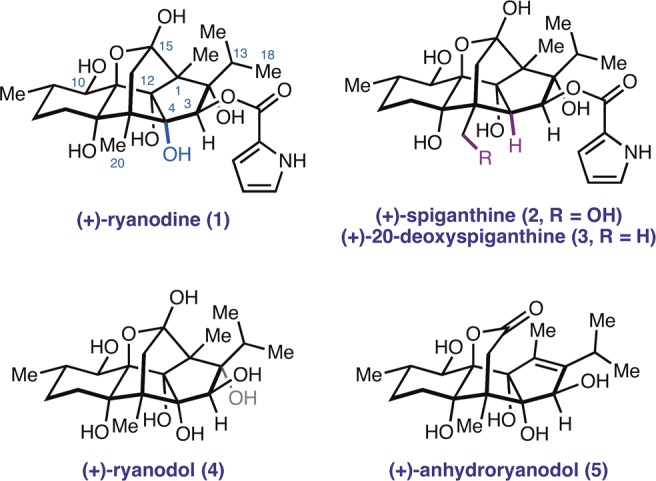
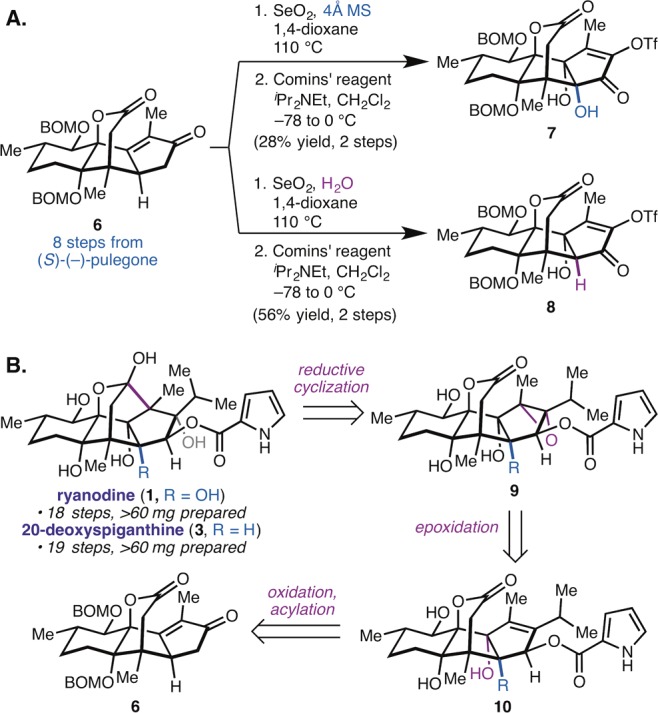
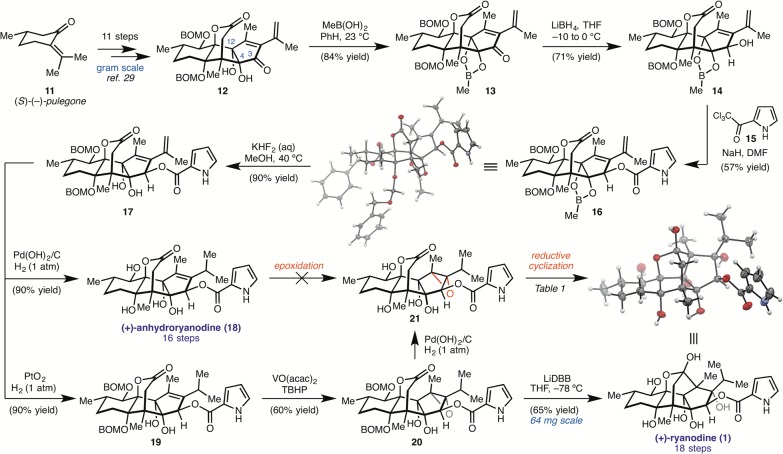
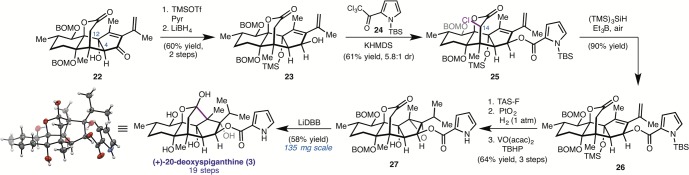
(+)-Ryanodine is a natural product modulator of ryanodine receptors, important intracellular calcium ion channels that play a critical role in signal transduction leading to muscle movement and synaptic transmission. Chemical derivatization of (+)-ryanodine has demonstrated that certain peripheral structural modifications can alter its pharmacology, and that the pyrrole-2-carboxylate ester is critical for high affinity binding to ryanodine receptors. However, the structural variation of available ryanodine analogues has been limited by the challenge of site-specific functionalization of semisynthetic intermediates, such as (+)-ryanodol. Here we report a synthetic strategy that provides access to (+)-ryanodine and the related natural product (+)-20-deoxyspiganthine in 18 and 19 steps, respectively. A key feature of this strategy is the reductive cyclization of an epoxide intermediate that possesses the critical pyrrole-2-carboxylate ester. This approach allows for the direct introduction of this ester in the final stage of the synthesis and provides a framework for the synthesis of previously inaccessible synthetic ryanoids.
Conflict of interest statement
The authors declare no competing financial interest.
Figures
References
-
- Ryanodine Receptors: Structure, Function and Dysfunction in Clinical Disease; Wehrens X. H. T., Marks A. R., Eds.; Springer US: Boston, 2005.
-
- Lanner J. T.Ryanodine Receptor Physiology and Its Role in Diseasec. In Calcium Signaling, Advances in Experimental Medicine and Biology; Islam S., Ed.; Springer: Dordrecht, 2012. - PubMed
-
- Laitinen P. J.; Brown K. M.; Piippo K.; Swan H.; Devaney J. M.; Brahmbhatt B.; Donarum E. A.; Marino M.; Tiso N.; Viitasalo M.; Toivonen L.; Stephan D. A.; Kontula K. Mutations of the cardiac ryanodine receptor (RyR2) gene in familial polymorphic ventricular tachycardia. Circulation 2001, 103, 485–490. 10.1161/01.CIR.103.4.485. - DOI - PubMed
Grants and funding
LinkOut - more resources
Full Text Sources
Other Literature Sources
