


Comparisons of Noninvasive Methods Used to Assess Exercise Stroke Volume in Heart Failure with Preserved Ejection Fraction
- PMID: 28471812
- PMCID: PMC5561476
- DOI: 10.1249/MSS.0000000000001308
Comparisons of Noninvasive Methods Used to Assess Exercise Stroke Volume in Heart Failure with Preserved Ejection Fraction
Abstract
Introduction: Cardiopulmonary exercise testing (CPET) plays an important role in properly phenotyping signs and symptoms of heart failure with preserved ejection fraction (HFpEF). The prognostic value of CPET is strengthened when accompanied by cardiac hemodynamic measurements. Although recognized as the "gold" standard, cardiac catheterization is impractical for routine CPET. Thus, advancing the scientific/methodologic understanding of noninvasive techniques for exercise cardiac hemodynamic assessment is clinically impactful in HFpEF. This study tested the concurrent validity of noninvasive acetylene gas (C2H2) uptake, echocardiography (ECHO), and oxygen pulse (O2pulse) for measuring/predicting exercise stroke volume (SV) in HFpEF.
Methods: Eighteen white HFpEF and 18 age-/sex-matched healthy controls participated in upright CPET (ages, 69 ± 9 yr vs 63 ± 9 yr). At rest, 20 W, and peak exercise, SV was measured at steady-state via C2H2 rebreathe (SVACET) and ECHO (SVECHO), whereas O2pulse was derived (=V˙O2/HR).
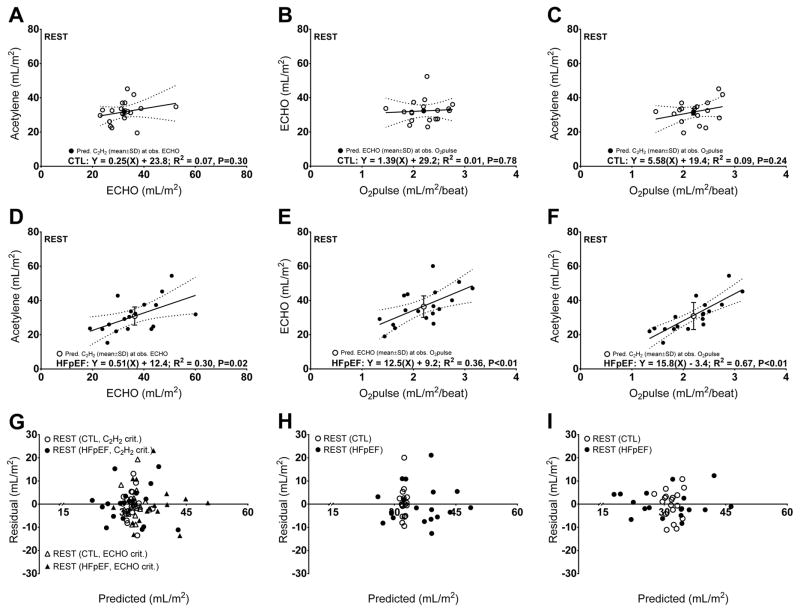
Results: Resting relationships between SVACET and SVECHO, SVECHO and O2pulse, or SVACET and O2pulse were significant in HFpEF (R = 0.30, 0.36, 0.67), but not controls (R = 0.07, 0.01, 0.09), respectively. Resting relationships persisted to 20 W in HFpEF (R = 0.70, 0.53, 0.70) and controls (R = 0.05, 0.07, 0.21), respectively. Peak exercise relationships were significant in HFpEF (R = 0.62, 0.24, 0.64), but only for SVACET versus O2pulse in controls (R = 0.07, 0.04, 0.33), respectively. Standardized standard error of estimate between techniques was strongest in HFpEF at 20 W: SVACET versus SVECHO = 0.57 ± 0.22; SVECHO versus O2pulse = 0.71 ± 0.28; SVACET versus O2pulse = 0.56 ± 0.22.
Conclusions: Constituting a clinically impactful step towards construct validation testing, these data suggest SVACET, SVECHO, and O2pulse demonstrate moderate-to-strong concurrent validity for measuring/predicting exercise SV in HFpEF.
Conflict of interest statement
The authors declare no conflicts of interest. The results of the present study do not constitute endorsement by ACSM. The results of the study are presented clearly, honestly, and without fabrication, falsification, or inappropriate data manipulation.
Figures


References
-
- Agostoni P, Cattadori G, Apostolo A, et al. Noninvasive measurement of cardiac output during exercise by inert gas rebreathing technique: a new tool for heart failure evaluation. J Am Coll Cardiol. 2005;46(9):1779–81. - PubMed
-
- Babu SC, Piccorelli GO, Shah PM, Stein JH, Clauss RH. Incidence and Results of Arterial Complications among 16,350 Patients Undergoing Cardiac-Catheterization. Journal of Vascular Surgery. 1989;10(2):113–6. - PubMed
-
- Bhambhani Y, Norris S, Bell G. Prediction of stroke volume from oxygen pulse measurements in untrained and trained men. Can J Appl Physiol. 1994;19(1):49–59. - PubMed
Publication types
MeSH terms
Substances
Grants and funding
LinkOut - more resources
Full Text Sources
Other Literature Sources
Medical
