. 2017 Sep 1;65(5):738-745.
doi: 10.1093/cid/cix417.

Whole-Genome Sequencing Accurately Identifies Resistance to Extended-Spectrum β-Lactams for Major Gram-Negative Bacterial Pathogens

Affiliations

Whole-Genome Sequencing Accurately Identifies Resistance to Extended-Spectrum β-Lactams for Major Gram-Negative Bacterial Pathogens

Samuel A Shelburne et al. Clin Infect Dis. .

Abstract

Background: There is marked interest in using DNA-based methods to detect antimicrobial resistance (AMR), with targeted polymerase chain reaction (PCR) approaches increasingly being incorporated into clinical care. Whole-genome sequencing (WGS) could offer significant advantages over targeted PCR for AMR detection, particularly for species where mutations are major drivers of AMR.

Methods: Illumina MiSeq WGS and broth microdilution (BMD) assays were performed on 90 bloodstream isolates of the 4 most common gram-negative bacteria causing bloodstream infections in neutropenic patients. The WGS data, including both gene presence/absence and detection of mutations in an array of AMR-relevant genes, were used to predict resistance to 4 β-lactams commonly used in the empiric treatment of neutropenic fever. The genotypic predictions were then compared to phenotypic resistance as determined by BMD and by commercial methods during routine patient care.

Results: Of 133 putative instances of resistance to the β-lactams of interest identified by WGS, only 87 (65%) would have been detected by a typical PCR-based approach. The sensitivity, specificity, and positive and negative predictive values for WGS in predicting AMR were 0.87, 0.98, 0.97, and 0.91, respectively. Using BMD as the gold standard, our genotypic resistance prediction approach had a significantly higher positive predictive value compared to minimum inhibitory concentrations generated by commercial methods (0.97 vs 0.92; P = .025).

Conclusions: These data demonstrate the potential feasibility of using WGS to guide antibiotic treatment decisions for patients with life-threatening infections for an array of medically important pathogens.

Keywords: antimicrobial resistance; bacteremia; gram-negative bacteria; neutropenic fever; whole-genome sequencing.


Figures

Figure 1.
Figure 1.
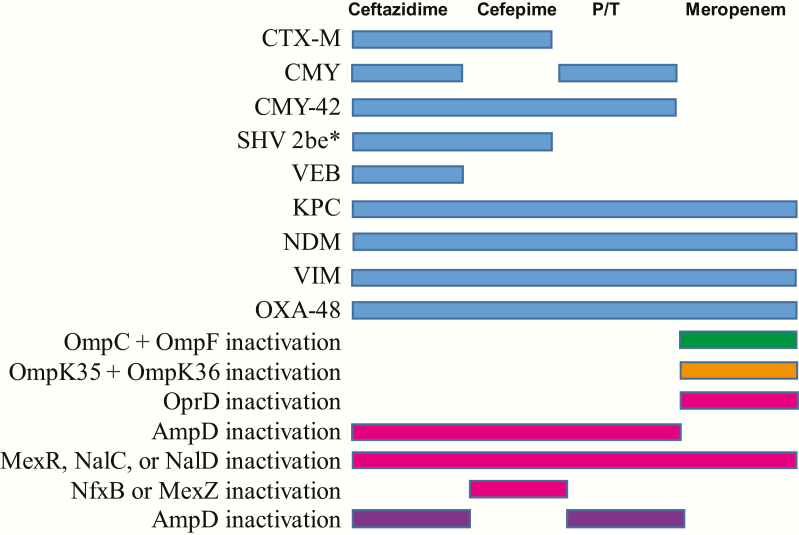
Schematic for how genotypic detection of antimicrobial resistance (AMR) mechanisms was translated into phenotypic predictions. On the left are various AMR mechanisms. When detected, phenotypic resistance to the antibiotic listed at the top was predicted when a shaded bar is present. A blue bar indicates AMR was predicted for all 4 species examined. A green bar indicates a mechanism specific to Escherichia coli. An orange bar indicates a mechanism specific to Klebsiella pneumoniae. A magenta bar indicates a mechanism specific to Pseudomonas aeruginosa. A purple bar indicates a mechanism specific to Enterobacter cloacae. AmpD is separated out for P. aeruginosa and E. cloacae because of the differential effects of AmpC depression on cefepime susceptibility in these 2 organisms. Only AMR mechanisms detected in our cohort are depicted here, although we searched for all mechanisms to the indicated antibiotics found in the antibiotic resistance database (ARDB) and comprehensive antibiotic resistance database (CARD) databases. *2 be indicates extended spectrum β-lactamase SHV variant with G238S and E240K mutations [40]. Abbreviation: P/T, piperacillin-tazobactam.
Figure 2.
Figure 2.
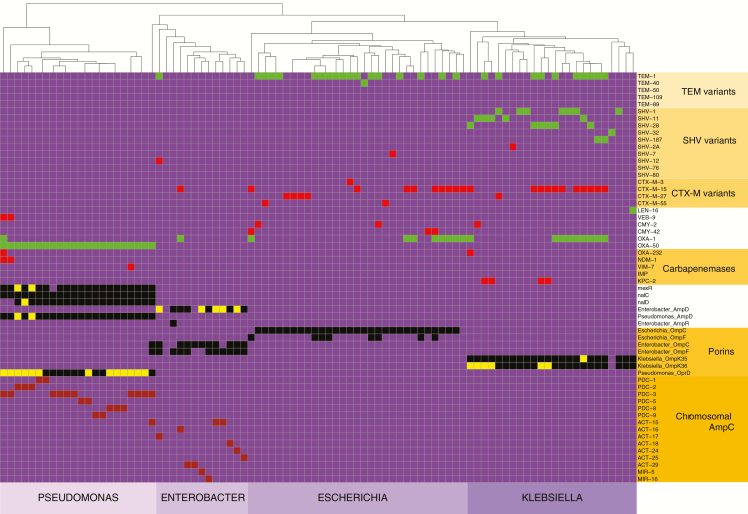
Antimicrobial resistance mechanisms identified via whole-genome sequencing. On the x-axis are individual strains sorted by species. On the y-axis are protein forms of various β-lactam resistance mechanisms. All β-lactam resistance mechanisms identified in our cohort are included along with some additional mechanisms that were not present in any of the studied strains. Box color scheme is as follows: purple, absent; green, β-lactamase encoding gene present but not predicted to mediate resistance as not active against the β-lactams being studied; red, β-lactamase encoding gene present and predicted to mediate resistance; black, endogenous chromosomal gene present and functional (eg, ampD); yellow, endogenous chromosomal gene predicted to be inactive and to result in resistance (eg, oprD); brown, chromosomal β-lactamase encoding gene present and capable of mediating resistance if de-repressed (eg, blaPDC-1).
Figure 3.
Figure 3.
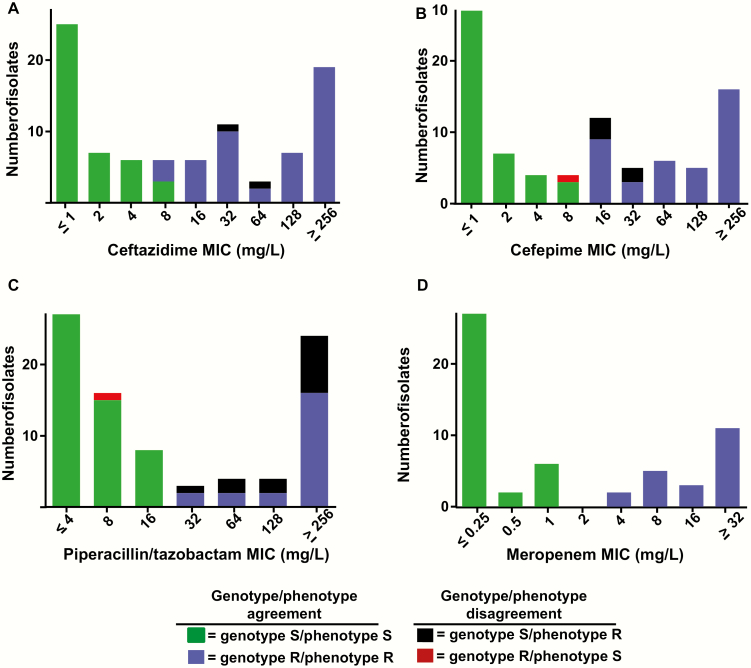
Agreement/disagreement between whole-genome sequencing and phenotypic data for antimicrobial resistance to 4 β-lactams. A–D, Minimum inhibitory concentrations for indicated β-lactams (phenotype) are shown. The colors of the bars represent various combinations of genotypic and phenotypic resistance as indicated in the legend. Abbreviations: MIC, minimum inhibitory concentration; R, resistant; S, susceptible.
Figure 4.
Figure 4.
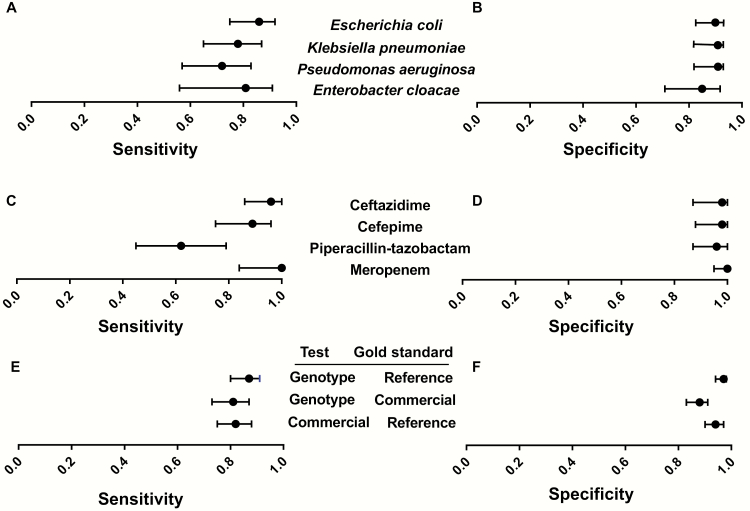
Sensitivity and specificity of genotypic predicted resistance. A–F, Data shown are either sensitivity or specificity (as noted in the y-axis) plus 95% confidence intervals. A–D, Data derived from predicted genotypic resistance using reference method (broth microdilution) as gold standard. Data are grouped by indicated organism (A and B) or by indicated antimicrobial (C and D). E and F, Summary data for all organism–antimicrobial combinations. Top line shows performance of genotypic prediction using reference method as gold standard. Middle line shows performance of genotypic prediction using commercial methods as gold standard. Bottom line shows performance of commercial methods using reference method as gold standard.

References

    1. Evans SR, Hujer AM, Jiang H et al. ; Antibacterial Resistance Leadership Group Rapid molecular diagnostics, antibiotic treatment decisions, and developing approaches to inform empiric therapy: PRIMERS I and II. Clin Infect Dis 2016; 62:181–9. - PMC - PubMed
    1. Ward C, Stocker K, Begum J, Wade P, Ebrahimsa U, Goldenberg SD. Performance evaluation of the Verigene (Nanosphere) and FilmArray (BioFire) molecular assays for identification of causative organisms in bacterial bloodstream infections. Eur J Clin Microbiol Infect Dis 2015; 34:487–96. - PubMed
    1. Walker T, Dumadag S, Lee CJ et al. . Clinical impact of laboratory implementation of verigene BC-GN microarray-based assay for detection of gram-negative bacteria in positive blood cultures. J Clin Microbiol 2016; 54:1789–96. - PMC - PubMed
    1. Goodman KE, Lessler J, Cosgrove SE et al. ; Antibacterial Resistance Leadership Group A clinical decision tree to predict whether a bacteremic patient is infected with an extended-spectrum β-lactamase-producing organism. Clin Infect Dis 2016; 63:896–903. - PMC - PubMed
    1. Caliendo AM, Gilbert DN, Ginocchio CC et al. ; Infectious Diseases Society of America (IDSA) Better tests, better care: improved diagnostics for infectious diseases. Clin Infect Dis 2013; 57(suppl 3):S139–70. - PMC - PubMed

MeSH terms