. 2017 Jul 1;32(7):1382-1392.
doi: 10.1093/humrep/dex087.

Adiponectin stimulates lipid metabolism via AMPK in rabbit blastocysts

Affiliations

Adiponectin stimulates lipid metabolism via AMPK in rabbit blastocysts

Maria Schindler et al. Hum Reprod. .

Abstract

Study question: How does a maternal diabetic hyperadiponectineamia affect signal transduction and lipid metabolism in rabbit preimplantation blastocysts?

Summary answer: In a diabetic pregnancy increased levels of adiponectin led to a switch in embryonic metabolism towards a fatty acid-dependent energy metabolism, mainly affecting genes that are responsible for fatty acid uptake and turnover.

What is known already: Although studies in cell culture experiments have shown that adiponectin is able to regulate lipid metabolism via 5'-AMP-activated protein kinase (AMPK) and peroxisome proliferator-activated receptor α (PPARα), data on the effects of adiponectin on embryonic lipid metabolism are not available. In a diabetic pregnancy in rabbits, maternal adiponectin levels are elevated fourfold and are accompanied by an increase in intracellular lipid droplets in blastocysts, implying consequences for the embryonic hormonal and metabolic environment.

Study design, size, duration: Rabbit blastocysts were cultured in vitro with adiponectin (1 μg/ml) and with the specific AMPK-inhibitor Compound C for 15 min, 1 h and 4 h (N ≥ 3 independent experiments: for RNA analysis, n ≥ 4 blastocysts per treatment group; for protein analysis three blastocysts pooled per sample and three samples used per experiment). Adiponectin signalling was verified in blastocysts grown in vivo from diabetic rabbits with a hyperadiponectinaemia (N ≥ 3 independent experiments, n ≥ 4 samples per treatment group, eight blastocysts pooled per sample).

Participants/materials, setting, methods: In these blastocysts, expression of molecules involved in adiponectin signalling [adaptor protein 1 (APPL1), AMPK, acetyl-CoA carboxylase (ACC), p38 mitogen-activated protein kinases (p38 MAPK)], lipid metabolism [PPARα, cluster of differentiation 36 (CD36), fatty acid transport protein 4 (FATP4), fatty acid binding protein (FABP4), carnitine palmityl transferase 1 (CPT1), hormone-senstive lipase (HSL), lipoprotein lipase (LPL)] and members of the insulin/insulin-like growth factor (IGF)-system [IGF1, IGF2, insulin receptor (InsR), IGF1 receptor (IGF1R)] were analyzed by quantitative RT-PCR and western blot. Analyses were performed in both models, i.e. adiponectin stimulated blastocysts (in vitro) and in blastocysts grown in vivo under increased adiponectin levels caused by a maternal diabetes mellitus.

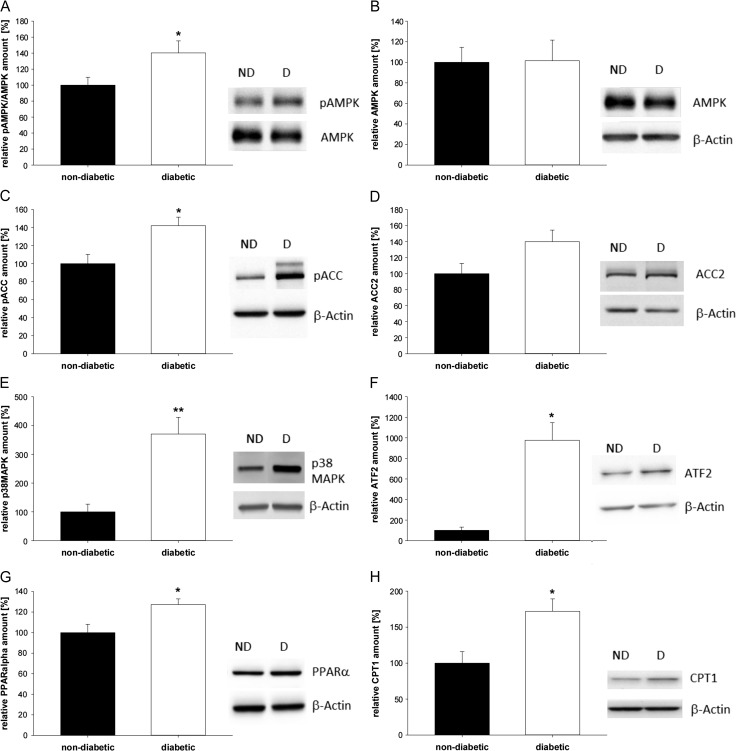
Main results and the role of chance: In both in vitro and in vivo models adiponectin increased AMPK and ACC phosphorylation, followed by an activation of the transcription factor PPARα, and CPT1, the key enzyme of β-oxidation (all P < 0.05 versus control). Moreover, mRNA levels of the fatty acid transporters CD36, FATP4 and FABP4, and HSL were upregulated by adiponectin/AMPK signalling (all P < 0.05 versus control). Under diabetic developmental conditions the amount of p38 MAPK was upregulated (P < 0.01 versus non-diabetic), which was not observed in blastocysts cultured in vitro with adiponectin, indicating that the elevated p38 MAPK was not related to adiponectin. However, a second effect of adiponectin has to be noted: its intensification of insulin sensitivity, by regulating IGF availability and InsR/IGF1R expression.

Large scale data: Not applicable.

Limitations reasons for caution: There are two main limitations for our study. First, human and rabbit embryogenesis can only be compared during blastocyst development. Therefore, the inferences from our findings are limited to the embryonic stages investigated here. Second, the increased adiponectin levels and lack of maternal insulin is only typical for a diabetes mellitus type one model.

Wider implications of the findings: This is the first mechanistic study demonstrating a direct influence of adiponectin on lipid metabolism in preimplantation embryos. The numbers of young women with a diabetes mellitus type one are increasing steadily. We have shown that preimplantation embryos are able to adapt to changes in the uterine milieu, which is mediated by the adiponectin/AMPK signalling. A tightly hormonal control during pregnancy is essential for survival and proper development. In this control process, adiponectin plays a more important role than known so far.

Study funding/competing interest(s): This work was supported by the German Research Council (DFG RTG ProMoAge 2155), the EU (FP7 Epihealth No. 278418, FP7-EpiHealthNet N°317146), COST Action EpiConcept FA 1201 and SALAAM BM 1308. The authors have no conflict(s) of interest to disclose.

Keywords: 5′-AMP-activated protein kinase; adiponectin; carnitine palmityl transferase 1; fatty acid uptake; lipid metabolism; peroxisome proliferator-activated receptor α; preimplantation embryo.


Figures

Figure 1
Figure 1
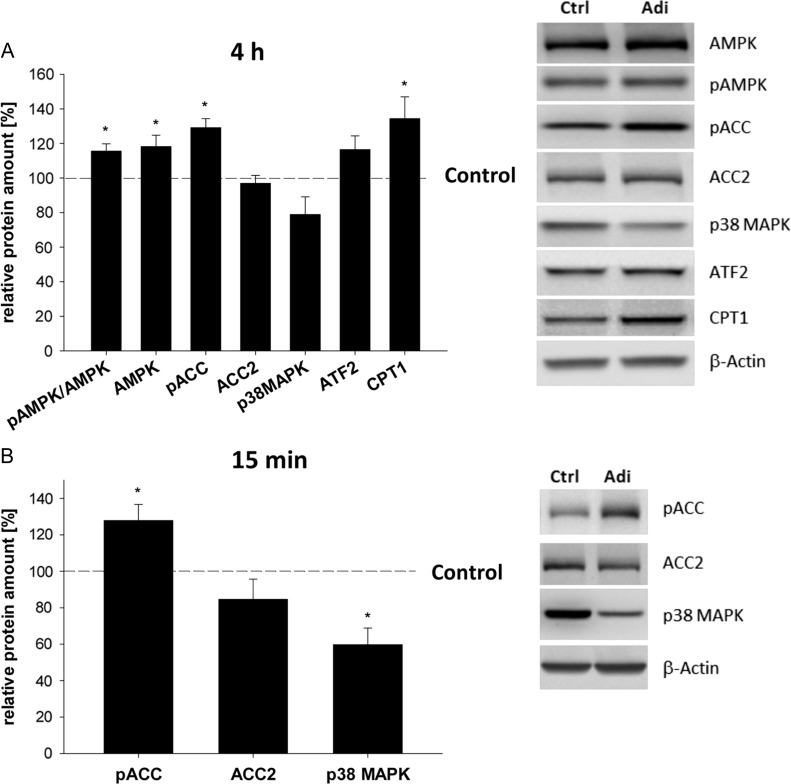
Relative amounts of phosphorylated acetyl-CoA carboxylase, p38 mitogen-activated protein kinase and acetyl-CoA carboxylase 2 protein in blastocysts cultured in vitro with 1 μg/ml adiponectin. (A) In vitro culture of blastocysts for 4 h with 1 μg/ml adiponectin led to significantly higher protein level of AMPK and carnitine palmityl transferase 1 (CPT1) compared to treatment control (set 100%) and are indicated with the dashed line (*P < 0.05, Student's t-test). Furthermore, phosphorylation of AMPK (ratio pAMPK/AMPK) and ACC (pACC) were increased. No significant changes were observed for acetyl-CoA carboxylase 2 (ACC2), p38 mitogen-activated protein kinase (p38 MAPK) and activating transcription factor 2 (ATF2) compared to the treatment control (set 100%, indicated with ---). Culture of blastocysts was performed in groups of at least three blastocysts. Per sample three blastocysts were pooled. The number of samples used per treatment group in each independent experiment was at least 3 (n ≥ 3,) with N = 3 (number of individual and independent experimental replicates). Protein levels were analyzed by western blot and results are shown as mean ± SEM. A representative western blot is shown. (B) pACC, ACC2 and p38 MAPK protein expression was quantified in blastocysts cultured for 15 min with adiponectin by western blot and calculated in relation to β-actin (mean ± SEM, N = 3 (number of independent experiments), n ≥ 3 (number of samples used per treatment group in each independent experiment, per sample three blastocysts have been pooled)). Phosphorylation of ACC was increased, while no changes in amount of ACC2 protein was observed after 15 min incubation with adiponectin. Total p38 MAPK protein amount was significantly decreased by adiponectin (*P < 0.05 Student's t-test).
Figure 2
Figure 2
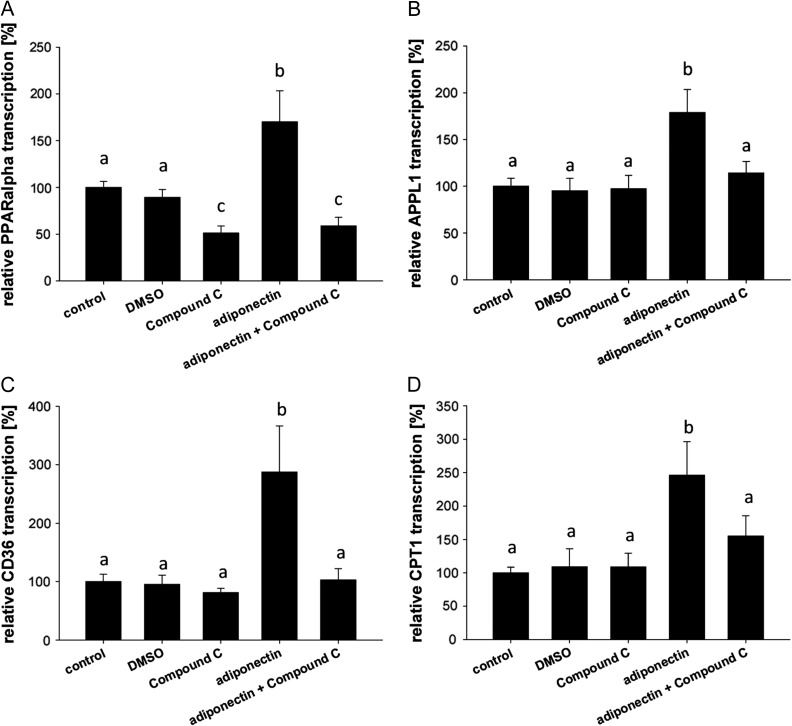
Changes in mRNAs in blastocysts cultured in vitro with adiponectin and/or Compound C for 1 h. Quantitative RT-PCR (RT-qPCR) of peroxisome proliferator-activated receptor alpha (PPARα; A), adaptor protein (APPL1; B), cluster of differentiation 36 (CD36; C) and CPT1 (D) after in vitro culture (for 1 h) of blastocysts with 1 μg/ml adiponectin or without (control; set 100%) showed an increased expression pattern. Inhibition of AMPK by Compound C blocked the adiponectin mediated increased transcription. In vitro culture was performed in groups of at least four blastocysts in each treatment and repeated in three independent replicates (N = 3 (number of individual and independent experiments); n ≥ 4 (number of blastocysts used per treatment group in each independent experiment)). Results are shown as mean ± SEM and control was set 100%. Means with different letters are significantly different (P < 0.05, Multiple comparisons by factorial variance analysis (ANOVA)).
Figure 3
Figure 3
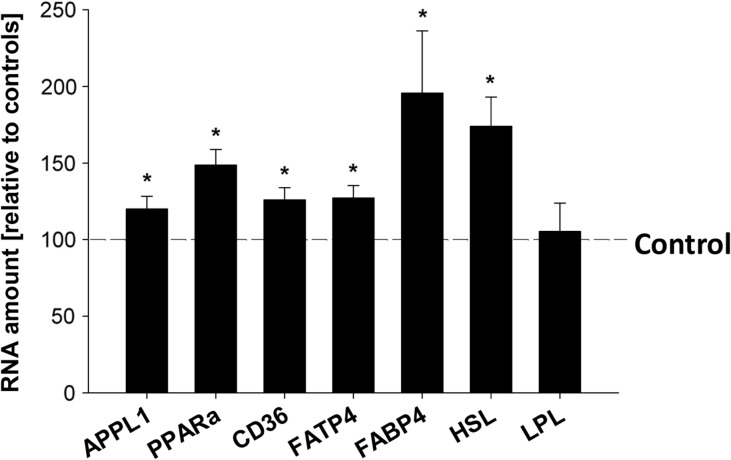
Relative amounts of adiponectin target genes in blastocysts stimulated in vitro with adiponectin for 4 h. Transcription analyses of adaptor protein (APPL1), peroxisome proliferator-activated receptor alpha (PPARα), CD36, fatty acid transporter 4 (FATP4), fatty acid binding protein 4 (FABP4), hormone sensitive lipase (HSL) and lipoprotein lipase (LPL) were performed by RT-qPCR in blastocysts cultured in vitro with adiponectin (1 μg/ml) for 4 h. Culture was performed in groups of at least 4 and repeated in three independent replicates (N = 3 (number of individual and independent experiments); n ≥ 4 (number of samples used per treatment group in each independent experiment, per sample four blastocysts have been pooled)). Values are expressed as fold change relative to the treatment control (set 100% and indicated with the dashed line) (*P < 0.05, Student's t-test).
Figure 4
Figure 4
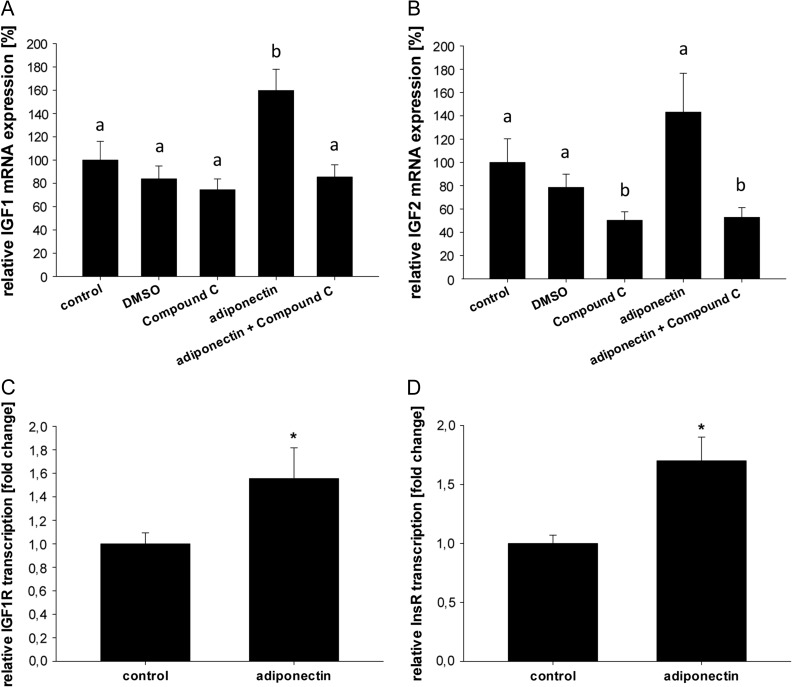
Transcription of insulin/insulin-like growth factor system in blastocysts cultured in vitro with adiponectin. (A) Analysis of insulin-like growth factor 1 (IGF1) mRNA amounts by RT-qPCR revealed an increased expression in blastocysts after in vitro culture with 1 μg/ml adiponectin or without [control, set 100%] after 1 h incubation. Inhibition of AMPK by Compound C blocked adiponectin mediated increased mRNA. (B) In vitro culture with 1 μg/ml adiponectin did not significantly influence insulin-like growth factor 2 (IGF2) mRNA level after 1 h incubation compared to treatment control [control, set 100%]. However, co-culture with Compound C reduces IGF2 mRNA compared to the solvent control, DMSO. In vitro culture was performed in groups of at least four blastocysts in each treatment and repeated in three independent replicates (N = 3 (number of individual and independent experiments); n ≥ 4 (number of blastocysts used per treatment group in each independent experiment)). Results are shown as mean ± SEM. Means with different letters are significantly different (P < 0.05, Multiple comparisons by factorial variance analysis (ANOVA)). In blastocysts cultured for 4 h with adiponectin mRNA levels of IGF1 receptor (IGF1R; C) and insulin receptor (InsR; D) were significantly increased compared to control, which was set 100% (*P < 0.05, Student's t-test). In vitro culture was performed in groups of at least four blastocysts in each treatment and repeated in three independent replicates (N = 3 (number of individual and independent experiments); n ≥ 4 (number of samples used per treatment group in each independent experiment)). Results are shown as mean ± SEM.
Figure 5
Figure 5
Western blot and densitometric quantification of proteins in blastocysts from diabetic rabbits. Phosphorylation and protein levels of phospho-AMPK (A), AMPK (B), phospho-ACC (C), ACC2 (D), p38 MAPK (E), ATF2 (F), PPARα (G) and CPT1 (H) were quantified in 6 day old blastocysts from diabetic [D] and non-diabetic rabbits [ND]. Rabbits were made diabetic before pregnancy. For all analyzed proteins a representative western blot is shown. The western blot is representative of more than three independent experiments with similar results (N ≥ 3 (number of individual and independent experiments), n ≥ 4 (number of samples used per treatment group in each independent experiment, per sample eight blastocysts have been pooled)). The relative amounts are shown in diagrams after normalization for the levels of β-actin. Values are expressed as mean ± SEM in % of non-diabetic controls (*P < 0.05, **P < 0.01, Student's t-test).
Figure 6
Figure 6
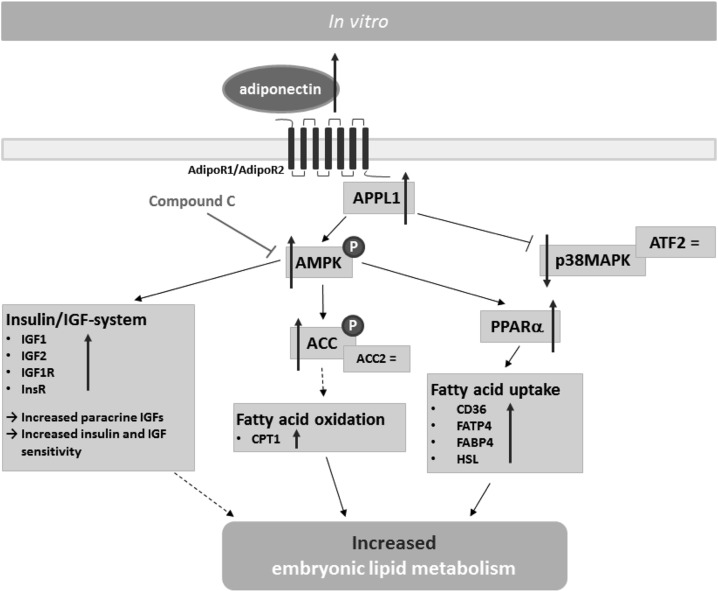
Model for adiponectin signalling in rabbit blastocysts stimulated in vitro with adiponectin. After binding of adiponectin to its receptors, AMPK is activated via APPL1. AMPK regulates β-oxidation by ACC phosphorylation, leading to an increased protein amount of CPT1. Furthermore, adiponectin increases PPARα expression and thereby regulating fatty acid uptake. However, the amount of p38 MAPK, a downstream target of APPL1, was decreased in blastocysts cultured in vitro with adiponectin. Besides its ability to regulate embryonic lipid metabolism directly, adiponectin increases paracrine amount of IGFs and InsR and IGF1R transcription in rabbit blastocysts via AMPK, which may indirectly influence embryonic lipid metabolism (formula image Direct activation, formula image Direct inhibition, formula image Indirect regulation, = no change, formula image increase).

References

    1. Abe H, Yamashita S, Satoh T, Hoshi H. Accumulation of cytoplasmic lipid droplets in bovine embryos and cryotolerance of embryos developed in different culture systems using serum-free or serum-containing media. Mol Reprod Dev 2002;61:57–66. doi:10.1002/mrd.1131. - DOI - PubMed
    1. Aouadi M, Laurent K, Prot M, Le Marchand-Brustel Y, Binétruy B, Bost F. Inhibition of p38MAPK increases adipogenesis from embryonic to adult stages. Diabetes 2006;55:281–289. - PubMed
    1. Awazawa M, Ueki K, Inabe K, Yamauchi T, Kaneko K, Okazaki Y, Bardeesy N, Ohnishi S, Nagai R, Kadowaki T. Adiponectin suppresses hepatic SREBP1c expression in an AdipoR1/LKB1/AMPK dependent pathway. Biochem Biophys Res Commun 2009;382:51–56. doi:10.1016/j.bbrc.2009.02.131. - DOI - PubMed
    1. Bell C, Watson AJ. p38 MAPK regulates cavitation and tight junction function in the mouse blastocyst. PLOS ONE 2013;8:e59528 doi:10.1371/journal.pone.0059528. - DOI - PMC - PubMed
    1. Brookheart RT, Michel CI, Schaffer JE. As a matter of fat. Cell Metab 2009;10:9–12. doi:10.1016/j.cmet.2009.03.011. - DOI - PMC - PubMed

Publication types

MeSH terms