Correlation of Thrombectomy Maneuver Count with Recanalization Success and Clinical Outcome in Patients with Ischemic Stroke
- PMID: 28473346
- PMCID: PMC7959895
- DOI: 10.3174/ajnr.A5212
Correlation of Thrombectomy Maneuver Count with Recanalization Success and Clinical Outcome in Patients with Ischemic Stroke
Abstract
Background and purpose: In the treatment of acute thromboembolic stroke, the effectiveness and success of thrombus removal when using stent retrievers is variable. In this study, we analyzed the correlation of thrombectomy maneuver count with a good clinical outcome and recanalization success.
Materials and methods: One hundred and four patients with acute occlusion of the middle cerebral artery or the terminal internal carotid artery who were treated with thrombectomy were included in this retrospective study. A good clinical outcome was defined as a 90-day mRS of ≤2, and successful recanalization was defined as TICI 2b-3.
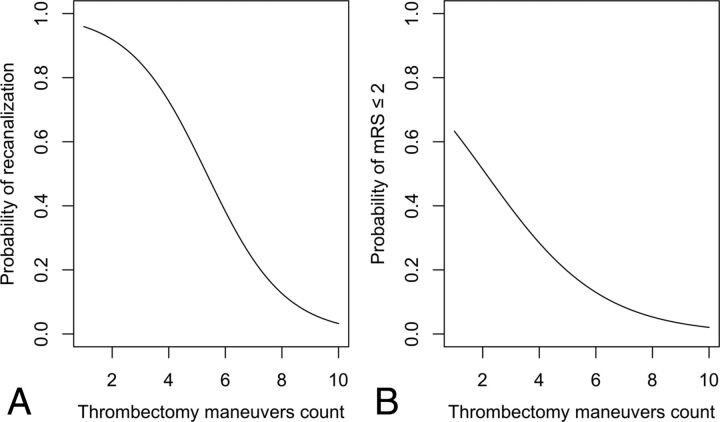
Results: The maneuver count ranged between 1-10, with a median of 2. Multivariate logistic regression analyses identified an increasing number of thrombectomy maneuvers as an independent predictor of poor outcome (adjusted OR, 0.59; 95% CI, 0.38-0.87; P = .011) and unsuccessful recanalization (adjusted OR, 0.48; 95% CI, 0.32-0.66; P < .001). A good outcome was significantly more likely if finished within 2 maneuvers compared with 3 or 4 maneuvers, or even more than 4 maneuvers (P < .001).
Conclusions: An increasing maneuver count correlates strongly with a decreasing probability of both good outcome and recanalization. The probability of successful recanalization decreases below 50% if not achieved within 5 thrombectomy maneuvers. Patients who are recanalized within 2 maneuvers have the best chance of achieving a good clinical outcome.
© 2017 by American Journal of Neuroradiology.
Figures
References
MeSH terms
LinkOut - more resources
Full Text Sources
Other Literature Sources
Medical