


Apolipoprotein C-III Levels and Incident Coronary Artery Disease Risk: The EPIC-Norfolk Prospective Population Study
- PMID: 28473441
- PMCID: PMC5484077
- DOI: 10.1161/ATVBAHA.117.309007
Apolipoprotein C-III Levels and Incident Coronary Artery Disease Risk: The EPIC-Norfolk Prospective Population Study
Abstract
Objective: Apolipoprotein C-III (apoC-III) is a key regulator of triglyceride metabolism. Elevated triglyceride-rich lipoproteins and apoC-III levels are causally linked to coronary artery disease (CAD) risk. The mechanism(s) through which apoC-III increases CAD risk remains largely unknown. The aim was to confirm the association between apoC-III plasma levels and CAD risk and to explore which lipoprotein subfractions contribute to this relationship between apoC-III and CAD risk.
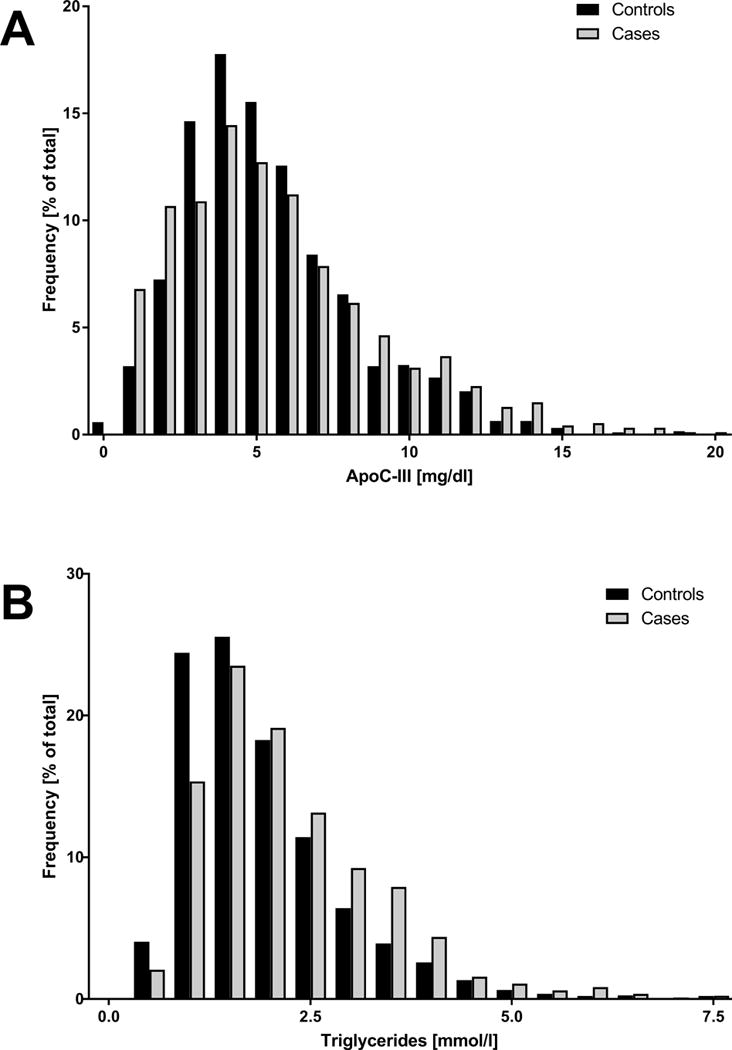
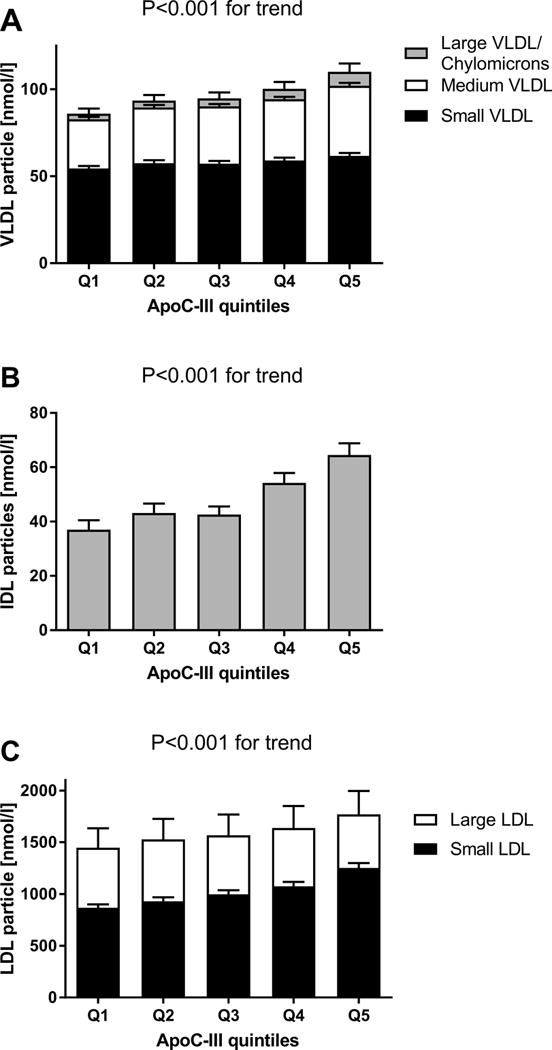
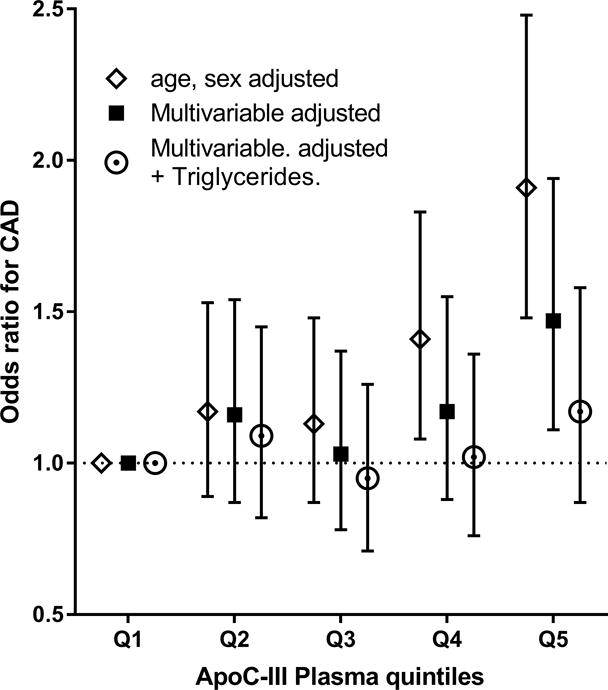
Approach and results: Plasma apoC-III levels were measured in baseline samples from a nested case-control study in the European Prospective Investigation of Cancer (EPIC)-Norfolk study. The study comprised 2711 apparently healthy study participants, of whom 832 subsequently developed CAD. We studied the association of baseline apoC-III levels with incident CAD risk, lipoprotein subfractions measured by nuclear magnetic resonance spectroscopy and inflammatory biomarkers. ApoC-III levels were significantly associated with CAD risk (odds ratio, 1.91; 95% confidence interval, 1.48-2.48 for highest compared with lowest quintile), retaining significance after adjustment for traditional CAD risk factors (odds ratio, 1.47; 95% confidence interval, 1.11-1.94). ApoC-III levels were positively correlated with triglyceride levels, (r=0.39), particle numbers of very-low-density lipoprotein (r=0.25), intermediate-density lipoprotein (r=0.23), small dense low-density lipoprotein (r=0.26), and high-sensitivity C-reactive protein (r=0.15), whereas an inverse correlation was observed with large low-density lipoprotein particle number (r=-0.11), P<0.001 for each. Mediation analysis indicated that the association between apoC-III and CAD risk could be explained by triglyceride elevation (triglyceride, very-low-density lipoprotein, and intermediate-density lipoprotein particles), small low-density lipoprotein particle size, and high-sensitivity C-reactive protein.
Conclusions: ApoC-III levels are significantly associated with incident CAD risk. Elevated levels of remnant lipoproteins, small dense low-density lipoprotein, and low-grade inflammation may explain this association.
Keywords: C-reactive protein; apolipoprotein CIII; coronary artery disease; lipoproteins; triglycerides.
© 2017 American Heart Association, Inc.
Figures
Comment in
-
Apolipoprotein C-III: The Small Protein With Sizeable Vascular Risk.Arterioscler Thromb Vasc Biol. 2017 Jun;37(6):1013-1014. doi: 10.1161/ATVBAHA.117.309493. Arterioscler Thromb Vasc Biol. 2017. PMID: 28539488 No abstract available.
References
-
- Sarwar N, Danesh J, Eiriksdottir G, Sigurdsson G, Wareham N, Bingham S, Boekholdt SM, Khaw K-T, Gudnason V. Triglycerides and the risk of coronary heart disease: 10,158 incident cases among 262,525 participants in 29 Western prospective studies. Circulation. 2007;115:450–8. - PubMed
-
- Gaudet D, Brisson D, Tremblay K, Alexander VJ, Singleton W, Hughes SG, Geary RS, Baker BF, Graham MJ, Crooke RM, Witztum JL. Targeting APOC3 in the familial chylomicronemia syndrome. N Engl J Med. 2014;371:2200–6. - PubMed
-
- Gaudet D, Alexander VJ, Baker BF, Brisson D, Tremblay K, Singleton W, Geary RS, Hughes SG, Viney NJ, Graham MJ, Crooke RM, Witztum JL, Brunzell JD, Kastelein JJP. Antisense Inhibition of Apolipoprotein C-III in Patients with Hypertriglyceridemia. N Engl J Med. 2015;373:438–47. - PubMed
Publication types
MeSH terms
Substances
Grants and funding
LinkOut - more resources
Full Text Sources
Other Literature Sources
Medical
Research Materials
Miscellaneous
