Review
. 2017:2017:5619472.
doi: 10.1155/2017/5619472. Epub 2017 Apr 4.

Stemness in Cancer: Stem Cells, Cancer Stem Cells, and Their Microenvironment

Affiliations
Review

Stemness in Cancer: Stem Cells, Cancer Stem Cells, and Their Microenvironment

Pedro M Aponte et al. Stem Cells Int. 2017.

Abstract

Stemness combines the ability of a cell to perpetuate its lineage, to give rise to differentiated cells, and to interact with its environment to maintain a balance between quiescence, proliferation, and regeneration. While adult Stem Cells display these properties when participating in tissue homeostasis, Cancer Stem Cells (CSCs) behave as their malignant equivalents. CSCs display stemness in various circumstances, including the sustaining of cancer progression, and the interaction with their environment in search for key survival factors. As a result, CSCs can recurrently persist after therapy. In order to understand how the concept of stemness applies to cancer, this review will explore properties shared between normal and malignant Stem Cells. First, we provide an overview of properties of normal adult Stem Cells. We thereafter elaborate on how these features operate in CSCs. We then review the organization of microenvironment components, which enables CSCs hosting. We subsequently discuss Mesenchymal Stem/Stromal Cells (MSCs), which, although their stemness properties are limited, represent essential components of the Stem Cell niche and tumor microenvironment. We next provide insights of the therapeutic strategies targeting Stem Cell properties in tumors and the use of state-of-the-art techniques in future research. Increasing our knowledge of the CSCs microenvironment is key to identifying new therapeutic solutions.


Figures
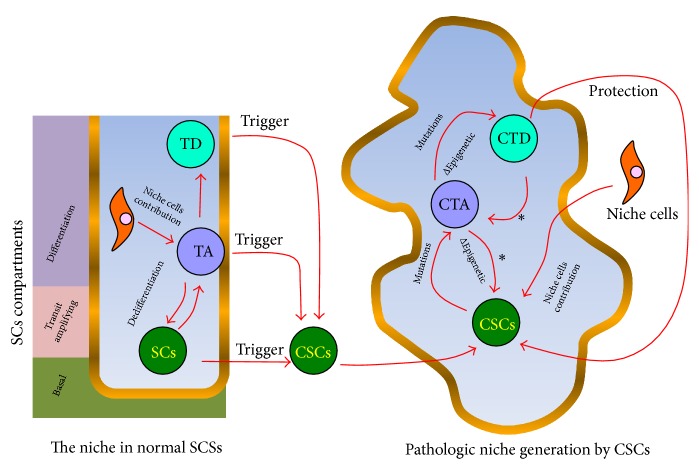
Figure 1
Figure 1
The origin of Cancer Stem Cells (CSCs) and Stem Cells (SCs) involvement in the generation of pathological cell hierarchies in tumors. In normal Stem Cell Systems, SCs located at the basal compartment generate committed progenitors (through asymmetrical divisions) which become spatially relocated to the transit-amplifying (TA) compartment. There, progenitors actively divide to produce differentiated daughter cells that carry on the normal physiology of the organ. Under physiological emergencies associated with SC loss, TA cells can dedifferentiate to reload the SC pool. Certain stressful triggers (i.e., chronic inflammation, ROS accumulation, and aging) can promote the transformation of cells in the system and generate CSCs or cancer initiating cells. CSCs remodel the niche and produce a pathological cancer microenvironment and associated hierarchy (pathological Stem Cell System) that resembles the original normal Stem Cell Systems (SCSs). The tumor is a very heterogeneous entity with cells that have accumulated mutations and epigenetic profile changes to secure CSCs survival and thriving. Features typical of SCSs such as niche support, SCs stemness, and dedifferentiation paths () remain in the tumor environment. SCs = Stem Cell; TA = transit-amplifying progenitor; TD = terminally differentiated cell; CSC = Cancer Stem Cell; CTA = cancer transit-amplifying progenitor; CTD = cancer terminally differentiated cell.
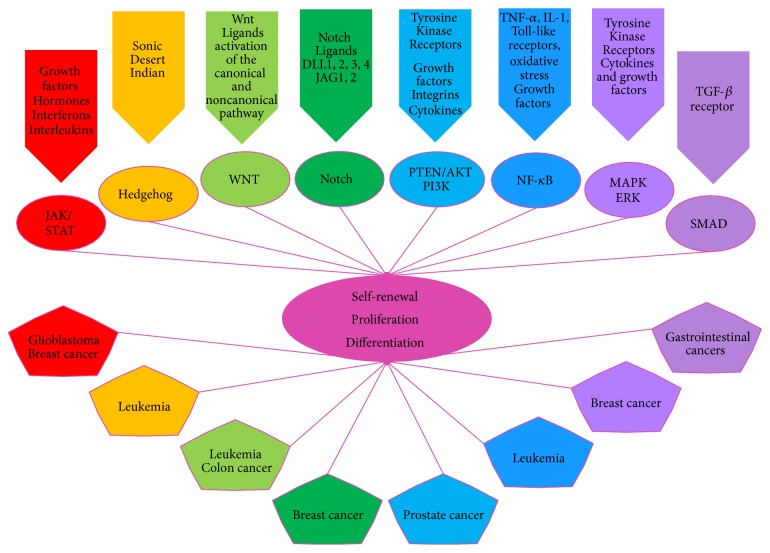
Figure 2
Figure 2
Common signaling pathways between Stem Cells (SCs) and Cancer Stem Cells (CSCs) [48]. CSCs share common signaling pathways, like the JAK/STAT, Hedgehog, Wnt, Notch, PTEN/AKT/P13K, NF-κB, MAPK/ERK, and SMAD. These SCs mechanisms are altered in CSCs and are characteristic of the cancer types mentioned. The JAK/STAT pathway (Janus kinase/signal transducer and activator of transcription) is mainly involved in glioblastoma development and breast CSCs [–52]. The Hedgehog pathways have effects on the patterning of the embryo but play a crucial role in the induction of myelogenous leukemia. Blocking of the Hedgehog pathway decreases the quantity of CSCs in leukemia, then representing an important target for cancer therapy [53]. The Wnt pathway is an important regulator of SCs and CSCs regarding self-renewal, being perturbed in colon cancer and leukemia [–56]. The Notch pathway is involved in the development of breast tissue as a regulator of cell fate and differentiation. An excess in the activation of Notch could determine the aggressiveness of breast cancer [, –59]. The phosphatase and tensin homolog (PTEN)/protein kinase B (PKB or AKT)/phosphatidylinositide 3-kinase (P13K) signaling is a key regulator of self-renewal and maintenance of SCs and CSCs with an important role in the emergence of CSCs in prostate cancer [51, 60]. The NF-κB pathway is crucial for leukemic cells survival and its inhibition affects CSCs development in breast cancer [61]. It has been seen that the increase of neural stem cell (NSC) proliferation is caused by the activation of NF-κB, through the TNF-α signal transduction pathway, but its aberrant regulation could lead to CSCs development in glioblastomas [62, 63]. Blocking the mitogen-activated protein kinase (MAPK)/extracellular signal-regulated kinase (ERK) results in the growth inhibition of breast cancer and the emergence of CSCs, sensitizing cancer cells to chemotherapy [–66]. Gastrointestinal SCs can be perturbed, changing their plasticity and differentiation potential by generating an aberrant response to TGF-β affecting the SMAD pathway and generating CSCs [67]. The hepatocellular carcinoma is an aggressive form of cancer in which the TGF-β, Notch, and Wnt are deregulated, also having consequences in the SMAD proteins and changing SCs renewal, differentiation, and survival patterns [68, 69]. In adult and CSCs systems all the mentioned pathways are common and conserved in the control of SCs renewal, proliferation, and differentiation.

References

    1. Siegel R. L., Miller K. D., Jemal A. Cancer statistics, 2016. CA Cancer Journal for Clinicians. 2016;66(1):7–30. doi: 10.3322/caac.21332. - DOI - PubMed
    1. Torre L. A., Siegel R. L., Ward E. M., Jemal A. Global cancer incidence and mortality rates and trends—an update. Cancer Epidemiology, Biomarkers and Prevention. 2016;25(1):16–27. doi: 10.1158/1055-9965.epi-15-0578. - DOI - PubMed
    1. Mathers C. D., Loncar D. Projections of global mortality and burden of disease from 2002 to 2030. PLoS Medicine. 2006;3(11, article e442) doi: 10.1371/journal.pmed.0030442. - DOI - PMC - PubMed
    1. Timp W., Feinberg A. P. Cancer as a dysregulated epigenome allowing cellular growth advantage at the expense of the host. Nature Reviews Cancer. 2013;13(7):497–510. doi: 10.1038/nrc3486. - DOI - PMC - PubMed
    1. Visvader J. E. Cells of origin in cancer. Nature. 2011;469(7330):314–322. doi: 10.1038/nature09781. - DOI - PubMed