. 2018 Feb;24(3-4):264-274.
doi: 10.1089/ten.TEA.2016.0510. Epub 2017 Jul 7.

Physioxia Promotes the Articular Chondrocyte-Like Phenotype in Human Chondroprogenitor-Derived Self-Organized Tissue

Affiliations

Physioxia Promotes the Articular Chondrocyte-Like Phenotype in Human Chondroprogenitor-Derived Self-Organized Tissue

Devon E Anderson et al. Tissue Eng Part A. 2018 Feb.

Abstract

Introduction: Biomaterial-based tissue engineering has not successfully reproduced the structural architecture or functional mechanical properties of native articular cartilage. In scaffold-free tissue engineering systems, cells secrete and organize the entire extracellular matrix over time in response to environmental signals such as oxygen level. In this study, we investigated the effect of oxygen on the formation of neocartilage from human-derived chondrogenic cells.

Materials and methods: Articular chondrocytes (ACs) and articular cartilage progenitor cells (ACPs) derived from healthy human adults were guided toward cell condensation by centrifugation onto plate inserts that were uncoated or coated with either agarose or fibronectin. Neocartilage discs were cultured at hyperoxic (20%) or physioxic (5%) oxygen levels, and biochemical, biomechanical, and molecular analyses were used to compare the cartilage produced by ACs versus ACPs.

Results: Fibronectin-coated inserts proved optimal for growing cartilaginous discs from both cell types. In comparison with culture in hyperoxia, AC neocartilage cultured at physioxia exhibited a significant increase in chondrogenic gene expression, proteoglycan production, and mechanical properties with a concomitant decrease in collagen content. At both oxygen levels, ACP-derived neocartilage produced tissue with significantly enhanced mechanical properties and collagen content relative to AC-derived neocartilage. Both ACs and ACPs produced substantial collagen II and reduced levels of collagens I and X in physioxia relative to hyperoxia. Neocartilage from ACPs exhibited anisotropic organization characteristic of native cartilage with respect to collagen VI of the pericellular matrix when compared with AC-derived neocartilage; however, only ACs produced abundant surface-localized lubricin.

Discussion and conclusions: Guiding human-derived cells toward condensation and subsequent culture in physioxia promoted the articular cartilage tissue phenotype for ACs and ACPs. Unlike ACs, ACPs are clonable and highly expandable while retaining chondrogenicity. The ability to generate large tissues utilizing a scaffold-free approach from a single autologous progenitor cell may represent a promising source of neocartilage destined for cartilage repair.

Keywords: articular cartilage; chondroprogenitors; scaffold-free.


Conflict of interest statement

No competing financial interests exist.

Figures
<b>FIG. 1.</b>
FIG. 1.
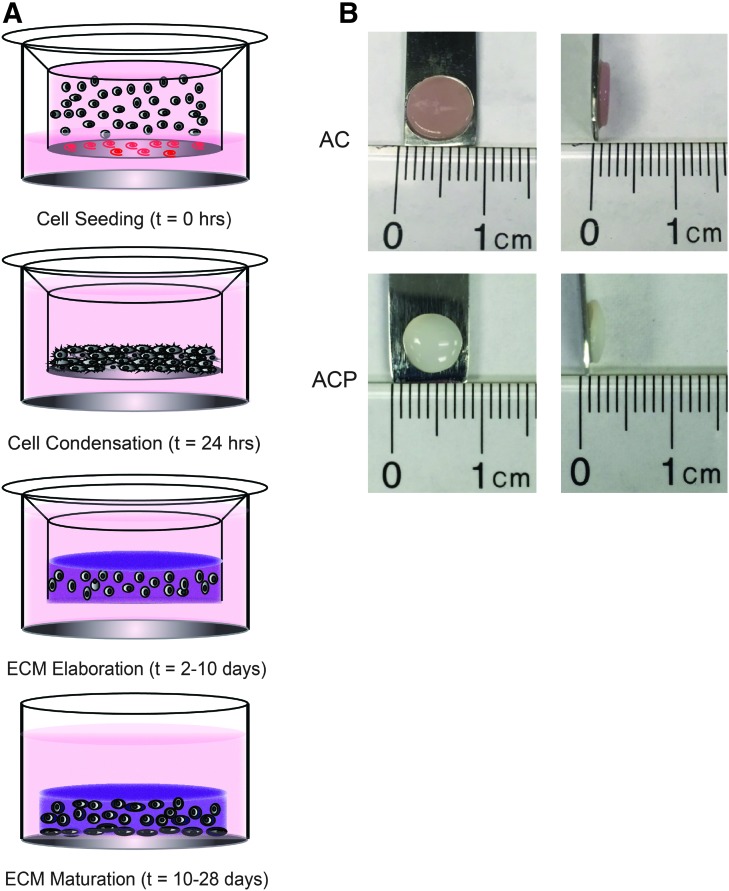
(A) Schematic representing stages of self-organization of scaffold-free neocartilage beginning with cell seeding through centrifugation onto a protein-coated membrane to direct cell condensation into a restricted geometry. Over the course of culture, cells produce an extracellular matrix that starts as an immature homogeneous matrix and matures over time with signals from the culture environment. (B) Gross images of AC- and ACP-derived neocartilage show that each cell type produced a disc of uniform dimensions after 28 days of culture. AC, articular chondrocyte; ACP, articular cartilage progenitor. Color images available online at www.liebertpub.com/tea
<b>FIG. 2.</b>
FIG. 2.
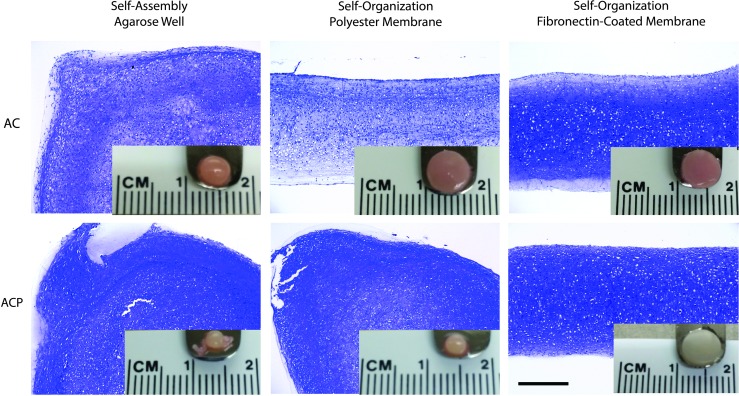
Toluidine blue histology and gross images demonstrate that human-derived ACs and ACPs formed a large pellet when cultured in nonadherent agarose wells after seeding into a flattened disc. Only ACs retained a disc morphology when cultured on porous polyester membranes, but both cell types retained a disc morphology when cultured on a polyester membrane coated with fibronectin. Scale bars = 400 μm. Color images available online at www.liebertpub.com/tea
<b>FIG. 3.</b>
FIG. 3.
(A) Tissue wet weight and (B) thickness were not different between cell type and oxygen level. Quantitative measurements for biochemical constituents of neocartilage discs, including (C, E) GAGs as a readout for total proteoglycan content, (D) DNA for relative cell count, and (F) hydroxyproline for total collagen content, indicating that relative to hyperoxia, culture in physioxia significantly increased total GAG content for only ACs. ACPs, however, had a significantly higher total collagen content than AC culture in physioxia. Results reported as mean + SD, and statistical significance was determined as *p < 0.05 by a paired or unpaired t-test where appropriate. GAG, glycosaminoglycan.
<b>FIG. 4.</b>
FIG. 4.
Quantitative analysis of (A) equilibrium compressive modulus reveals that scaffold-free neocartilage demonstrated strain-stiffening behavior, physioxia significantly increased the bulk compressive equilibrium modulus for AC neocartilage, and ACP neocartilage was significantly more stiff than AC neocartilage. There were no differences in (B) dynamic compressive modulus between cell types and oxygen levels. Results reported as a box plot, representing mean, the 1st and 3rd quartiles, and SD. Statistical significance was determined as *p < 0.05, **p < 0.01, and ****p < 0.0001 by a paired t-test within a cell type between oxygen levels, an unpaired t-test between cell types within a given oxygen level. Statistical significance between consecutive strain ramps for a given group was determined as #p < 0.05 to characterize strain stiffening. Chevron box represents a range of reported values for native adult articular cartilage.,,
<b>FIG. 5.</b>
FIG. 5.
Fold change in chondrogenic gene expression for culture in physioxia relative to hyperoxia demonstrates that (A) ACs, but not (B) ACPs, were highly responsive to oxygen level and upregulated genes representative of the articular cartilage phenotype in physioxia. Results reported as mean ± SD of log2-fold change, and statistical significance for comparison of mean expression in physioxia versus hyperoxia was determined as *p < 0.05 by a paired or unpaired t-test where appropriate.
<b>FIG. 6.</b>
FIG. 6.
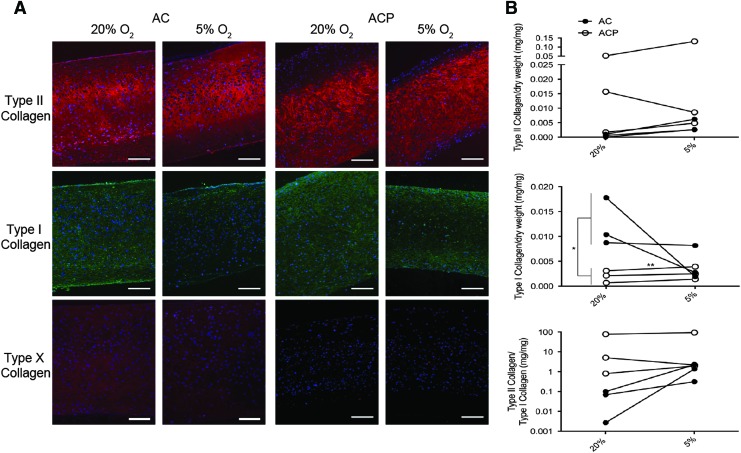
(A) Collagen immunohistochemistry demonstrates consistently high collagen II expression in tissues derived from both ACs and ACPs in hyperoxia and physioxia, but reduced collagen I for both AC- and ACP-derived tissues in physioxia relative to hyperoxia. AC-derived neocartilage had low collagen X expression in hyperoxia that was undetectable in physioxia, but ACP-derived neocartilage lacked collagen X at both oxygen levels. (B) Quantification of collagen by ELISA indicates that ACP-derived neocartilage contained more collagen II and I regardless of oxygen level, but AC-derived neocartilage increases the ratio of collagen II to collagen I with culture in physioxia relative to hyperoxia. Scale bars = 100 μm. Color images available online at www.liebertpub.com/tea
<b>FIG. 7.</b>
FIG. 7.
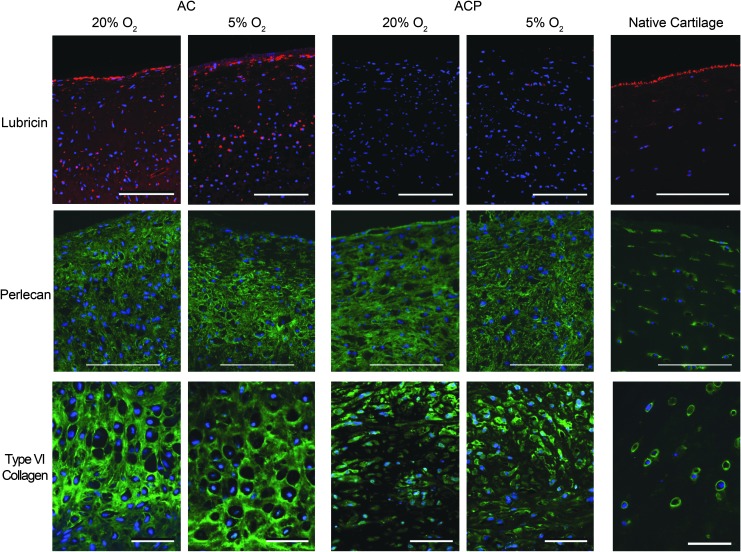
Immunohistochemistry of lubricin, perlecan, and collagen VI revealed that only AC-derived neocartilage produced lubricin that was localized to the surface regardless of oxygen level. In addition, independent of oxygen level, neocartilage from both cell types produced perlecan that was distributed throughout the extracellular matrix, and ACP-derived neocartilage had collagen VI localized to the pericellular matrix, while collagen VI was distributed throughout the entire extracellular matrix for AC-derived neocartilage. Scale bars = 100 μm for lubricin and perlecan, 20 μm for collagen VI. Color images available online at www.liebertpub.com/tea

References

    1. Murphy L., Schwartz T.A., Helmick C.G., Renner J.B., Tudor G., Koch G., et al. Lifetime risk of symptomatic knee osteoarthritis. Arthritis Rheum 59, 1207, 2008 - PMC - PubMed
    1. Murphy L.B., Helmick C.G., Schwartz T.A., Renner J.B., Tudor G., Koch G.G., et al. One in four people may develop symptomatic hip osteoarthritis in his or her lifetime. Osteoarthr Cartilage 18, 1372, 2010 - PMC - PubMed
    1. McCormick F., Harris J.D., Abrams G.D., Frank R., Gupta A., Hussey K., et al. Trends in the Surgical Treatment of Articular Cartilage Lesions in the United States: An Analysis of a Large Private-Payer Database Over a Period of 8 Years. Arthroscopy 30, 222, 2014 - PubMed
    1. Makris E.A., Gomoll A.H., Malizos K.N., Hu J.C., and Athanasiou K.A. Repair and tissue engineering techniques for articular cartilage. Nat Rev Rheumatol 11, 21, 2014 - PMC - PubMed
    1. Athanasiou K.A., Eswaramoorthy R., Hadidi P., and Hu J.C. Self-organization and the self-assembling process in tissue engineering. Annu Rev Biomed Eng 15, 115, 2013 - PMC - PubMed

Publication types

LinkOut - more resources