. 2017 Aug 1;26(15):2912-2922.
doi: 10.1093/hmg/ddx172.

Heteroplasmic shifts in tumor mitochondrial genomes reveal tissue-specific signals of relaxed and positive selection

Affiliations

Heteroplasmic shifts in tumor mitochondrial genomes reveal tissue-specific signals of relaxed and positive selection

Sneha Grandhi et al. Hum Mol Genet. .

Abstract

Although mitochondrial genomes (mtDNA) accumulate elevated levels of mutations in cancer cells, the origin and functional impact of these mutations remain controversial. Here, we queried whole-genome sequence data from 1,916 patients across 24 cancer types to characterize patterns of mtDNA mutations and elucidate the selective constraints driving their fate. Given that mitochondrial genomes are polyploid, cells with advantageous levels of mtDNA mutations can be selected for depending on their cellular environment. Therefore, we tracked changes in per-cell abundances of mtDNA mutations from normal to tumor cells in the same patient. Tumor mitochondrial genomes show distinct mutational patterns and are disproportionately enriched for protein-altering changes. Moreover, protein-altering mtDNA variants that are initially present at low frequencies in normal cells preferentially expand in the altered tumor environment, suggesting selective advantage. We also perform these analyses with attention to the cancer's tissue of origin, which revealed tissue-specific differences in selective signals. The mitochondrial genomes in renal chromophobe and thyroid cancers show particularly strong signals of positive selection, indicated by higher proportions and per-cell abundances of truncating variants. Dramatic tumor- and tissue-specific variations in selective pressures suggest that cancer cells with advantageous levels of damaged mitochondrial genomes will selectively proliferate to facilitate the tumorigenic process.


Figures

Figure 1
Figure 1
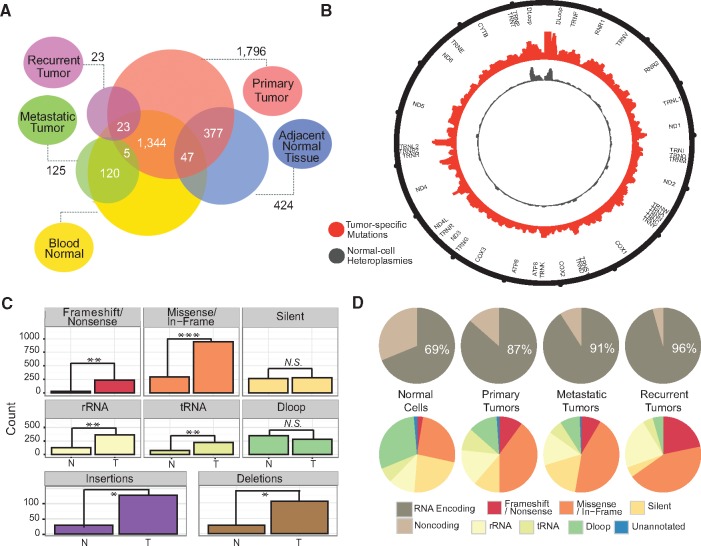
Tumor mitochondrial genomes show distinct mutational features. (A) Venn diagram of all TCGA samples and sample types under consideration. Numbers within the circle intersections indicate numbers of patients with the corresponding sample types available. (B) Circos plot representing mtDNA variant distribution across the mitochondrial genome plotted using 50 base pair sliding windows. (C) Counts of tumor-specific somatic mutations (T) and normal cell heteroplasmies (N) stratified by genome annotation (* signifies P < 1 × 10⁻¹⁵, **P < 1 × 10⁻³⁰, ***P < 1 × 10−45, and N.S. = not significant). (D) RNA encoding vs. non-coding (TOP; omnibus P = 5.40 × 10−37) and variant annotation (BOTTOM) proportions for various sample types.
Figure 2
Figure 2
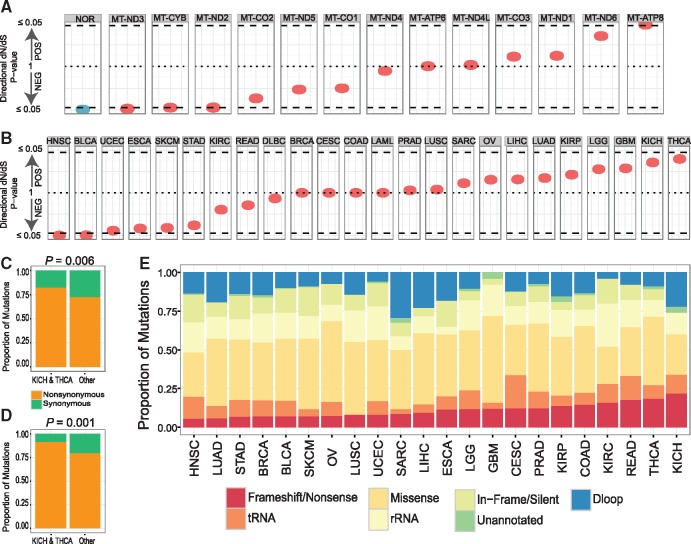
Tissue-specific signals of selection on tumor mitochondrial genomes. (A) Nominal P-values derived from dN/dS permutation analysis to indicate direction and statistical significance of selection on protein-altering variants in normal (NOR, blue), and tumor cells (red) across mitochondrial genes and (B) across individual cancer types. (C) Proportions of synonymous and nonsynonymous mtDNA mutations including both tumor-specific somatic variants and those already present in the normal cell and (D) tumor-specific somatic variants only. (E) Proportions of mtDNA variants of various categories, stratified by tumor type.
Figure 3
Figure 3
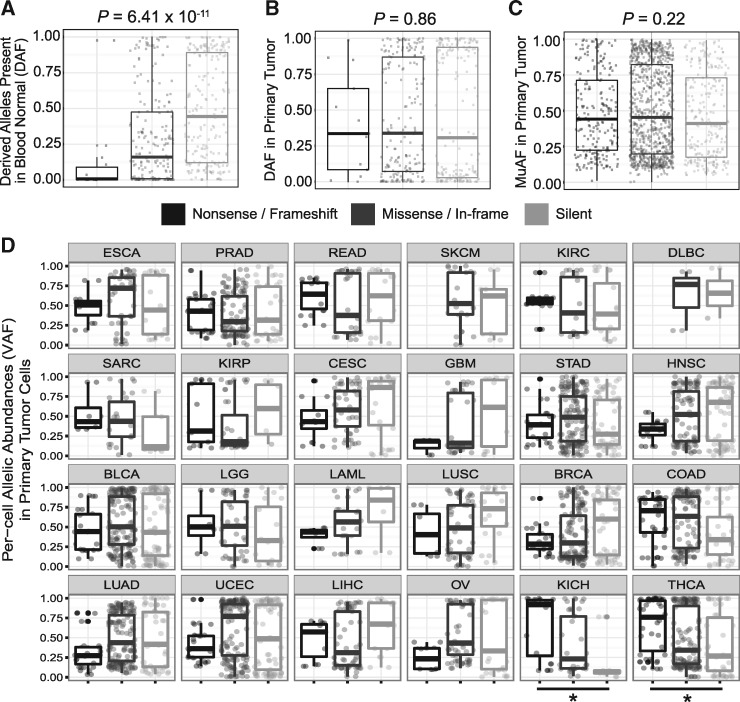
Tissue-specific signals of relaxed and positive selection on mtDNA allelic abundances in tumor cells. Stratified by their effects on the protein: nonsense/frameshift, missense/in-frame, and silent, distributions of derived allele frequencies (DAFs) of (A) variants present in blood normal (Kruskal-Wallis, P =  6.41 × 10⁻¹¹) and (B) primary tumor variants which were also present in the normal (P =  0.86). (C) Distributions of mutant allele frequencies (MuAFs) of tumor-specific somatic mutations present only in primary cells (P =  0.22). (D) Per-cell allelic abundances of all variants present in primary tumor cells stratified by cancer type, * indicates Jonckheere’s trend test P-values < 1 × 10⁻² (P =  1.6 × 10⁻³ for KICH and P =  1.55 × 10⁻⁴ for THCA).
Figure 4
Figure 4
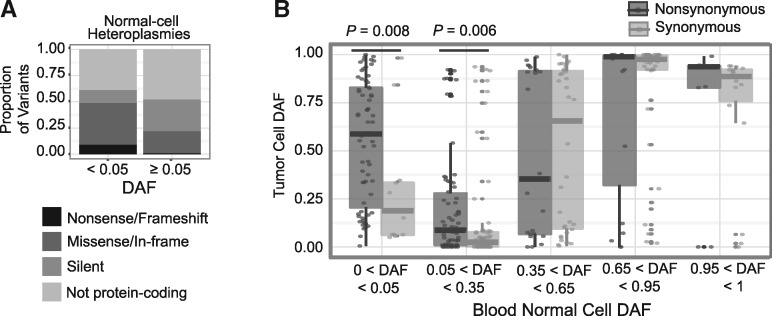
Disruptive low-level mtDNA variants preferentially expand in the tumor. (A) Proportions of each variant type are shown for all variants with DAF < 5% and ≥ 5%. (B) Tumor cell DAF of nonsynonymous vs. synonymous variants, stratified by normal cell DAF binned into five incremental categories.
Figure 5
Figure 5
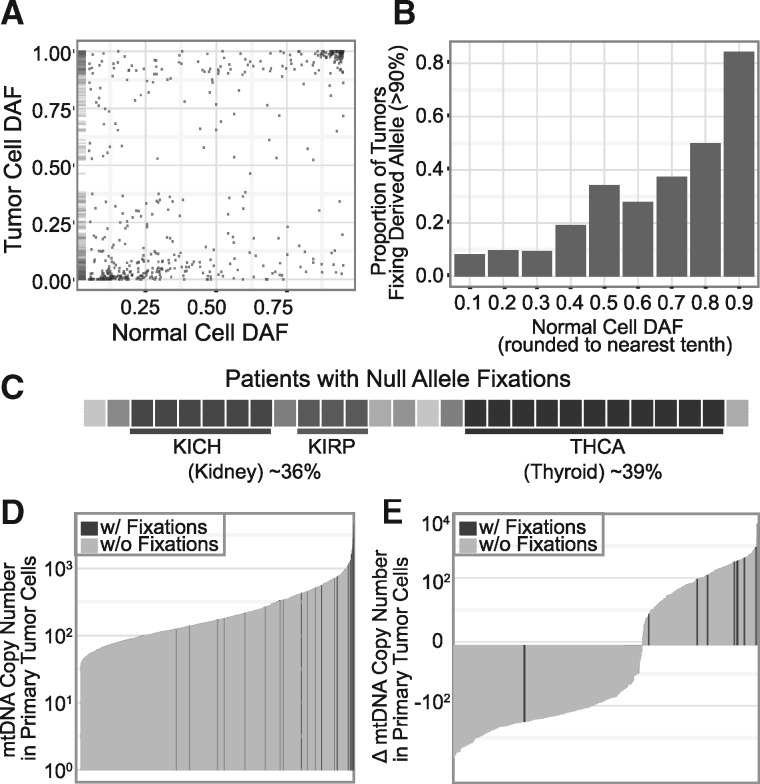
Null alleles present at extremely low levels in the normal rise to near-fixation in the tumor. (A) DAF in tumor cells plotted versus normal cell (starting) DAF; rug plot on the left shows density of points along the y-axis. (B) Proportion of variants that achieve fixation (defined as DAF > 90%) stratified by normal cell (starting) DAF. (C) Distribution of cancer types among patients with null allele fixations, each shade represents a unique tumor type. With null allele fixators indicated in black, barplots of (D) mtDNA copy numbers in all primary tumor samples and (E) change in mtDNA copy number in primary tumor cells from matched adjacent normal tissue cells.

References

    1. Ishikawa K., Takenaga K., Akimoto M., Koshikawa N., Yamaguchi A., Imanishi H., Nakada K., Honma Y., Hayashi J. (2008) ROS-generating mitochondrial DNA mutations can regulate tumor cell metastasis. Science, 320, 661–664. - PubMed
    1. St-Pierre J., Buckingham J.A., Roebuck S.J., Brand M.D. (2002) Topology of superoxide production from different sites in the mitochondrial electron transport chain. J. Biol. Chem., 277, 44784–44790. - PubMed
    1. Mattiazzi M., Vijayvergiya C., Gajewski C.D., DeVivo D.C., Lenaz G., Wiedmann M., Manfredi G. (2004) The mtDNA T8993G (NARP) mutation results in an impairment of oxidative phosphorylation that can be improved by antioxidants. Hum. Mol. Genet., 13, 869–879. - PubMed
    1. Taylor R.W., Turnbull D.M. (2005) Mitochondrial DNA mutations in human disease. Nat. Rev. Genet., 6, 389–402. - PMC - PubMed
    1. Alexeyev M., Shokolenko I., Wilson G., LeDoux S. (2013) The maintenance of mitochondrial DNA integrity–critical analysis and update. Cold Spring Harb. Perspect. Biol., 5, a012641.. - PMC - PubMed

Publication types

Substances