


P4 medicine approach to obstructive sleep apnoea
- PMID: 28477347
- PMCID: PMC6996118
- DOI: 10.1111/resp.13063
P4 medicine approach to obstructive sleep apnoea
Abstract
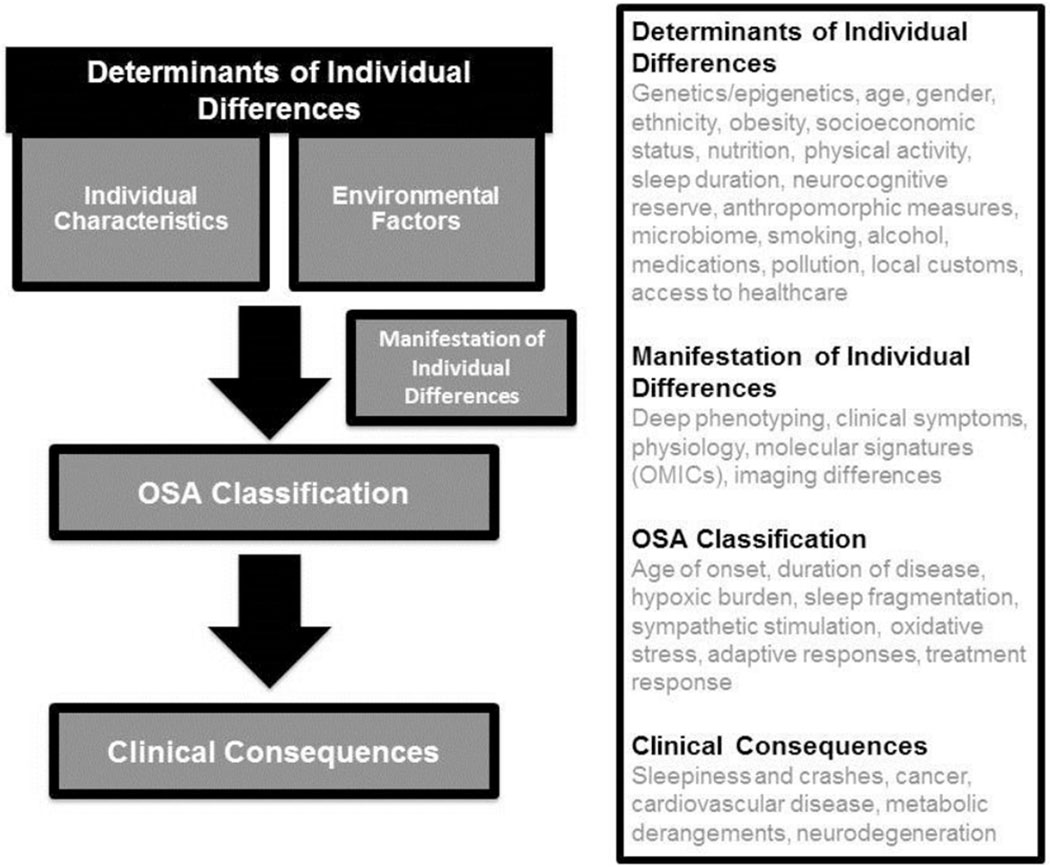
P4 medicine is an evolving approach to personalized medicine. The four Ps offer a means to: Predict who will develop disease and co-morbidities; Prevent rather than react to disease; Personalize diagnosis and treatment; have patients Participate in their own care. P4 medicine is very applicable to obstructive sleep apnoea (OSA) because each OSA patient has a different pathway to disease and its consequences. OSA has both structural and physiological mechanisms with different clinical subgroups, different molecular profiles and different consequences. This may explain why there are different responses to alternative therapies, such as intraoral devices and hypoglossal nerve stimulation therapy. Currently, technology facilitates patients to participate in their own care from screening for OSA (snoring and apnoea apps) to monitoring response to therapy (sleep monitoring, blood pressure, oxygen saturation and heart rate) as well as monitoring their own continuous positive airway pressure (CPAP) compliance. We present a conceptual framework that provides the basis for a new, P4 medicine approach to OSA and should be considered more in depth: predict and prevent those at high risk for OSA and consequences, personalize the diagnosis and treatment of OSA and build in patient participation to manage OSA.
Keywords: continuous positive airway pressure; intraoral devices; obesity; obstructive sleep apnoea; precision medicine.
© 2017 Asian Pacific Society of Respirology.
Figures
References
-
- Nandakumar R, Gollakota S, Watson N. Contactless sleep apnea detection on smartphones. MobiSys’15 ACM, Florence, Italy, 2015; 1–13.
-
- Pack AI. Application of Personalized, Predictive, Preventative, and Participatory (P4) Medicine to Obstructive Sleep Apnea. A Roadmap for Improving Care? Ann Am Thorac Soc. 2016; 13: 1456–67. - PubMed
-
- Dinov ID, Heavner B, Tang M, Glusman G, Chard K, Darcy M, Madduri R, Pa J, Spino C, Kesselman C, Foster I, Deutsch EW, Price ND, Van Horn JD, Ames J, Clark K, Hood L, Hampstead BM, Dauer W, Toga AW. Predictive Big Data Analytics: A Study of Parkinson’s Disease Using Large, Complex, Heterogeneous, Incongruent, Multi-Source and Incomplete Observations. PLoS ONE. 2016; 11: e0157077. - PMC - PubMed
Publication types
MeSH terms
Grants and funding
LinkOut - more resources
Full Text Sources
Other Literature Sources
