. 2016 Dec 27;4(1):ofw266.
doi: 10.1093/ofid/ofw266. eCollection 2017 Winter.

Cost Effectiveness and Cost Containment in the Era of Interferon-Free Therapies to Treat Hepatitis C Virus Genotype 1

Affiliations

Cost Effectiveness and Cost Containment in the Era of Interferon-Free Therapies to Treat Hepatitis C Virus Genotype 1

Benjamin P Linas et al. Open Forum Infect Dis. .

Abstract

Background: Interferon-free regimens to treat hepatitis C virus (HCV) genotype 1 are effective but costly. At this time, payers in the United States use strategies to control costs including (1) limiting treatment to those with advanced disease and (2) negotiating price discounts in exchange for exclusivity.

Methods: We used Monte Carlo simulation to investigate budgetary impact and cost effectiveness of these treatment policies and to identify strategies that balance access with cost control. Outcomes included nondiscounted 5-year payer cost per 10000 HCV-infected patients and incremental cost-effectiveness ratios.

Results: We found that the budgetary impact of HCV treatment is high, with 5-year undiscounted costs of $1.0 billion to 2.3 billion per 10000 HCV-infected patients depending on regimen choices. Among noncirrhotic patients, using the least costly interferon-free regimen leads to the lowest payer costs with negligible difference in clinical outcomes, even when the lower cost regimen is less convenient and/or effective. Among cirrhotic patients, more effective but costly regimens remain cost effective. Controlling costs by restricting treatment to those with fibrosis stage 2 or greater disease was cost ineffective for any patient type compared with treating all patients.

Conclusions: Treatment strategies using interferon-free therapies to treat all HCV-infected persons are cost effective, but short-term cost is high. Among noncirrhotic patients, using the least costly interferon-free regimen, even if it is not single tablet or once daily, is the cost-control strategy that results in best outcomes. Restricting treatment to patients with more advanced disease often results in worse outcomes than treating all patients, and it is not preferred.

Keywords: HCV; budget impact; treatment restriction.


Figures

Figure 1.
Figure 1.
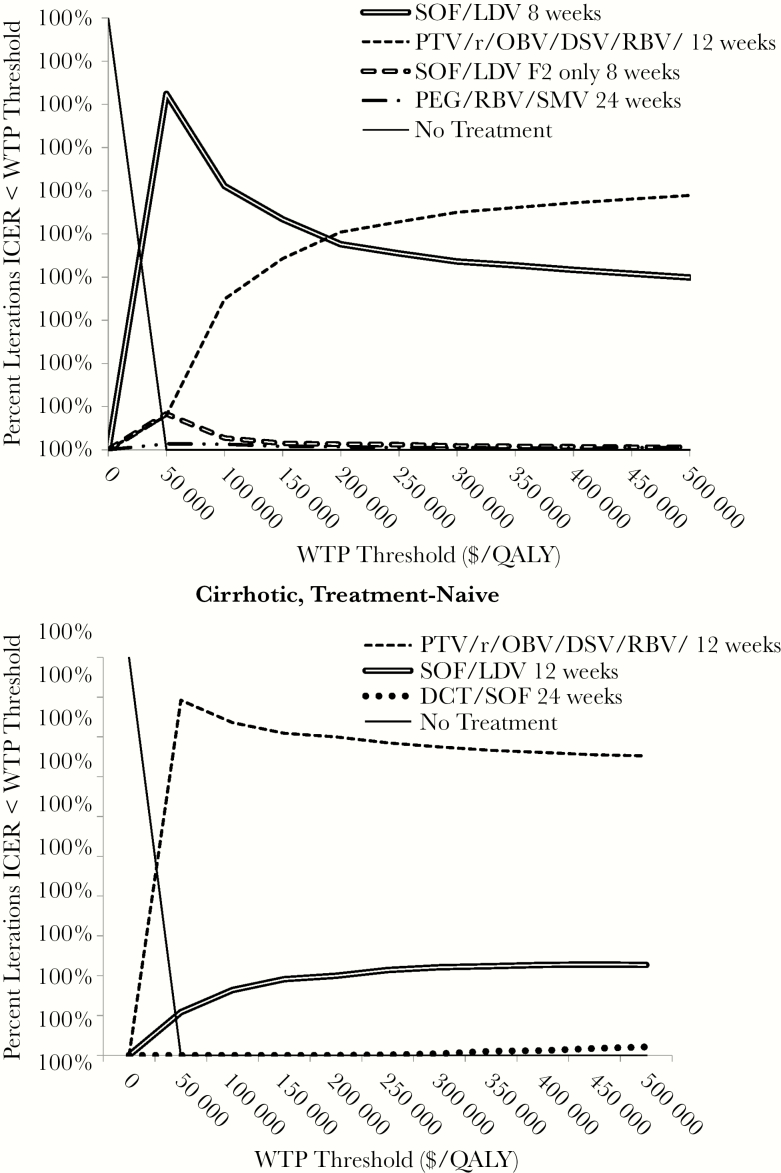
Cost-effectiveness acceptability curves for the treatment of hepatitis C virus (HCV) genotype 1b patients with and without cirrhosis. Each panel presents the results of probabilistic sensitivity analyses in which we performed multiple iterations of the cost-effectiveness simulation, each time drawing treatment efficacy parameters from defined probability density functions. The horizontal axis represents increasing societal willingness to pay thresholds. Each line represents a treatment strategy. For clarity, we excluded those strategies where the incremental cost-effectiveness ratio (ICER) was above a willingness-to-pay (WTP) threshold of $500 000 in >99% of iterations. The vertical axis depicts the percentage of the simulation iterations in which a given strategy was “preferred” from a cost-effectiveness perspective at a given societal willingness to pay. All costs are in 2014 US dollars and discounted at an annual rate of 3%. DCV, daclatasvir; DSV, dasabuvir; LDV, ledipasvir; OBV, ombitasvir; PTV, paritaprevir; QALY, quality-adjusted life year; r, ritonavir; RBV, ribavirin; SMV, simeprevir; SOF, sofosbuvir.
Figure 2.
Figure 2.
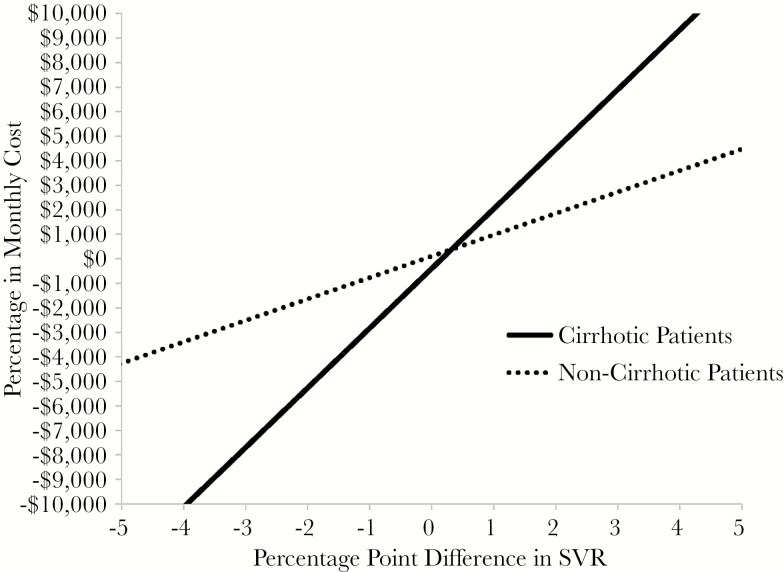
Two-way sensitivity analysis on interferon-free regimen efficacy and cost. The analysis holds the efficacy and cost of 1 interferon-free treatment (“regimen A”) constant, while varying the efficacy and cost of a competing interferon-free regimen (“regimen B”). To improve generalizability such that the analysis applies to future interferon-free treatment options, we defined the ranges of drug cost and efficacy based on those of current competing drugs, but the analysis is not based on a single regimen. The horizontal axis depicts the relative efficacy of regimen B compared with regimen A. The vertical axis depicts the relative cost. Each line depicts the threshold cost that results in regimen B having an incremental cost-effectiveness ratio (ICER) <$100 000/quality-adjusted life year compared with regimen A at the given relative efficacy. The slope of the line thus represents the economic value of an additional percentage point increase in treatment efficacy. The solid line represents cirrhotic patients, and the dotted line represents noncirrhotic patients. All costs are in 2014 US dollars and discounted at an annual rate of 3%. SVR, sustained virologic response.

References

    1. Micromedex 2.0. Drug Topics Red Book Online. Avalable at: http://www.micromedexsolutions.com Accessed 22 December 2015
    1. Chhatwal J, Kanwal F, Roberts MS, Dunn MA. Cost-effectiveness and budget impact of hepatitis C virus treatment with sofosbuvir and ledipasvir in the United States. Ann Intern Med 2015; 162:397–406. - PMC - PubMed
    1. Najafzadeh M, Andersson K, Shrank WH, et al. Cost-effectiveness of novel regimens for the treatment of hepatitis C virus. Ann Intern Med 2015; 162:407–19. - PubMed
    1. Rein DB, Wittenborn JS, Smith BD, et al. The cost-effectiveness, health benefits, and financial costs of new antiviral treatments for hepatitis C virus. Clin Infect Dis 2015; 61:157–68. - PMC - PubMed
    1. Leidner AJ, Chesson HW, Xu F, et al. Cost-effectiveness of hepatitis C treatment for patients in early stages of liver disease. Hepatology 2015; 61:1860–9. - PMC - PubMed