


EVALUATION OF EFFECTIVENESS IN A NOVEL WOUND HEALING OINTMENT-CROCODILE OIL BURN OINTMENT
- PMID: 28480384
- PMCID: PMC5411886
- DOI: 10.21010/ajtcam.v14i1.8
EVALUATION OF EFFECTIVENESS IN A NOVEL WOUND HEALING OINTMENT-CROCODILE OIL BURN OINTMENT
Abstract
Background: Crocodile oil and its products are used as ointments for burns and scalds in traditional medicines. A new ointment formulation - crocodile oil burn ointment (COBO) was developed to provide more efficient wound healing activity. The purpose of the study was to evaluate the burn healing efficacy of this new formulation by employing deep second-degree burns in a Wistar rat model. The analgesic and anti-inflammatory activities of COBO were also studied to provide some evidences for its further use.
Materials and methods: The wound healing potential of this formulation was evaluated by employing a deep second-degree burn rat model and the efficiency was comparatively assessed against a reference ointment - (1% wt/wt) silver sulfadiazine (SSD). After 28 days, the animals were euthanized and the wounds were removed for transversal and longitudinal histological studies. Acetic acid-induced writhing in mice was used to evaluate the analgesic activity and its anti-inflammatory activity was observed in xylene -induced edema in mice.
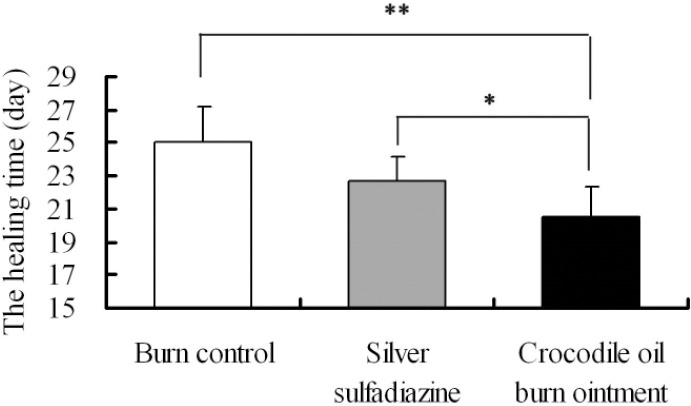
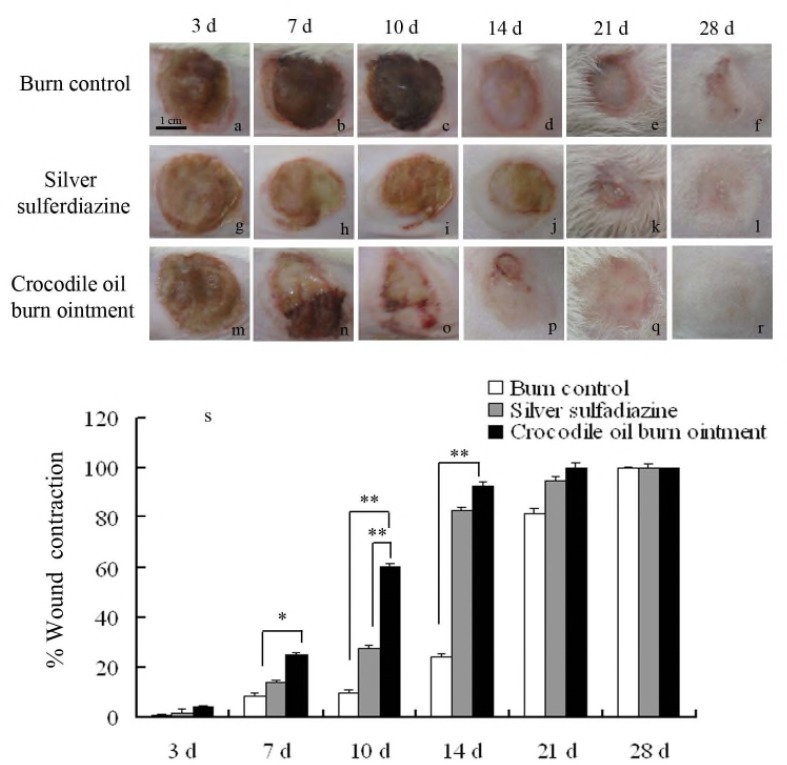
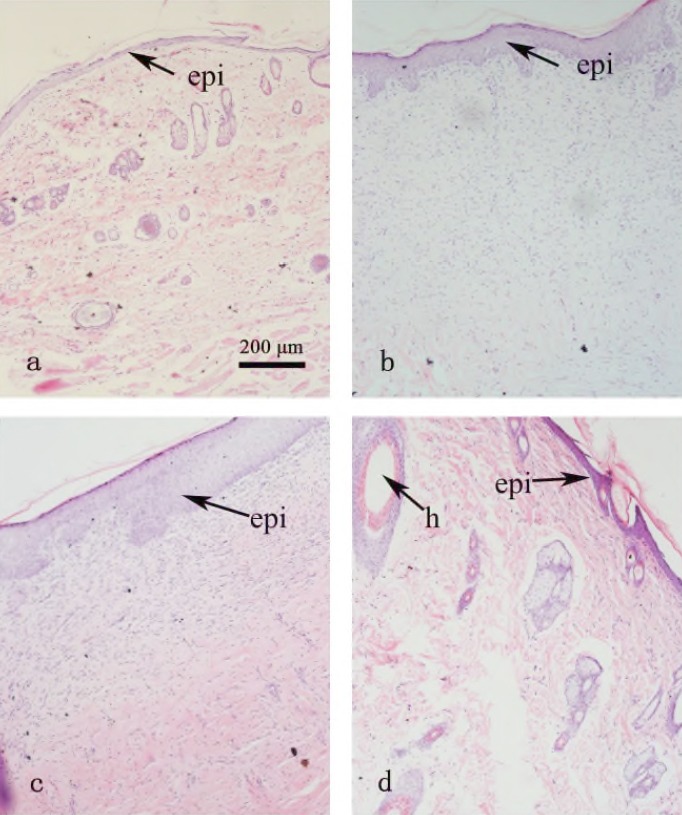
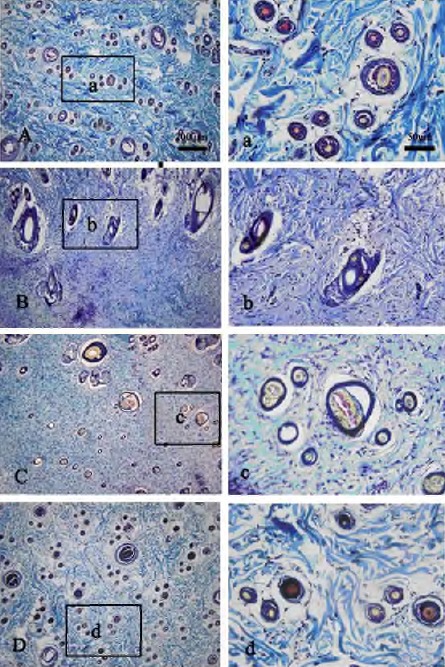
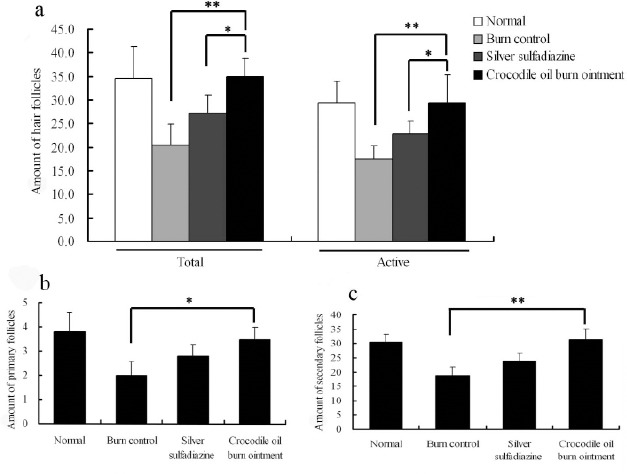
Results: COBO enhanced the burn wound healing (20.5±1.3 d) as indicated by significant decrease in wound closure time compared with the burn control (25.0±2.16 d) (P<0.01). Hair follicles played an importance role in the physiological functions of the skin, and their growth in the wound could be revealed for the skin regeneration situation. Histological results showed that the hair follicles were well-distributed in the post-burn skin of COBO treatment group, and the amounts of total, active, primary and secondary hair follicles in post-burn 28-day skin of COBO treatment groups were more than those in burn control and SSD groups. On the other hand, the analgesic and anti-inflammatory activity of COBO were much better than those of control group, while they were very close to those of moist exposed burn ointment (MEBO).
Conclusions: COBO accelerated wound closure, reduced inflammation, and had analgesic effects compared with SSD in deep second degree rat burn model. These findings suggest that COBO would be a potential therapy for treating human burns. Abbreviations: COBO, crocodile oil burn ointment; SSD, silver sulfadiazine; MEBO, moist exposed burn ointment; TCM, traditional Chinese medicine; CHM, Chinese herbal medicine; GC-MS, gas chromatography-mass spectrometry.
Keywords: Anti-inflammatory; Antinociceptive; Burn healing; Chinese herbal medicine; Crocodile oil burn ointment; Hair follicles.
Figures
References
-
- Bell G.D, Powell K.U, Burridge S.M, Harrison G, Rameh B, Weil J, Gant P.W, Jones P.H, Trowell J.E. Reinfection or recrudescence after apparently successful eradication of Helicobacter pylori infection: implications for treatment of patients with duodenal ulcer disease. QJM-An International Journal of Medicine. 1993;86:375–382. - PubMed
-
- Buchanan L.A. Kambara taraina sp. nov. (Crocodylia, Crocodyloidea), a new Eocene mekosuchine from Queensland, Australia, and a revision of the genus. Journal of Vertebrate Paleontology. 2009;29:473–486.
-
- Buthelezi S, Southway C, Govinden U, Bodenstein J, du Toit K. An investigation of the antimicrobial and anti-inflammatory activities of crocodile oil. Journal of Ethnopharmacology. 2012;143:325–330. - PubMed
-
- Chan K, Shaw D, Simmonds M.S, Leon C.J, Xu Q, Lu A, Sutherland I, Ignatova S, Zhu Y.P, Verpoorte R, Williamson E.M, Duez P. Good practice in reviewing and publishing studies on herbal medicine, with special emphasis on traditional Chinese medicine and Chinese materia medica. Journal of Ethnopharmacology. 2012;140:469–475. - PubMed
-
- Chen Q.X, Xiong Y.X, Li H.L, Hu Y.H, Chen L.P, Kang J.H, Zhang X.S. Crocodile oil burn ointment (COBO) and its preparation method. China Patent No. ZL 201010505834. 2011
MeSH terms
Substances
LinkOut - more resources
Full Text Sources
Other Literature Sources
Medical
Miscellaneous