


Computed Tomography Measure of Lung at Risk and Lung Function Decline in Chronic Obstructive Pulmonary Disease
- PMID: 28481639
- PMCID: PMC5620667
- DOI: 10.1164/rccm.201701-0050OC
Computed Tomography Measure of Lung at Risk and Lung Function Decline in Chronic Obstructive Pulmonary Disease
Abstract
Rationale: The rate of decline of lung function is greater than age-related change in a substantial proportion of patients with chronic obstructive pulmonary disease, even after smoking cessation. Regions of the lung adjacent to emphysematous areas are subject to abnormal stretch during respiration, and this biomechanical stress likely influences emphysema initiation and progression.
Objectives: To assess whether quantifying this penumbra of lung at risk would predict FEV1 decline.
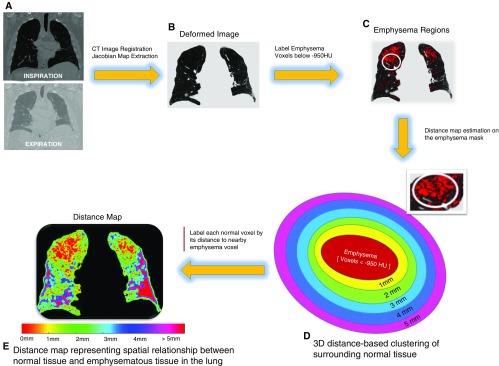
Methods: We analyzed paired inspiratory-expiratory computed tomography images at baseline of 680 subjects participating in a large multicenter study (COPDGene) over approximately 5 years. By matching inspiratory and expiratory images voxel by voxel using image registration, we calculated the Jacobian determinant, a measure of local lung expansion and contraction with respiration. We measured the distance between each normal voxel to the nearest emphysematous voxel, and quantified the percentage of normal voxels within each millimeter distance from emphysematous voxels as mechanically affected lung (MAL). Multivariable regression analyses were performed to assess the relationship between the Jacobian determinant, MAL, and FEV1 decline.
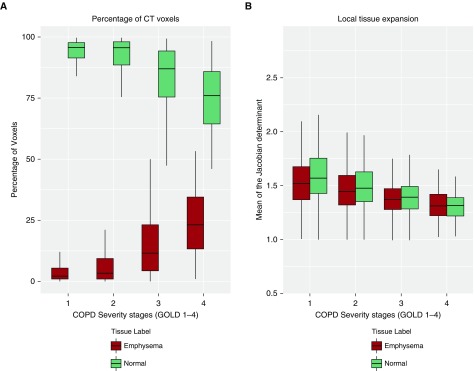
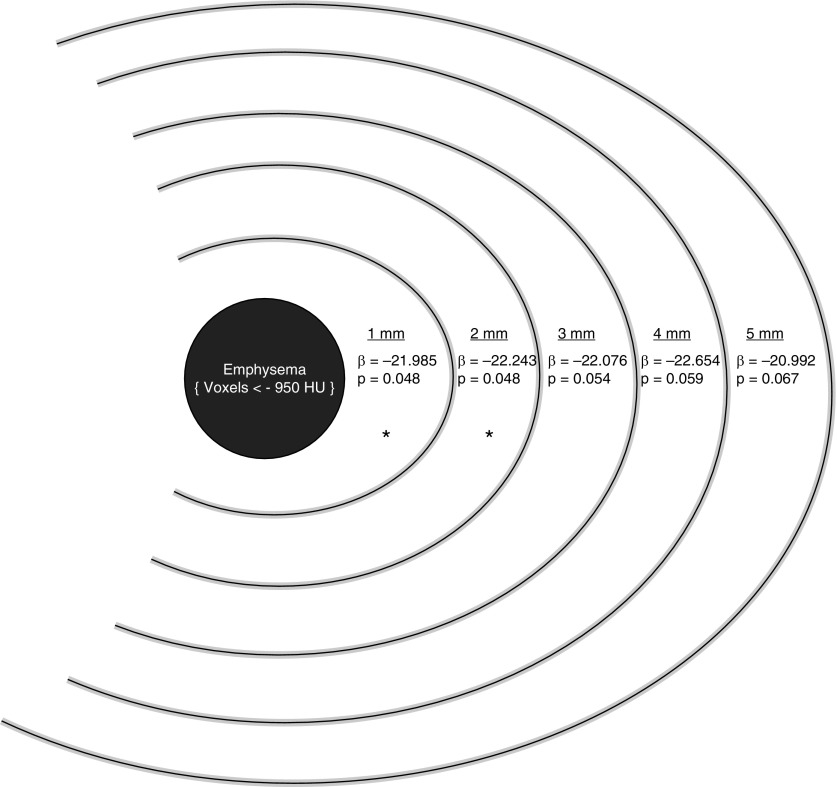
Measurements and main results: The mean (SD) rate of decline in FEV1 was 39.0 (58.6) ml/yr. There was a progressive decrease in the mean Jacobian determinant of both emphysematous and normal voxels with increasing disease stage (P < 0.001). On multivariable analyses, the mean Jacobian determinant of normal voxels within 2 mm of emphysematous voxels (MAL2) was significantly associated with FEV1 decline. In mild-moderate disease, for participants at or above the median MAL2 (threshold, 36.9%), the mean decline in FEV1 was 56.4 (68.0) ml/yr versus 43.2 (59.9) ml/yr for those below the median (P = 0.044).
Conclusions: Areas of normal-appearing lung are mechanically influenced by emphysematous areas and this lung at risk is associated with lung function decline. Clinical trial registered with www.clinicaltrials.gov (NCT00608764).
Keywords: FEV1; biomechanical; emphysema; image registration; lung at risk.
Figures
Comment in
-
Quantifying the Lung at Risk in Chronic Obstructive Pulmonary Disease. Does Emphysema Beget Emphysema?Am J Respir Crit Care Med. 2017 Sep 1;196(5):535-536. doi: 10.1164/rccm.201705-0962ED. Am J Respir Crit Care Med. 2017. PMID: 28609633 No abstract available.
References
-
- Vestbo J, Hurd SS, Agustí AG, Jones PW, Vogelmeier C, Anzueto A, Barnes PJ, Fabbri LM, Martinez FJ, Nishimura M, et al. Global strategy for the diagnosis, management, and prevention of chronic obstructive pulmonary disease: GOLD executive summary. Am J Respir Crit Care Med. 2013;187:347–365. - PubMed
-
- Nishimura M, Makita H, Nagai K, Konno S, Nasuhara Y, Hasegawa M, Shimizu K, Betsuyaku T, Ito YM, Fuke S, et al. Hokkaido COPD Cohort Study Investigators. Annual change in pulmonary function and clinical phenotype in chronic obstructive pulmonary disease. Am J Respir Crit Care Med. 2012;185:44–52. - PubMed
-
- Vestbo J, Edwards LD, Scanlon PD, Yates JC, Agusti A, Bakke P, Calverley PM, Celli B, Coxson HO, Crim C, et al. ECLIPSE Investigators. Changes in forced expiratory volume in 1 second over time in COPD. N Engl J Med. 2011;365:1184–1192. - PubMed
-
- Mead J, Turner JM, Macklem PT, Little JB. Significance of the relationship between lung recoil and maximum expiratory flow. J Appl Physiol. 1967;22:95–108. - PubMed
Publication types
MeSH terms
Associated data
Grants and funding
LinkOut - more resources
Full Text Sources
Other Literature Sources
Medical
Research Materials
