


The potential impact of sleep-related movement disorders on stroke risk: a population-based longitudinal study
- PMID: 28482057
- PMCID: PMC5914305
- DOI: 10.1093/qjmed/hcx097
The potential impact of sleep-related movement disorders on stroke risk: a population-based longitudinal study
Abstract
Background: Sleep-related movement disorders (SRMD) have been shown to increase the risk of cardiovascular diseases. However, the relationship between SRMD and stroke remains unclear.
Aim: To explore the relationship between SRMD and stroke in the general population.
Design: Two cohorts of patients with SRMD and without SRMD were followed up for the occurrence of hemorrhagic and ischemic stroke.
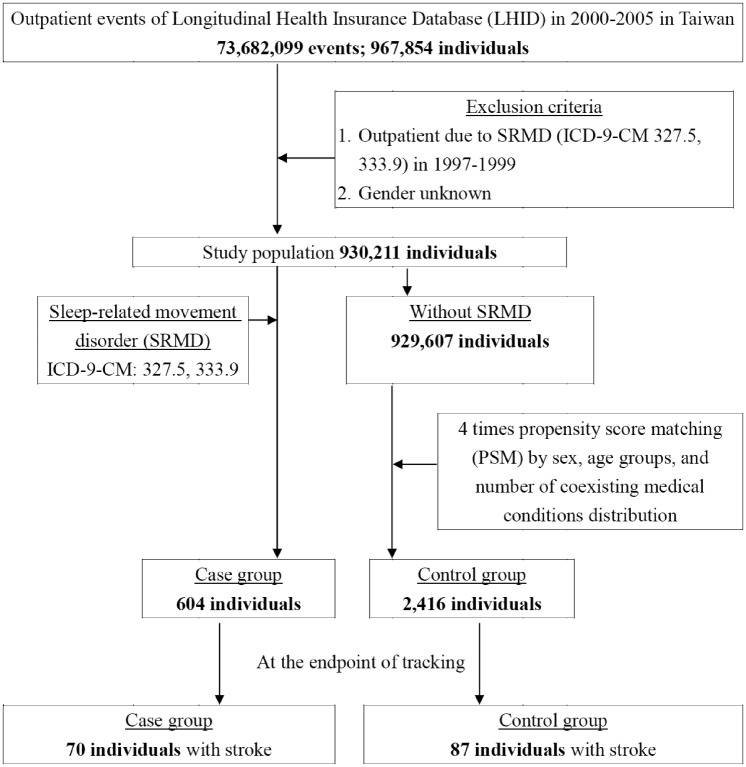
Methods: The study cohort enrolled 604 patients who were initially diagnosed as SRMD between 2000 and 2005. 2,416 age- and sex-matched patients without prior stroke were selected as the comparison cohort. A Cox-proportional hazard regression analysis was performed for multivariate adjustment.
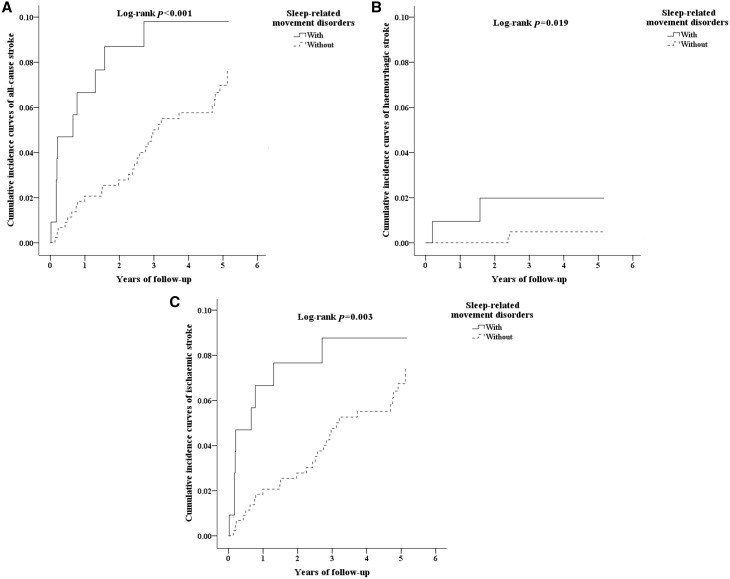
Results: Patients with SRMD had a higher risk for developing all-cause stroke [adjusted hazard ratio (HR) = 2.29, 95% confidence interval (CI) = 1.42-3.80]. Patients of below 45 years old had the greatest stroke risk (HR = 4.03, 95% CI = 3.11-5.62), followed by patients aged ≥65 years (HR = 2.64, 95% CI = 1.12-3.44) and 45-64 years (HR = 1.07, 95% CI = 1.02-1.71). The age-stratified analysis suggested that the increased risk of hemorrhagic stroke was more significant than ischemic stroke among all age groups. Furthermore, males with SRMD were at greater risk to develop all-cause stroke (HR = 2.98, 95% CI = 1.74-4.50) than that of females (HR = 1.94, 95% CI = 1.01-3.77).
Conclusions: Patients with SRMD were found to have an increased risk of all-cause stroke along with a higher possibility of hemorrhagic stroke over ischemic stroke.
© The Author(s) 2017. Published by Oxford University Press on behalf of the Association of Physicians.
Figures
References
-
- Mims KN, Kirsch D.. Sleep and stroke. Sleep Med Clinic 2016; 11:39–51. - PubMed
-
- Stanke-Labesque F, Pepin JL, Gautier-Veyret E, Levy P, Back M.. Leukotrienes as a molecular link between obstructive sleep apnoea and atherosclerosis. Cardiovasc Res 2014; 101:187–93. - PubMed
-
- Somers VK, White DP, Amin R, Abraham WT, Costa F, Culebras A, et al. Sleep apnea and cardiovascular disease: an American Heart Association/american College Of Cardiology Foundation Scientific Statement from the American Heart Association Council for High Blood Pressure Research Professional Education Committee, Council on Clinical Cardiology, Stroke Council, and Council On Cardiovascular Nursing. In collaboration with the National Heart, Lung, and Blood Institute National Center on Sleep Disorders Research (National Institutes of Health). Circulation 2008; 118:1080–111. - PubMed
-
- Williams SK, Ravenell J, Jean-Louis G, Zizi F, Underberg JA, McFarlane SI, et al. Resistant hypertension and sleep apnea: pathophysiologic insights and strategic management. Curr Diabetes Reports 2011; 11:64–9. - PubMed
Publication types
MeSH terms
LinkOut - more resources
Full Text Sources
Other Literature Sources
Medical
