


Dietary Isoflavone-Dependent and Estradiol Replacement Effects on Body Weight in the Ovariectomized (OVX) Rat
- PMID: 28482370
- PMCID: PMC5820000
- DOI: 10.1055/s-0043-108250
Dietary Isoflavone-Dependent and Estradiol Replacement Effects on Body Weight in the Ovariectomized (OVX) Rat
Abstract
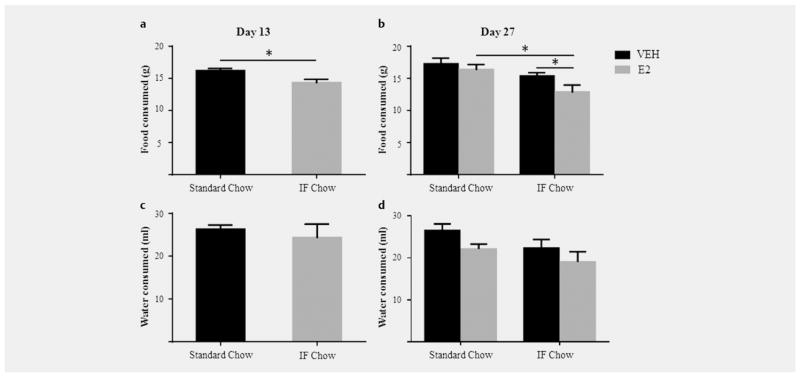
17β-Estradiol is known to regulate energy metabolism and body weight. Ovariectomy results in body weight gain while estradiol administration results in a reversal of weight gain. Isoflavones, found in rodent chow, can mimic estrogenic effects making it crucial to understand the role of these compounds on metabolic regulation. The goal of this study is to examine the effect of dietary isoflavones on body weight regulation in the ovariectomized rat. This study will examine how dietary isoflavones can interact with estradiol treatment to affect body weight. Consistent with previous findings, animals fed an isoflavone-rich diet had decreased body weight (p<0.05), abdominal fat (p<0.05), and serum leptin levels (p<0.05) compared to animals fed an isoflavone-free diet. Estradiol replacement resulted in decreased body weight (p<0.05), abdominal fat (p<0.05), and serum leptin (p<0.05). Current literature suggests the involvement of cytokines in the inflammatory response of body weight gain. We screened a host of cytokines and chemokines that may be altered by dietary isoflavones or estradiol replacement. Serum cytokine analysis revealed significant (p<0.05) diet-dependent increases in inflammatory cytokines (keratinocyte-derived chemokine). The isoflavone-free diet in OVX rats resulted in the regulation of the following cytokines and chemokines: interleukin-10, interleukin-18, serum regulated on activation, normal T cell expressed and secreted, and monocyte chemoattractant protein-1 (p<0.05). Overall, these results reveal that estradiol treatment can have differential effects on energy metabolism and body weight regulation depending on the presence of isoflavones in rodent chow.
© Georg Thieme Verlag KG Stuttgart · New York.
Conflict of interest statement
Conflict of Interests: The opinions or assertions contained herein are the private ones of the authors and are not to be construed as official or reflecting the views of the Department of Defense or the Uniformed Services University of the Health Sciences. There is no conflict of interest that could be perceived as prejudicing the impartiality of the research reported.
Figures



References
-
- Larco DO, Cruthirds DF, Weiser MJ, Handa RJ, Wu TJ. The effect of chronic immobilization stress on leptin signaling in the ovariectomized (OVX) rat. Endocrine. 2012;42:717–725. - PubMed
-
- Nelson LR, Bulun SE. Estrogen production and action. J Am Acad Dermatol. 2001;45(3 Suppl):S116–S124. - PubMed
-
- Dechering K, Boersma C, Mosselman S. Estrogen receptors alpha and beta: two receptors of a kind? Curr Med Chem. 2000;7:561–576. - PubMed
MeSH terms
Substances
Grants and funding
LinkOut - more resources
Full Text Sources
Other Literature Sources
Medical
Research Materials
