


Comparing national infectious disease surveillance systems: China and the Netherlands
- PMID: 28482830
- PMCID: PMC5423001
- DOI: 10.1186/s12889-017-4319-3
Comparing national infectious disease surveillance systems: China and the Netherlands
Abstract
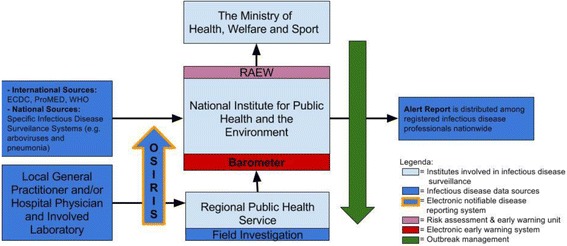
Background: Risk assessment and early warning (RAEW) are essential components of any infectious disease surveillance system. In light of the International Health Regulations (IHR)(2005), this study compares the organisation of RAEW in China and the Netherlands. The respective approaches towards surveillance of arboviral disease and unexplained pneumonia were analysed to gain a better understanding of the RAEW mode of operation. This study may be used to explore options for further strengthening of global collaboration and timely detection and surveillance of infectious disease outbreaks.
Methods: A qualitative study design was used, combining data retrieved from the literature and from semi-structured interviews with Chinese (5 national-level and 6 provincial-level) and Dutch (5 national-level) experts.
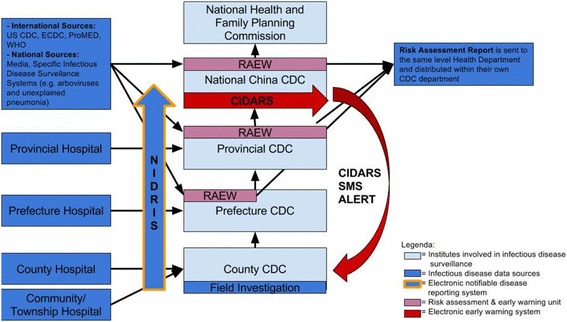
Results: The results show that some differences exist such as in the use of automated electronic components of the early warning system in China ('CIDARS'), compared to a more limited automated component in the Netherlands ('barometer'). Moreover, RAEW units in the Netherlands focus exclusively on infectious diseases, while China has a broader 'all hazard' approach (including for example chemical incidents). In the Netherlands, veterinary specialists take part at the RAEW meetings, to enable a structured exchange/assessment of zoonotic signals.
Conclusion: Despite these differences, the main conclusion is that for the two infections studied, the early warning system in China and the Netherlands are remarkably similar considering their large differences in infectious disease history, population size and geographical setting. Our main recommendations are continued emphasis on international corporation that requires insight into national infectious disease surveillance systems, the usage of a One Health approach in infectious disease surveillance, and further exploration/strengthening of a combined syndromic and laboratory surveillance system.
Keywords: Arthropod borne virus disease surveillance; China; Infectious disease surveillance systems; Risk assessment and early warning; Surveillance of unexplained pneumonia; The Netherlands.
Figures
References
-
- Pilot E, Schwarz C, Wang L, Krafft T. Health and environmental change in urban areas. Beijing: China Environmental Press; 2014. Syndromic surveillance: enhancing detection of disease outbreaks in urban China; pp. 293–303.
-
- van Asten L, Fanoy EB, Hooiveld M, Koopmans MPG, Kretzschmar MEE, syndroomsurveillance Wi. Syndroomsurveillance: een vinger aan de pols van de volksgezondheid. Nederlands Tijdschrift van Geneeskunde. 2014:1–8. - PubMed
-
- International Health Regulations. Geneva: World Health Organization; 2008.
MeSH terms
LinkOut - more resources
Full Text Sources
Other Literature Sources
Medical
