Review
. 2017 May 8;16(1):79.
doi: 10.1186/s12934-017-0691-z.

Beneficial effects on host energy metabolism of short-chain fatty acids and vitamins produced by commensal and probiotic bacteria

Affiliations
Review

Beneficial effects on host energy metabolism of short-chain fatty acids and vitamins produced by commensal and probiotic bacteria

Jean Guy LeBlanc et al. Microb Cell Fact. .

Abstract

The aim of this review is to summarize the effect in host energy metabolism of the production of B group vitamins and short chain fatty acids (SCFA) by commensal, food-grade and probiotic bacteria, which are also actors of the mammalian nutrition. The mechanisms of how these microbial end products, produced by these bacterial strains, act on energy metabolism will be discussed. We will show that these vitamins and SCFA producing bacteria could be used as tools to recover energy intakes by either optimizing ATP production from foods or by the fermentation of certain fibers in the gastrointestinal tract (GIT). Original data are also presented in this work where SCFA (acetate, butyrate and propionate) and B group vitamins (riboflavin, folate and thiamine) production was determined for selected probiotic bacteria.

Keywords: Energy metabolism; Microbiota; Short-chain fatty acids; Vitamins.


Figures
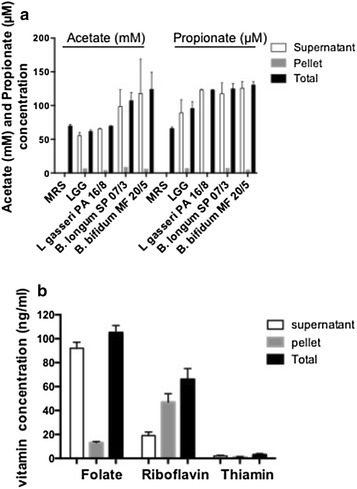
Fig. 1
Fig. 1
a Acetate and propionate production by Lactobacillus rhamnosus GG and L. gasseri PA 16/8, Bifidobacterium longum SP 07/3 and B. bifidum MF 20/5in supernatant (white bars), cellular extracts (stripped bars) and total production (black bars). The bacterial strains have been grown overnight in MRS medium (plus cysteine for bifidobacteria strains) at 37 °C. Cultures were then centrifuged (5000g for 10 mn at 4 °C). Supernatants and pellets were separated and frozen in liquid nitrogen immediately. The error bars are SEM (Standard Error Mean) and the experiments were performed four times. They were kept at −80 °C until further analyses. Acetate, butyrate and propionate were quantified in supernatant and pellets by Mass Spectromectry. b B group vitamin production by L. rhamnosus GG in supernatant (white bars), cellular extracts (stripped bars) and total production (black bars). The probiotic strain was grown in folate, riboflavin or thiamin free media (Difco) after which cells were centrifuged (4000×g) and washed with saline solution (0.85% NaCl, m/v). Folates and riboflavin were quantified according to previously described microbiological methods [41, 88] and thiamin using a Xevo Triple-Quadrupole mass spectrometer (Waters Corporation) equipped with an electrospray ionization interface coupled to an Acquity H-Class UPLCTM device (Waters Corporation) according to Waters application notes LGC/R/2011/181
Fig. 2
Fig. 2
Whereare microbial synthesized short-chain fatty acids (SCFA) and B group vitamins (B1 thiamin, B2 riboflavin, B3 niacin, B5 panthothenic acid, B7 biotin, B12 cobalamin) involved in energy metabolism? In parenthesis are the active forms of the co-factors involved in each reaction (FADH2 flavin adenine dinucleotide in hydroquinone form, CoA acetyl coenzyme A, NADH nicotinamide adenine dinucleotide, TPP thiamin pyrophosphate)

References

    1. Martens JH, Barg H, Warren MJ, Jahn D. Microbial production of vitamin B12. Appl Microbiol Biotechnol. 2002;58:275–285. doi: 10.1007/s00253-001-0902-7. - DOI - PubMed
    1. LeBlanc JG, Milani C, de Giori GS, Sesma F, van Sinderen D, Ventura M. Bacteria as vitamin suppliers to their host: a gut microbiota perspective. Curr Opin Biotechnol. 2013;24:160–168. doi: 10.1016/j.copbio.2012.08.005. - DOI - PubMed
    1. Morowitz MJ, Carlisle EM, Alverdy JC. Contributions of intestinal bacteria to nutrition and metabolism in the critically ill. Surg Clin North Am. 2011;91:771–785. doi: 10.1016/j.suc.2011.05.001. - DOI - PMC - PubMed
    1. Patterson E, Cryan JF, Fitzgerald GF, Ross RP, Dinan TG, Stanton C. Gut microbiota, the pharmabiotics they produce and host health. Proc Nutr Soc. 2014;73:477–489. doi: 10.1017/S0029665114001426. - DOI - PubMed
    1. Blaut M, Clavel T. Metabolic diversity of the intestinal microbiota: implications for health and disease. J Nutr. 2007;137:751S–755S. - PubMed
