. 2017 Jun 7;37(23):5681-5689.
doi: 10.1523/JNEUROSCI.3618-16.2017. Epub 2017 May 8.

Chronic and Acute Stress Promote Overexploitation in Serial Decision Making

Affiliations

Chronic and Acute Stress Promote Overexploitation in Serial Decision Making

Jennifer K Lenow et al. J Neurosci. .

Abstract

Many decisions that humans make resemble foraging problems in which a currently available, known option must be weighed against an unknown alternative option. In such foraging decisions, the quality of the overall environment can be used as a proxy for estimating the value of future unknown options against which current prospects are compared. We hypothesized that such foraging-like decisions would be characteristically sensitive to stress, a physiological response that tracks biologically relevant changes in environmental context. Specifically, we hypothesized that stress would lead to more exploitative foraging behavior. To test this, we investigated how acute and chronic stress, as measured by changes in cortisol in response to an acute stress manipulation and subjective scores on a questionnaire assessing recent chronic stress, relate to performance in a virtual sequential foraging task. We found that both types of stress bias human decision makers toward overexploiting current options relative to an optimal policy. These findings suggest a possible computational role of stress in decision making in which stress biases judgments of environmental quality.SIGNIFICANCE STATEMENT Many of the most biologically relevant decisions that we make are foraging-like decisions about whether to stay with a current option or search the environment for a potentially better one. In the current study, we found that both acute physiological and chronic subjective stress are associated with greater overexploitation or staying at current options for longer than is optimal. These results suggest a domain-general way in which stress might bias foraging decisions through changing one's appraisal of the overall quality of the environment. These novel findings not only have implications for understanding how this important class of foraging decisions might be biologically implemented, but also for understanding the computational role of stress in behavior and cognition more broadly.

Keywords: decision making; foraging; stress.


Figures

Figure 1.
Figure 1.
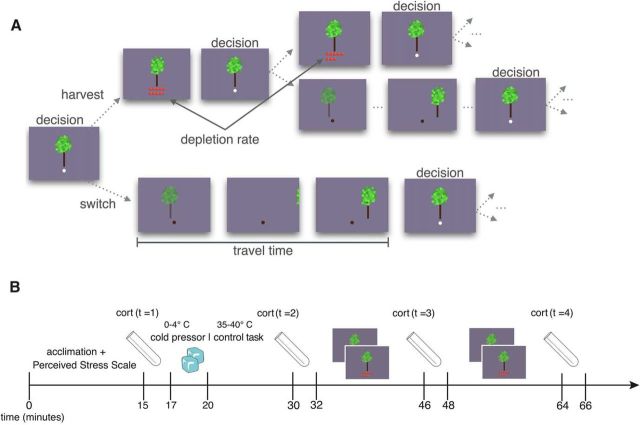
Task design and experimental procedures. A, Schematic of fixed-duration foraging task. In this task, subjects decide sequentially whether to harvest a currently displayed tree or travel to a different tree. Trees yield fewer apples with each successive harvest according to a randomly drawn depletion rate. New trees have an unharvested supply of apples, but entail a travel time (waiting) cost, the length of which varies across two environment types (with long and short travel times). B, Timeline of experimental procedures, which include the collection of questionnaire measurements, an experimental stress or control manipulation, the periodic collection of saliva (cortisol) measurements, and the behavioral task.
Figure 2.
Figure 2.
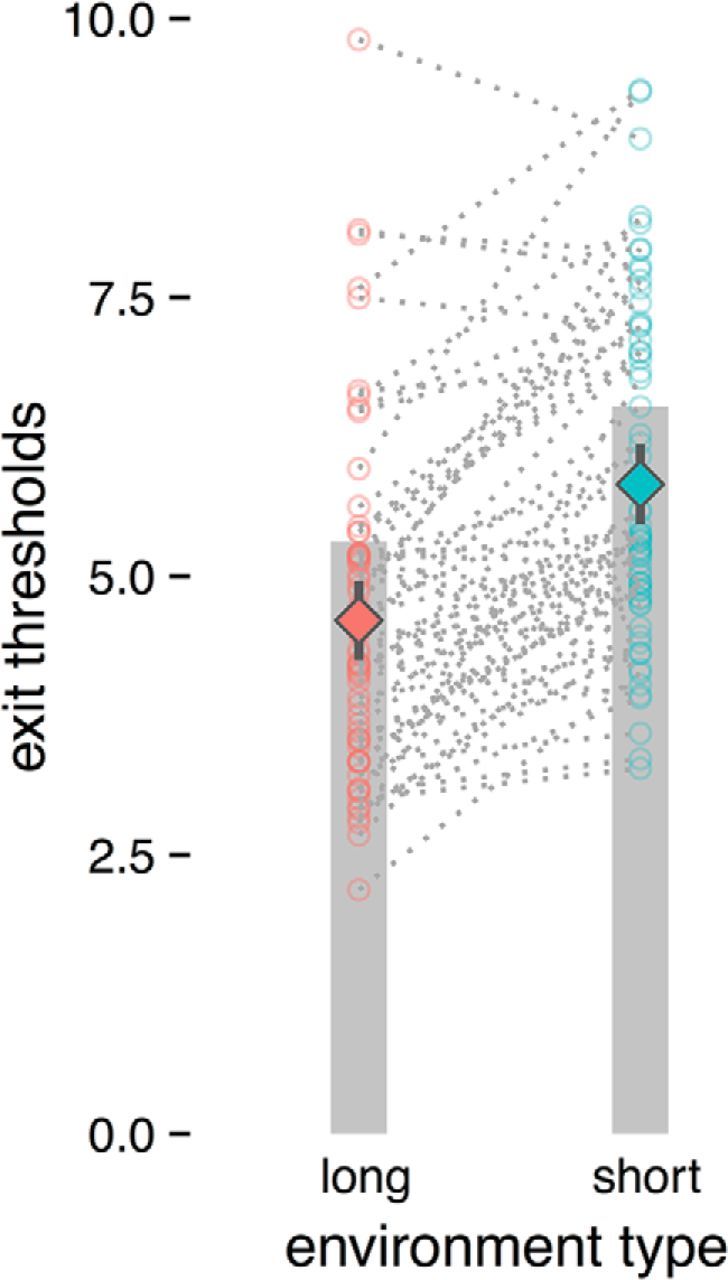
Mean exit thresholds per environment type. Gray bars indicate optimal thresholds for each environment type (long or short) as given by the MVT. Open circles indicate per-subject mean exit thresholds for each environment type. Diamonds indicate mean exit thresholds across all subjects for each environment type, with 95% confidence intervals. Overall, subjects demonstrated sensitivity to changes in the environment quality by adjusting their thresholds adaptively in a manner consistent with the MVT.
Figure 3.
Figure 3.
Relationship between PSS scores and foraging behavior. A, Deviation from optimal scores conditional on the mixed-effects linear regression plotted as a function of PSS scores across all subjects. Note that positive values of this variable indicate underharvesting (i.e., desisting sooner than optimal) and negative values indicate overharvesting (i.e., desisting later than optimal). The regression line is computed from the group-level intercept and PSS fixed effects. Dashed lines indicate 2 SEs estimated from the group-level mixed-effects linear regression. B, Tree-by-tree data for a subject with a relatively low PSS score (based upon a median split). Solid lines indicate exit thresholds per tree as a function of time (y-axis), block (discontinuities between lines), and environment type (color). Dashed lines indicate subjects' average exit thresholds per block. Gray bars indicate optimal thresholds per environment type. C, Tree-by-tree threshold data for a subject with a relatively high PSS score. Subjects in B and C had comparable log cortisol Δ values. Note that, although both subjects are sensitive to environmental changes in the direction predicted by the MVT, the subject in C was biased toward suboptimally overexploiting trees.
Figure 4.
Figure 4.
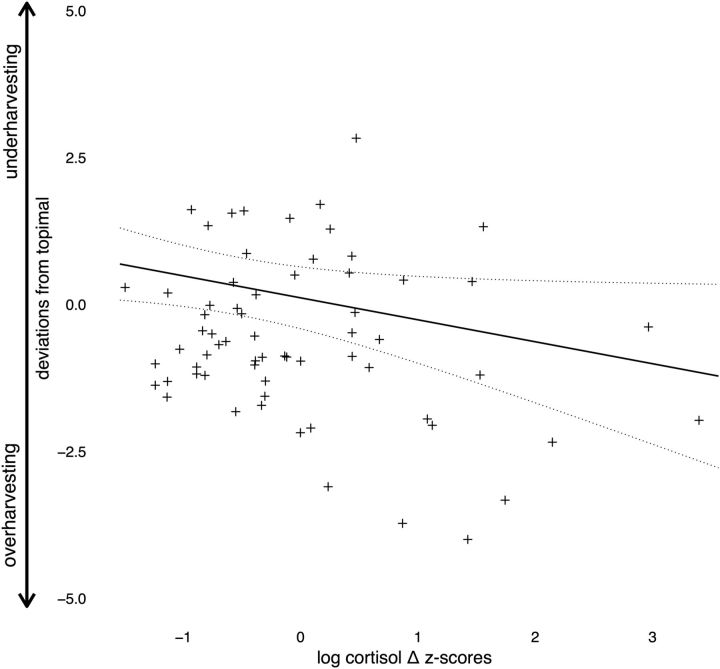
Relationship between log cortisol Δ and foraging behavior. Deviation from optimal scores conditional on the mixed-effects linear regression is plotted as a function of log cortisol Δ across all subjects. The regression line is computed from the group-level intercept and log cortisol Δ fixed effects. Dashed lines indicate 2 SEs estimated from the group-level mixed-effects linear regression.

Comment in

  • Stress and Exploitative Decision-Making.
    Harms MB. Harms MB. J Neurosci. 2017 Oct 18;37(42):10035-10037. doi: 10.1523/JNEUROSCI.2169-17.2017. J Neurosci. 2017. PMID: 29046439 Free PMC article. No abstract available.

References

    1. Arnsten AF. (2009) Stress signalling pathways that impair prefrontal cortex structure and function. Nat Rev Neurosci 10:410–422. 10.1038/nrn2648 - DOI - PMC - PubMed
    1. Boureau YL, Sokol-Hessner P, Daw ND (2015) Deciding how to decide: self-control and meta-decision making. Trends Cogn Sci 19:700–710. 10.1016/j.tics.2015.08.013 - DOI - PubMed
    1. Cassini MH, Lichtenstein G, Ongay JP, Kacelnik A (1993) Foraging behaviour in guinea pigs: further tests of the marginal value theorem. Behav Processes 29:99–112. 10.1016/0376-6357(93)90030-U - DOI - PubMed
    1. Charnov EL. (1976) Optimal foraging, the marginal value theorem. Theor Popul Biol 9:129–136. 10.1016/0040-5809(76)90040-X - DOI - PubMed
    1. Cohen S, Kamarck T, Mermelstein R (1983) A global measure of perceived stress. J Health Soc Behav 24:385–396. 10.2307/2136404 - DOI - PubMed

Publication types

LinkOut - more resources