


Erythritol is a pentose-phosphate pathway metabolite and associated with adiposity gain in young adults
- PMID: 28484010
- PMCID: PMC5448202
- DOI: 10.1073/pnas.1620079114
Erythritol is a pentose-phosphate pathway metabolite and associated with adiposity gain in young adults
Abstract
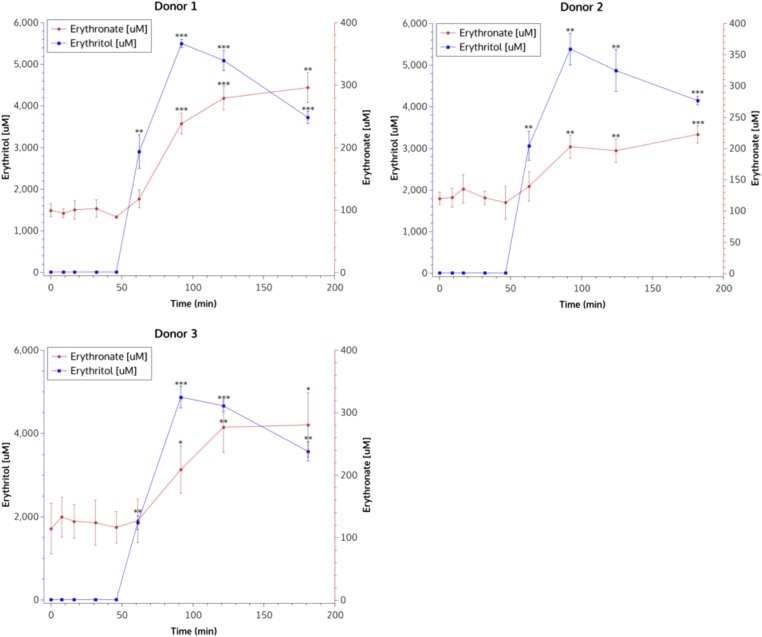
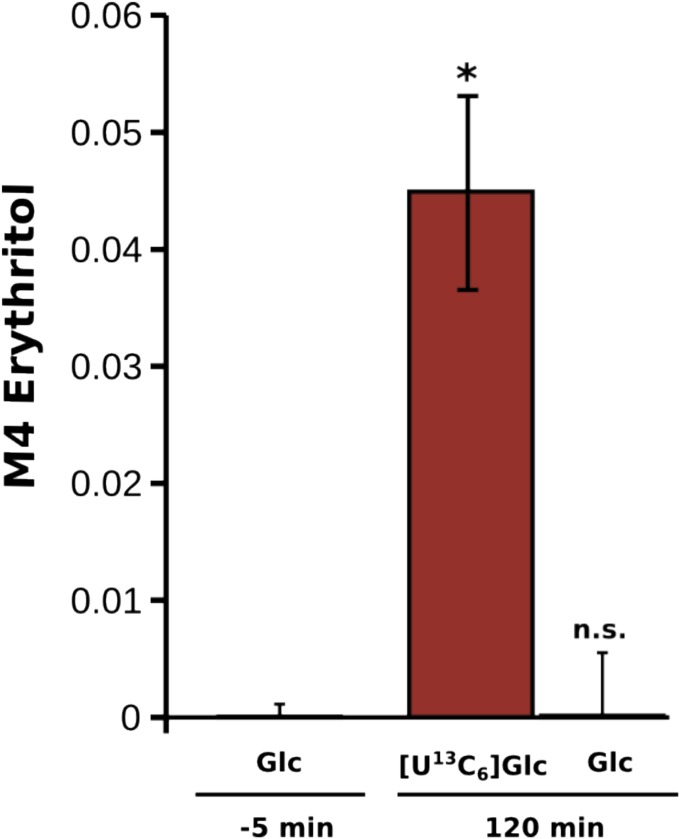
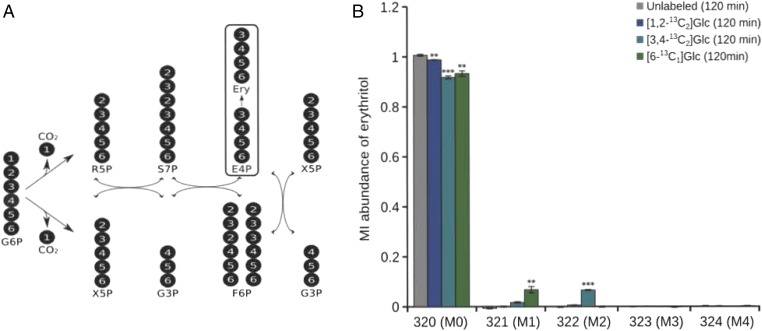
Metabolomic markers associated with incident central adiposity gain were investigated in young adults. In a 9-mo prospective study of university freshmen (n = 264). Blood samples and anthropometry measurements were collected in the first 3 d on campus and at the end of the year. Plasma from individuals was pooled by phenotype [incident central adiposity, stable adiposity, baseline hemoglobin A1c (HbA1c) > 5.05%, HbA1c < 4.92%] and assayed using GC-MS, chromatograms were analyzed using MetaboliteDetector software, and normalized metabolite levels were compared using Welch's t test. Assays were repeated using freshly prepared pools, and statistically significant metabolites were quantified in a targeted GC-MS approach. Isotope tracer studies were performed to determine if the potential marker was an endogenous human metabolite in men and in whole blood. Participants with incident central adiposity gain had statistically significantly higher blood erythritol [P < 0.001, false discovery rate (FDR) = 0.0435], and the targeted assay revealed 15-fold [95% confidence interval (CI): 13.27, 16.25] higher blood erythritol compared with participants with stable adiposity. Participants with baseline HbA1c > 5.05% had 21-fold (95% CI: 19.84, 21.41) higher blood erythritol compared with participants with lower HbA1c (P < 0.001, FDR = 0.00016). Erythritol was shown to be synthesized endogenously from glucose via the pentose-phosphate pathway (PPP) in stable isotope-assisted ex vivo blood incubation experiments and through in vivo conversion of erythritol to erythronate in stable isotope-assisted dried blood spot experiments. Therefore, endogenous production of erythritol from glucose may contribute to the association between erythritol and obesity observed in young adults.
Keywords: adiposity; erythritol; metabolomics; pentose-phosphate pathway; weight gain.
Conflict of interest statement
The authors declare no conflict of interest.
Figures
Comment in
-
Obesity: Sweetener associated with increased adiposity in young adults.Nat Rev Endocrinol. 2017 Aug;13(8):443-444. doi: 10.1038/nrendo.2017.71. Epub 2017 Jun 9. Nat Rev Endocrinol. 2017. PMID: 28621336 No abstract available.
References
-
- National Center for Education Statistics & Integrated Postsecondary Education Data System 2012 Projections of Education Statistics to 2021. Table 30. Available at https://nces.ed.gov/programs/projections/projections2021/tables/table_30...). Accessed April 18, 2017.
-
- Vella-Zarb RA, Elgar FJ. The ‘freshman 5’: A meta-analysis of weight gain in the freshman year of college. J Am Coll Health. 2009;58:161–166. - PubMed
-
- Crombie AP, Ilich JZ, Dutton GR, Panton LB, Abood DA. The freshman weight gain phenomenon revisited. Nutr Rev. 2009;67:83–94. - PubMed
-
- Naukkarinen J, Rissanen A, Kaprio J, Pietiläinen KH. Causes and consequences of obesity: The contribution of recent twin studies. Int J Obes. 2012;36:1017–1024. - PubMed
-
- Nelson MC, Story M, Larson NI, Neumark-Sztainer D, Lytle LA. Emerging adulthood and college-aged youth: An overlooked age for weight-related behavior change. Obesity (Silver Spring) 2008;16:2205–2211. - PubMed
Publication types
MeSH terms
Substances
Grants and funding
LinkOut - more resources
Full Text Sources
Other Literature Sources
Miscellaneous
