. 2017 May 8;7(1):1554.
doi: 10.1038/s41598-017-01765-6.

Detecting the Molecular System Signatures of Idiopathic Pulmonary Fibrosis through Integrated Genomic Analysis

Affiliations

Detecting the Molecular System Signatures of Idiopathic Pulmonary Fibrosis through Integrated Genomic Analysis

Indu Gangwar et al. Sci Rep. .

Abstract

Idiopathic Pulmonary Fibrosis (IPF) is an incurable progressive fibrotic disease of the lungs. We currently lack a systematic understanding of IPF biology and a systems approach may offer new therapeutic insights. Here, for the first time, a large volume of high throughput genomics data has been unified to derive the most common molecular signatures of IPF. A set of 39 differentially expressed genes (DEGs) was found critical to distinguish IPF. Using high confidence evidences and experimental data, system level networks for IPF were reconstructed, involving 737 DEGs found common across at least two independent studies. This all provided one of the most comprehensive molecular system views for IPF underlining the regulatory and molecular consequences associated. 56 pathways crosstalks were identified which included critical pathways with specified directionality. The associated steps gained and lost due to crosstalk during IPF were also identified. A serially connected system of five crucial genes was found, potentially controlled by nine miRNAs and eight transcription factors exclusively in IPF when compared to NSIP and Sarcoidosis. Findings from this study have been implemented into a comprehensive molecular and systems database on IPF to facilitate devising diagnostic and therapeutic solutions for this deadly disease.


Conflict of interest statement

The authors declare that they have no competing interests.

Figures
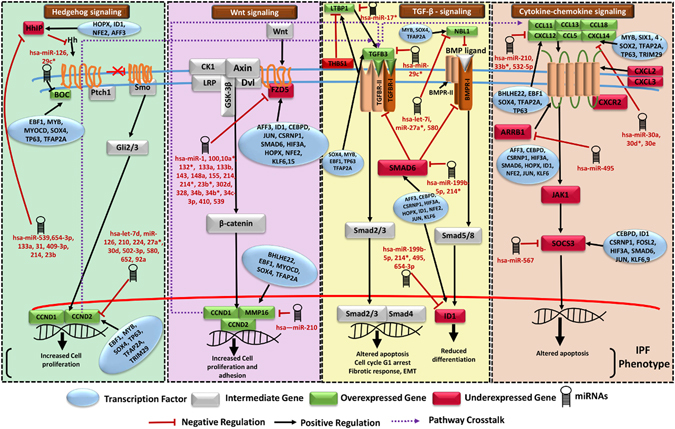
Figure 1
Figure 1
A molecular system model for IPF. It involves four crucial biological pathways (Hedgehog signaling, Wnt signaling, TGFβ signaling and Cytokine-chemokine signaling) having cross-talk with each other. The model describes the mechanism and several regulatory components involved in IPF disease mechanism causing increased cell proliferation, adhesion, reduced differentiation, altered apoptosis and epithelial to mesenchymal transition. DEGs Frizzled 5 receptor, LTBP1, HHIP, BOC, CXCL12, CXCL14, ARRB1, NBL1 and SOCS3 appeared critical in IPF.
Figure 2
Figure 2
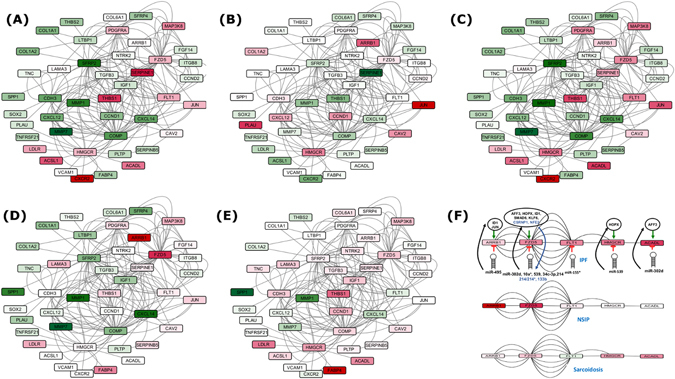
Variation in differential expression of most confident Set A genes along with their first neighbors during IPF progression. (A) Normal to Early IPF shifts in differential expression, (B) Early to advanced IPF shifts in differential expression, (C) Normal to Advanced IPF shift in differential expression, (D) differentially expressing genes in NSIP and in (E) Sarcoidosis. Green color depicts the degree of overexpression whereas red shows degree of underexpression, (F) Critical chain of five serially connected genes (ACADL-HMGCR-FLT1-FZD5-ARRB1) which appeared downregulated in IPF specifically. This chain is broken in Sarcoidosis due to upregulation of FLT1 while in case of NSIP, the chain is not completely formed. Eight TFs and nine miRNAs appeared crucial in regulating IPF through these check points.
Figure 3
Figure 3
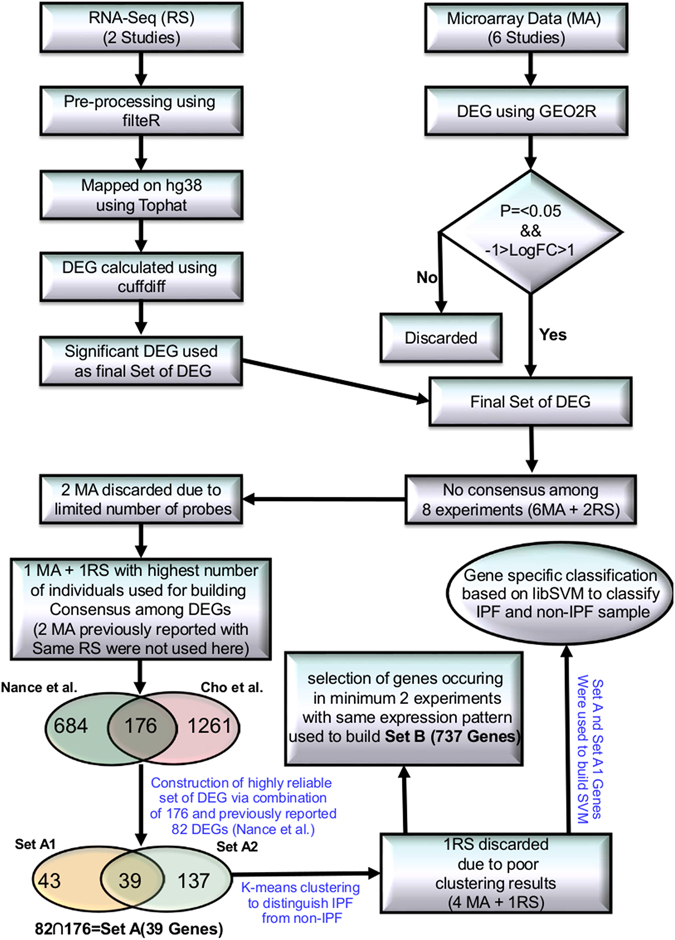
Protocol showing various steps in high-throughput data processing. Two MA studies were discarded due to less number of probes. Initially, Set A2 was constructed using one MA (GSE21411) and one RNA-seq (SRP033095) study. Set A was developed from overlap of Set A1 and Set A2. To construct Set B, DEGs were chosen so that they occurred in least two different high throughput studies. A SVM based classification model was generated for using Set A to distinguish IPF sample from non IPF ones.
Figure 4
Figure 4
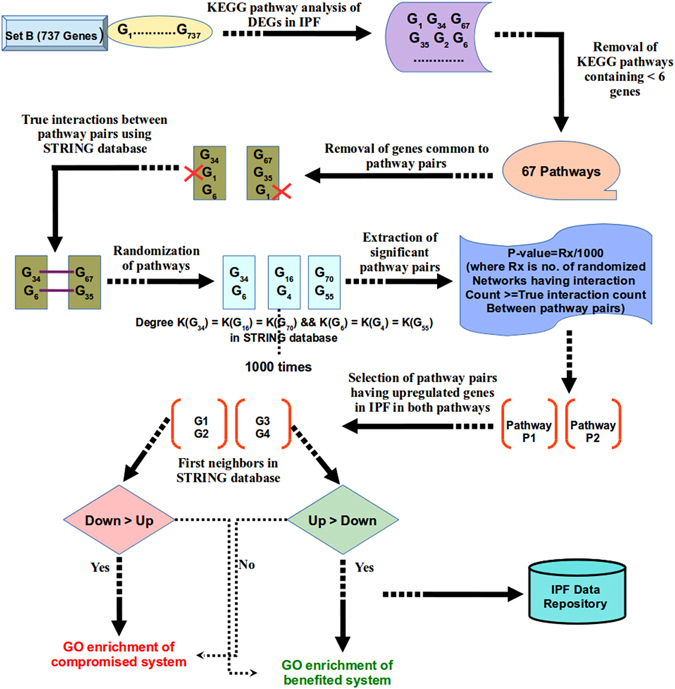
Pipeline depicting global pathway crosstalk network generation protocol for DEGs. Crosstalk network analysis starts by filtering out the pathways containing less than six genes, considering sufficient number of genes to address biological relevance of analysis. Protein interactions occurring between all pathway pairs were counted. Every pathway pair was randomized 1000 times and protein interaction counts in real network were compared with randomized ones. Significant pathway pairs were further analyzed to obtain the benefited and compromised chains in IPF specific pathway crosstalks.

References

    1. Ley B, Collard HR, King TE. Clinical course and prediction of survival in idiopathic pulmonary fibrosis. Am. J. Respir. Crit. Care Med. 2011;183:431–440. doi: 10.1164/rccm.201006-0894CI. - DOI - PubMed
    1. Mazzei ME, Richeldi L, Collard HR. Nintedanib in the treatment of idiopathic pulmonary fibrosis. Ther Adv Respir Dis. 2015;9:121–129. doi: 10.1177/1753465815579365. - DOI - PubMed
    1. Maher TM. Pirfenidone in idiopathic pulmonary fibrosis. Drugs Today. 2010;46:473–482. doi: 10.1358/dot.2010.46.7.1488336. - DOI - PubMed
    1. Sun C-X, et al. Role of A2B adenosine receptor signaling in adenosine-dependent pulmonary inflammation and injury. J. Clin. Invest. 2006;116:2173–2182. doi: 10.1172/JCI27303. - DOI - PMC - PubMed
    1. Jakubzick C, Kunkel SL, Puri RK, Hogaboam CM. Therapeutic targeting of IL-4- and IL-13-responsive cells in pulmonary fibrosis. Immunol. Res. 2004;30:339–349. doi: 10.1385/IR:30:3:339. - DOI - PubMed

Publication types