


Management of Chronic Tinnitus and Insomnia with Repetitive Transcranial Magnetic Stimulation and Cognitive Behavioral Therapy - a Combined Approach
- PMID: 28484405
- PMCID: PMC5399016
- DOI: 10.3389/fpsyg.2017.00575
Management of Chronic Tinnitus and Insomnia with Repetitive Transcranial Magnetic Stimulation and Cognitive Behavioral Therapy - a Combined Approach
Abstract
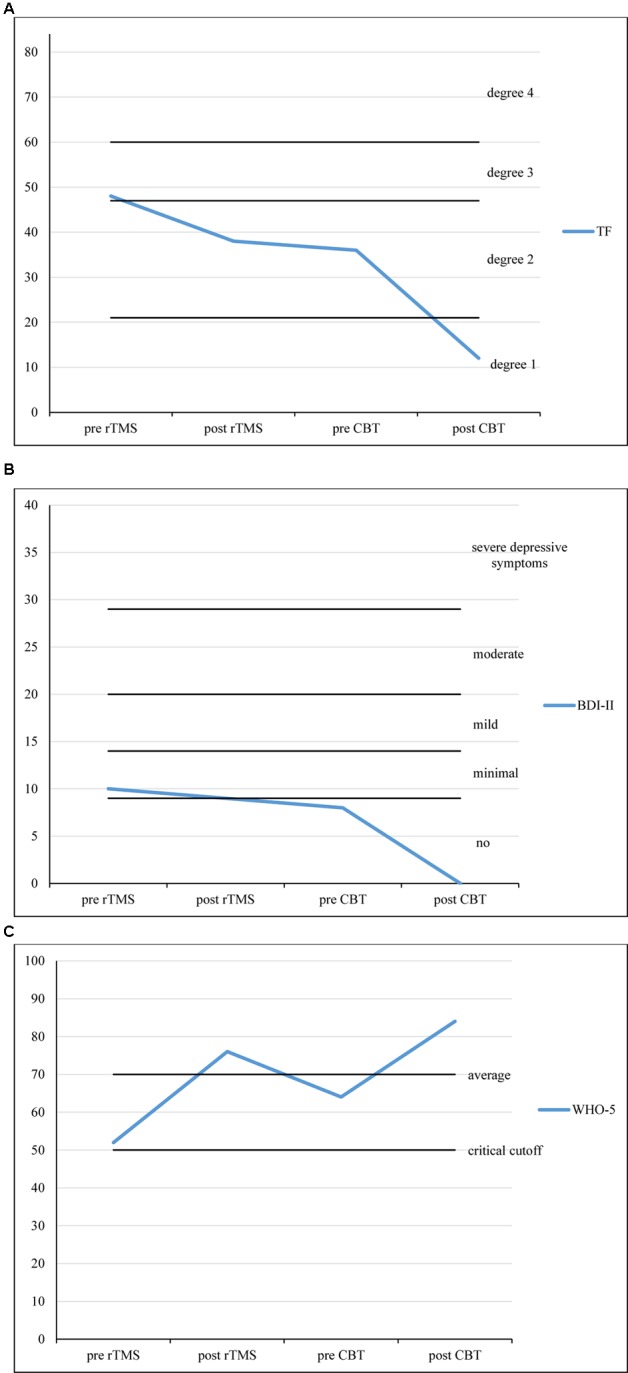
It has been estimated that up to 80% of people will experience symptoms of tinnitus over the courses of their lives, with rates of comorbid sleeping problems ranging from 50 to 77%. Because of a potential connection between tinnitus and sleep disorders as well as high rates of comorbid psychiatric disorders, interdisciplinary approaches to treatment seem to be the most efficient option. In this study, we present the case of a 53-year-old male patient, who started to experience symptoms of tinnitus at the age of 49, most likely caused by work-related stress. Over the course of his illness, the patient developed comorbid insomnia. He consulted us for treatment of both conditions and we developed a treatment plan with ten sessions of repetitive transcranial magnetic stimulation (rTMS) followed by 10 sessions of cognitive behavioral therapy (CBT). We used the Tinnitus Fragebogen (TF) to assess the severity of the tinnitus, the Beck Depression Inventory (BDI-II) for depressive symptoms, and the WHO Well-being Index (WHO-5) for subjective well-being. Improvements could be achieved with regard to both diagnoses and the patient went from severe (48) to clinically negligible (12) TF scores, from minimal (BDI-II score 10) to no (0) depressive symptoms, and from just above critical (WHO-5 percentile 52) to above average (84) well-being. The combination of technological and psychological approaches to treat tinnitus and insomnia thus proved successful in this case. One may therefore conclude that rTMS may be considered an effective first therapeutic step for tinnitus treatment prior to CBT. To our knowledge this is the first published case in which rTMS and CBT were combined for tinnitus therapy. The approach proved successful since it led to a considerable increase in well-being and everyday functioning. To gauge the effect on a more general level, large-scale studies are still needed to cancel out potential placebo effects. Likewise, the importance of the order of the two treatments, and the possibility of using other therapies in combination with CBT to address certain tinnitus subtypes and different etiologies must be studied in greater detail.
Keywords: CBT; insomnia; rTMS; sleep; tinnitus.
Figures
Similar articles
-
Combined rTMS to the auditory cortex and prefrontal cortex for tinnitus control in patients with depression: a pilot study.Acta Otolaryngol. 2013 Jun;133(6):600-6. doi: 10.3109/00016489.2012.763181. Epub 2013 Feb 28. Acta Otolaryngol. 2013. PMID: 23448323
-
[Health-related quality of life assessment in depression after low-frequency transcranial magnetic stimulation].Encephale. 2014 Feb;40(1):74-80. doi: 10.1016/j.encep.2013.04.004. Epub 2013 Oct 1. Encephale. 2014. PMID: 24091070 French.
-
A proof-of-concept study on the combination of repetitive transcranial magnetic stimulation and relaxation techniques in chronic tinnitus.J Neural Transm (Vienna). 2016 Oct;123(10):1147-57. doi: 10.1007/s00702-016-1588-4. Epub 2016 Jun 17. J Neural Transm (Vienna). 2016. PMID: 27315823 Clinical Trial.
-
Repetitive transcranial magnetic stimulation for the treatment of chronic tinnitus after traumatic brain injury: a case study.J Head Trauma Rehabil. 2013 Sep-Oct;28(5):386-9. doi: 10.1097/HTR.0b013e318254736e. J Head Trauma Rehabil. 2013. PMID: 22688213 Review.
-
Repetitive transcranial magnetic stimulation (rTMS): a new therapeutic approach in subjective tinnitus?Neurophysiol Clin. 2006 May-Jun;36(3):145-55. doi: 10.1016/j.neucli.2006.08.001. Epub 2006 Aug 22. Neurophysiol Clin. 2006. PMID: 17046609 Review.
Cited by
-
Effect of Tinnitus on Sleep Quality and Insomnia.Int Arch Otorhinolaryngol. 2023 Mar 22;27(2):e197-e202. doi: 10.1055/s-0041-1735455. eCollection 2023 Apr. Int Arch Otorhinolaryngol. 2023. PMID: 37125358 Free PMC article.
-
[Improving the role of rTMS and tDCS in the treatment of chronic tinnitus by combining other rehabilitation techniques].Lin Chuang Er Bi Yan Hou Tou Jing Wai Ke Za Zhi. 2021 May;35(5):468-471. doi: 10.13201/j.issn.2096-7993.2021.05.020. Lin Chuang Er Bi Yan Hou Tou Jing Wai Ke Za Zhi. 2021. PMID: 34304478 Free PMC article. Review. Chinese.
-
Editorial: Impact of neurostimulation and psychotherapy on mental health.Front Psychol. 2022 Aug 9;13:992634. doi: 10.3389/fpsyg.2022.992634. eCollection 2022. Front Psychol. 2022. PMID: 36017433 Free PMC article. No abstract available.
-
Insomnia Associated with Tinnitus and Gender Differences.Int J Environ Res Public Health. 2021 Mar 19;18(6):3209. doi: 10.3390/ijerph18063209. Int J Environ Res Public Health. 2021. PMID: 33808865 Free PMC article.
-
rTMS in mental health disorders.Front Netw Physiol. 2023 Jul 28;3:943223. doi: 10.3389/fnetp.2023.943223. eCollection 2023. Front Netw Physiol. 2023. PMID: 37577037 Free PMC article. Review.
References
-
- Acker J., Scholz F., Richter K., Niklewski G. (2010). Behandlungseffekte der repetitiven transkraniellen Magnetstimulation (rTMS) bei Patienten mit chronischem Tinnitus aurium: Erste Ergebnisse der Behandlung mit niederfrequenter rTMS. Psychiatr. Forsch. Suppl. 1 9–12. 10.5283/pf.19 - DOI
-
- American Academy of Sleep Medicine (2005). International Classification of Sleep Disorders, Revised: Diagnostic and Coding Manual 2nd Edn. Chicago, IL: American Sleep Disorders Association.
-
- AWMF (2015). German S3 Guideline Ol 7/064: Chronic tinnitus. Current revision 02/2015. Leitlinie Chronischer Tinnitus Deutsche Gesellschaft für Hals-Nasen-Ohren-Heilkunde. Available at: http://www.awmf.org/fileadmin/user_upload/Leitlinien/017_D_G_f_Hals-Nase...
-
- Backhaus J., Riemann D. (1999). Schlafstörungen. Fortschritte der Psychotherapie Vol. 7. Göttingen: Hogrefe, Verl. für Psychologie.
LinkOut - more resources
Full Text Sources
Other Literature Sources
Miscellaneous
