


Reducing risks of Transfusion-transmitted infections in a resource-limited hospital-based blood bank: the case of the Yaoundé University Teaching Hospital, Cameroon
- PMID: 28484511
- PMCID: PMC5419684
- DOI: 10.1111/voxs.12287
Reducing risks of Transfusion-transmitted infections in a resource-limited hospital-based blood bank: the case of the Yaoundé University Teaching Hospital, Cameroon
Abstract
Background and objectives: Although interest in assessing risk of TTIs, very few trends in blood safety epidemiological data from resource-limited blood services are reported in the literature. This analysis aims at reporting trends in seroprevalences of TTIs in blood donations in the Yaoundé University Teaching Hospital (UTH) from 2011 to 2015 and to describe reasons for these changes.
Materials and methods: All donations of 2015 were tested for HIV 1&2 antibodies and the P24 antigen, HBsAg, HCV antibody and the Treponema pallidum antibody. Screening for HIV uses a national algorithm based on the systematic use of two assays of different principles: a rapid determination testing assay and an EIA HIV 1 & 2 Ab-Ag. The tests used for HBsAg and HCVAb screening were all based on EIA techniques. Treponema pallidum antibody screening was based on Treponema Pallidum hemagglutination assay (TPHA) and rapid immunochromatographic test (RIT). Screening techniques and results from 2015 were compared to retrospective data from 2011, 2012, 2013 and 2014.
Results: In 2015, 13·4% (n = 214) of 1,596 blood donations were seropositive for at least one screened TTIs. The most frequent serological marker was HBsAg with 123 (7·7%) blood units contaminated. Nineteen (1·2%) and 18 (1·1%) blood units was positive for HIV and syphilis, respectively. There was a significant decrease in the total number of blood donations (P < 10-4) and HIV, HBsAg and syphilis seroprevalences and an increase in the proportion of voluntary non-remunerated blood donor (P < 0·05). HCVAb seroprevalence was 3·8% in 2015 and has not decreased significantly over the years (P = 0·09).
Conclusion: Significant progress is noted in reduction in seroprevalences of HIV, HBV, HCV and syphilis since the beginning of a regular registration of data in 1990.
Keywords: Cameroun Africa; blood donation; transfusion-transmitted infections.
Figures
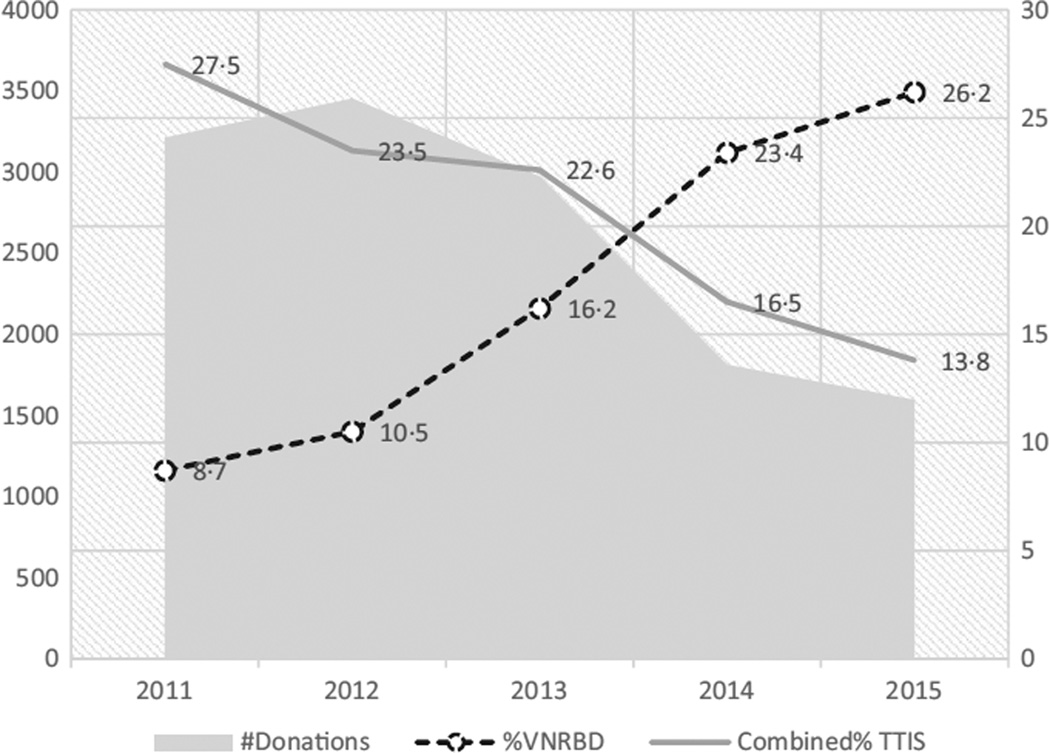
 : Number of donations;
  : Percentage of voluntary non-remunerated blood donations;
  : Combined percentage of transfusion-transmitted Infections.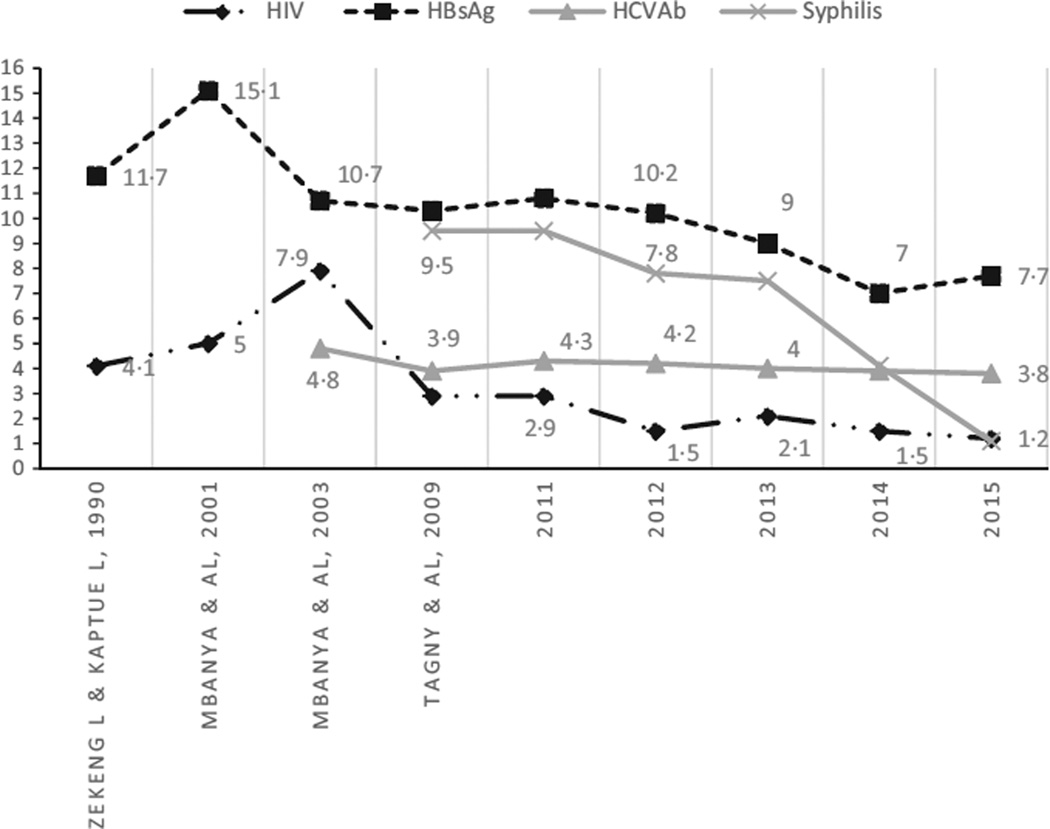
 : Seroprevalence of HIV;
  : Seroprevalence of AgHBs;
  : Seroprevalence of HCV Antibody;
  : Seroprevalence of syphilis Antibody.
References
-
- Zekeng L, Kaptue L. Sérologie HIV et portage de l’antigène HBs et Hbe chez les donneurs de sang au CHU de Yaoundé. Cameroun. Ann Soc Belg Med Trop. 1990;70:49–53. - PubMed
-
- Institut National de la Statistique. Enquête Démographique et de Santé du Cameroun. Yaoundé, Cameroun: Ministère de l’administration territoriale; 2004.
-
- Comité National de Lutte contre le Sida. Profil des Estimations et projections en matière de VIH/sida au Cameroun. Yaoundé Cameroun: Ministère de la Sante Publique; 2012.
-
- Mbanya DN, Tagny CT. Blood safety begins with safe donations: update among blood donors in Yaoundé, Cameroon. Transfus Med. 2005;5:395–399. - PubMed
Grants and funding
LinkOut - more resources
Full Text Sources
Other Literature Sources