Review
. 2017 May 5:8:42.
doi: 10.1186/s40104-017-0173-5. eCollection 2017.

Fetal and neonatal programming of postnatal growth and feed efficiency in swine

Affiliations
Review

Fetal and neonatal programming of postnatal growth and feed efficiency in swine

Yun Ji et al. J Anim Sci Biotechnol. .

Abstract

Maternal undernutrition or overnutrition during pregnancy alters organ structure, impairs prenatal and neonatal growth and development, and reduces feed efficiency for lean tissue gains in pigs. These adverse effects may be carried over to the next generation or beyond. This phenomenon of the transgenerational impacts is known as fetal programming, which is mediated by stable and heritable alterations of gene expression through covalent modifications of DNA and histones without changes in DNA sequences (namely, epigenetics). The mechanisms responsible for the epigenetic regulation of protein expression and functions include chromatin remodeling; DNA methylation (occurring at the 5´-position of cytosine residues within CpG dinucleotides); and histone modifications (acetylation, methylation, phosphorylation, and ubiquitination). Like maternal malnutrition, undernutrition during the neonatal period also reduces growth performance and feed efficiency (weight gain:feed intake; also known as weight-gain efficiency) in postweaning pigs by 5-10%, thereby increasing the days necessary to reach the market body-weight. Supplementing functional amino acids (e.g., arginine and glutamine) and vitamins (e.g., folate) play a key role in activating the mammalian target of rapamycin signaling and regulating the provision of methyl donors for DNA and protein methylation. Therefore, these nutrients are beneficial for the dietary treatment of metabolic disorders in offspring with intrauterine growth restriction or neonatal malnutrition. The mechanism-based strategies hold great promise for the improvement of the efficiency of pork production and the sustainability of the global swine industry.

Keywords: Epigenetics; Fetal programming; Gene expression; Neonatal programming; Nutrition.


Figures
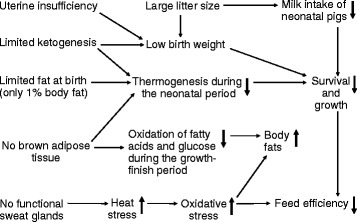
Fig. 1
Fig. 1
Unique biological characteristics of swine that differ from livestock ruminant species. Pigs possess no brown adipose tissue (BAT), limited ketogenesis, and a limited amount of fetal fats, which result in a low rate of thermogenesis during the neonatal period. Both uterine insufficiency and large litter size due to genetic selection contribute to intrauterine growth restriction. With a large number of piglets and no increase in the lactation performance of sows, milk consumption by them is inadequate for their maximum survival and growth. Failure to maintain body temperature or receive adequate nutritional support results in the high rates of morbidity and mortality in neonatal pigs. On the other hand, pigs are susceptible to heat stress due to their lack of functional sweat glands, and, therefore, exhibit the enhanced production of oxygen free radicals in response to high ambient temperatures. Their oxidative stress and lack of BAT promote fat deposition in the body. Both oxidative stress and mortality decrease feed efficiency in pigs. The signs “↓” and “↑” denote decrease and increase, respectively
Fig. 2
Fig. 2
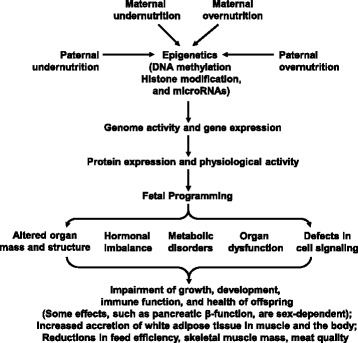
Genetic and environmental factors affecting fetal growth and development in swine. Either undernutrition or overnutrition of both the mother and father will affect the expression of the fetal genome, which may have lifelong consequences on the offspring. Thus, fetal malnutrition results in developmental adaptations that permanently change the structure, physiology and metabolism of the offspring. This predisposes the affected individuals to reductions in growth performance, skeletal-muscle mass, feed efficiency, as well as metabolic, endocrine, and cardiovascular disorders
Fig. 3
Fig. 3
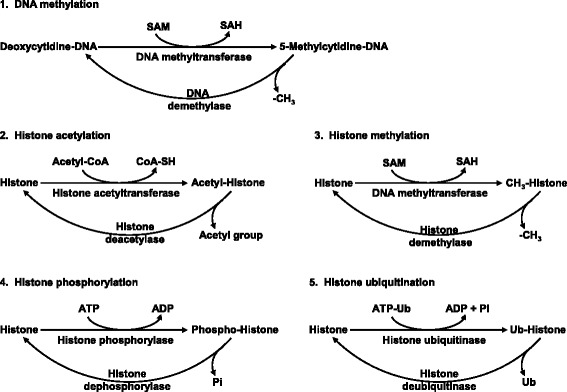
Biochemical reactions involving DNA methylation and histone modifications. These reactions are localized in specific compartments of the cell and are responsible for the epigenetic regulation of protein expression and function. Abbreviations: SAH, S-adenosylhomocysteine; SAM, S-adenosylmethionine; Ub, ubiquitin. Taken from Wang et al. [85]

References

    1. Wu G, Bazer FW, Dai ZL, Li DF, Wang JJ, Wu ZL. Amino acid nutrition in animals: protein synthesis and beyond. Annu Rev Anim Biosci. 2014;2:387–417. doi: 10.1146/annurev-animal-022513-114113. - DOI - PubMed
    1. Foxcroft GR, Dixon WT, Novak S, Putman CT, Town SC, Vinsky MDA. The biological basis for prenatal programming of postnatal performance in pigs. J Anim Sci. 2006;84(E. Suppl):E105–12. doi: 10.2527/2006.8413_supplE105x. - DOI - PubMed
    1. Freking BA, Lents CA, Vallet JL. Selection for uterine capacity improves lifetime productivity of sows. Anim Reprod Sci. 2016;167:16–21. doi: 10.1016/j.anireprosci.2016.01.018. - DOI - PubMed
    1. Bazer FW, Spencer TE, Johnson GA, Burghardt RC, Wu G. Comparative aspects of implantation. Reproduction. 2009;138:195–209. doi: 10.1530/REP-09-0158. - DOI - PubMed
    1. Wu G, Bazer FW, Burghardt RC, Johnson GA, Kim SW, Li XL, et al. Impacts of amino acid nutrition on pregnancy outcome in pigs: mechanisms and implications for swine production. J Anim Sci. 2010;88:E195–E204. doi: 10.2527/jas.2009-2446. - DOI - PubMed

LinkOut - more resources