


The evidence on tiotropium bromide in asthma: from the rationale to the bedside
- PMID: 28484598
- PMCID: PMC5420159
- DOI: 10.1186/s40248-017-0094-3
The evidence on tiotropium bromide in asthma: from the rationale to the bedside
Erratum in
-
Erratum to: The evidence on tiotropium bromide in asthma: from the rationale to the bedside.Multidiscip Respir Med. 2017 Jun 1;12:17. doi: 10.1186/s40248-017-0099-y. eCollection 2017. Multidiscip Respir Med. 2017. PMID: 28593046 Free PMC article.
Abstract
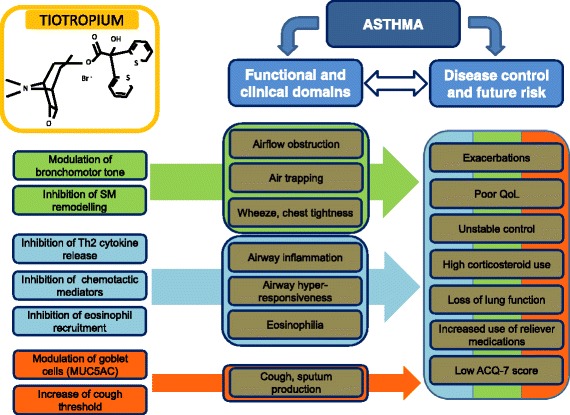
Severe and poorly controlled asthma still accounts for a great portion of the patients affected. Disease control and future risk management have been identified by international guidelines as the main goals in patients with asthma. The need for new treatment approaches has led to reconsider anticholinergic drugs as an option for asthma treatment. Tiotropium is the first anticholinergic drug that has been approved for children and adults with poorly controlled asthma and is currently considered as an option for steps 4 and 5 of the Global Initiative for Asthma. In large randomized clinical trials enrolling patients with moderate to severe asthma, add-on therapy with tiotropium has demonstrated to be efficacious in improving lung function, decreasing risk of exacerbation and slowing the worsening of disease; accordingly, tiotropium demonstrated to be non inferior compared to long acting beta-agonists in the maintenance treatment along with medium to high inhaled corticosteroids. In view of the numerous ancillary effects acting on inflammation, airway remodeling, mucus production and cough reflex, along with the good safety profile and the broad spectrum of efficacy demonstrated in different disease phenotypes, tiotropium can represent a beneficial alternative in the therapeutic management of poorly controlled asthma. The present extensive narrative review presents the pharmacological and pathophysiological basis that guided the rationale for the introduction of tiotropium in asthma treatment algorithm, with a particular focus on its conventional and unconventional effects; finally, data on tiotropium efficacy and safety. from recent randomized clinical trials performed in all age categories will be extensively discussed.
Keywords: Airway remodeling; Anticholinergic; Asthma; Exacerbation; Forced expiratory flow; Inflammation; Muscarinic receptor; Poor control; Tiotropium.
Figures
References
-
- World Health Organization (WHO). Facts on asthma. Fact sheet n° 307. http://www.who.int/features/factfiles/asthma/asthma_facts/en/ 2013. Accessed 23 Apr 2017.
-
- Global strategy for asthma management and prevention in: Global Initiative for Asthma (GINA). 2017. Available from: http://ginasthma.org/2017-gina-report-global-strategy-for-asthma-managem.... Accessed 20 Jan 2017.
-
- National Asthma Education and Prevention Program. Third Expert Panel on the Diagnosis and Management of Asthma (EPR-3). U.S. Department of Health and Human services, National Heart, Lung and Blood Institute. 2007. https://www.nhlbi.nih.gov/files/docs/guidelines/asthsumm.pdf. Accessed 15 Feb 2017.
Publication types
LinkOut - more resources
Full Text Sources
Other Literature Sources
