Review
. 2017 May 9;18(5):1018.
doi: 10.3390/ijms18051018.

Drug-Induced Liver Injury: Cascade of Events Leading to Cell Death, Apoptosis or Necrosis

Affiliations
Review

Drug-Induced Liver Injury: Cascade of Events Leading to Cell Death, Apoptosis or Necrosis

Andrea Iorga et al. Int J Mol Sci. .

Abstract

Drug-induced liver injury (DILI) can broadly be divided into predictable and dose dependent such as acetaminophen (APAP) and unpredictable or idiosyncratic DILI (IDILI). Liver injury from drug hepatotoxicity (whether idiosyncratic or predictable) results in hepatocyte cell death and inflammation. The cascade of events leading to DILI and the cell death subroutine (apoptosis or necrosis) of the cell depend largely on the culprit drug. Direct toxins to hepatocytes likely induce oxidative organelle stress (such as endoplasmic reticulum (ER) and mitochondrial stress) leading to necrosis or apoptosis, while cell death in idiosyncratic DILI (IDILI) is usually the result of engagement of the innate and adaptive immune system (likely apoptotic), involving death receptors (DR). Here, we review the hepatocyte cell death pathways both in direct hepatotoxicity such as in APAP DILI as well as in IDILI. We examine the known signaling pathways in APAP toxicity, a model of necrotic liver cell death. We also explore what is known about the genetic basis of IDILI and the molecular pathways leading to immune activation and how these events can trigger hepatotoxicity and cell death.

Keywords: DILI; acetaminophen; adaptation; apoptosis; hepatotoxicity; human leukocyte antigen (HLA); necrosis.


Conflict of interest statement

The authors declare no conflict of interest.

Figures
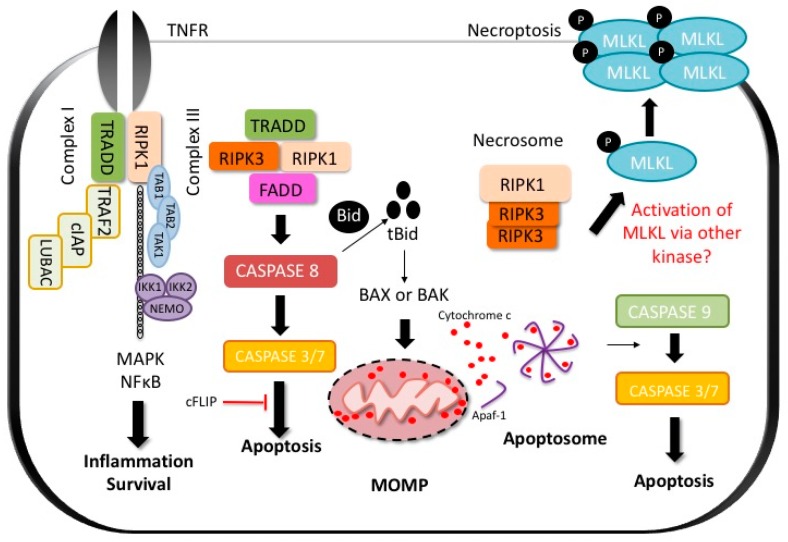
Figure 1
Figure 1
Tumor necrosis factor (TNF) receptor-mediated cell death. TNF binding to TNF receptor (TNFR) results in the formation of complex I which includes TNFR-associated death domain (TRADD), receptor interacting protein kinase-1 (RIPK1), TNFR-associated factor 2 (TRAF2), cellular inhibitor of apoptosis 1 (cIAP1), cellular inhibitor of apoptosis 2 (cIAP2) and linear ubiquitin chain assembly complex (LUBAC). RIPK1 is ubiquitinated resulting in the formation of a platform and recruitment of the IκB kinase (IKK) complex (NFκB Essential Modulator (NEMO), IKK1 and IKK2) and TAB (TAK1-binding protein)/TAK-1 (transforming growth factor-β-activated kinase 1) complexes. This results in the activation of NFκB and mitogen-activated protein kinase (MAPK). For apoptosis to occur, the cytoplasmic Complex II is formed which can have two forms. Complex IIa is made up of TRADD, FADD (fas-associated protein with death domain) and caspase-8 and complex IIb consists of RIPK1/RIPK3, FADD, caspase 8 and FLICE-like inhibitory protein long form (FLIPL). Complex II leads to caspase-8-mediated activation of caspase 3/7 and apoptosis in type I cells such as lymphocytes. In type II cells such as hepatocytes, caspase 8 mediates cleavage of Bid to cleaved Bid (tBid) resulting in Bax- (Bcl-2-like protein 4) and BAK-mediated (Bcl-2 homologous antagonist/killer) mitochondrial outer membrane permeabilization (MOMP) and Cytochrome C release from mitochondria. Cytochrome C binds to apoptotic peptidase activating factor-1 (APAF-1) releasing its auto-inhibitory hold. APAF-1 oligomerizes to form a wheel-like structure called the apoptosome which activates caspase 9. Caspase 9 in turn activates the effector caspases (caspase 3/7) to induce apoptosis. In certain cells, when caspase-8 is inhibited, the cell switches to an alternative form of cell death termed necroptosis. For necroptosis to occur, RIPK1, RIPK3 and mixed lineage domain like (MLKL) form the necrosome. RIPK3 phospho-activates MLKL, leading to its oligomerization and translocation to the cell membrane to induce pore opening and oncolysis. cFLIP: cellular FLICE-like inhibitory protein.
Figure 2
Figure 2
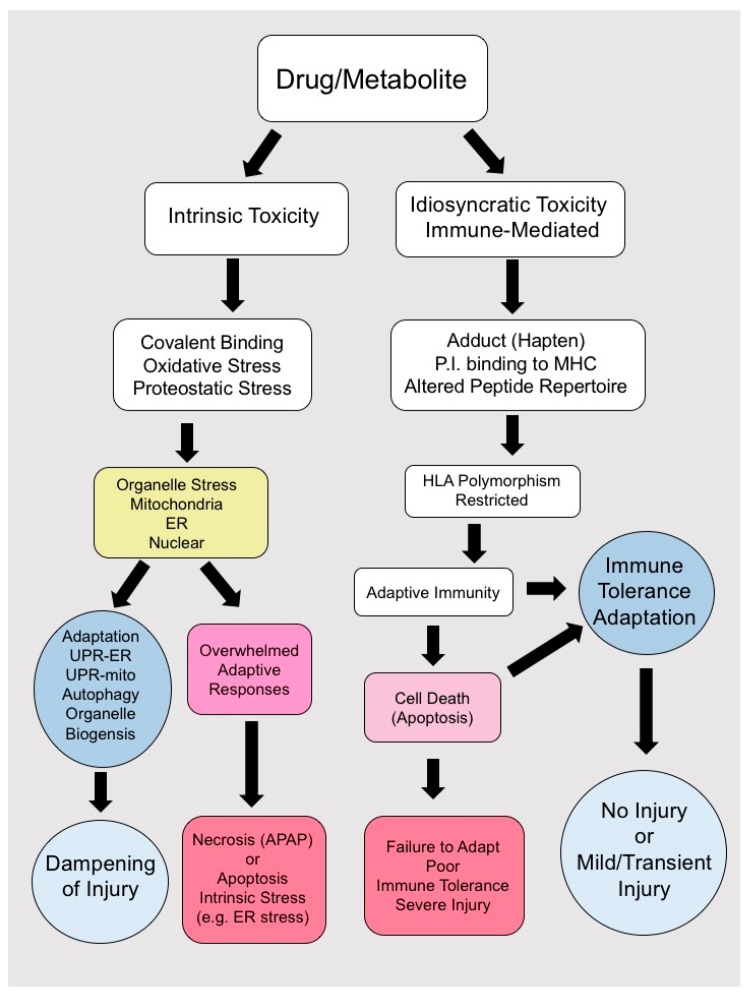
Drugs or toxic metabolites can cause intrinsic predictable toxicity by binding to intracellular proteins, generating reactive oxygen species (ROS) and inducing organelle stress. If the stress is minor, organelle adaptive responses (such as the unfolded protein responses in the ER or mitochondria) will compensate and adapt and the injury will be dampened. If these responses are overwhelmed, cell death follows. Most drugs cause an idiosyncratic and immune-mediated injury which is HLA-associated and only occurs in individuals with the susceptible HLA polymorphism. Due to the process of adaptation and the liver’s inherent capacity for immune tolerance, most individuals exposed to a toxic drug even in the presence of a susceptible HLA polymorphism will experience mild and transient injury or no injury at all. In a minority of individuals, failure of adaptation results in persistent and severe injury.

References

    1. Motamedi N.D.L., Kaplowitz N. Clinical considerations of drug-induced hepatotoxicity. In: McQueen C., editor. Comprehensive Toxicology. 3rd ed. Elsevier; Amsterdam, The Netherlands: 2017.
    1. Kaplowitz N. Idiosyncratic drug hepatotoxicity. Nat. Rev. Drug Discov. 2005;4:489–499. doi: 10.1038/nrd1750. - DOI - PubMed
    1. Yuan L., Kaplowitz N. Mechanisms of drug-induced liver injury. Clin. Liver Dis. 2013;17:507–518. doi: 10.1016/j.cld.2013.07.002. - DOI - PMC - PubMed
    1. Dara L., Han D., Kaplowitz N. Mechanisms of Cell Death and Relevance to Drug Toxicity. 3rd ed. Academic Press (an imprint of Elsevier); Cambridge, MA, USA: 2012.
    1. Larson A.M., Polson J., Fontana R.J., Davern T.J., Lalani E., Hynan L.S., Reisch J.S., Schiodt F.V., Ostapowicz G., Shakil A.O., et al. Acetaminophen-induced acute liver failure: Results of a united states multicenter, prospective study. Hepatology. 2005;42:1364–1372. doi: 10.1002/hep.20948. - DOI - PubMed