


doi: 10.1371/journal.pone.0177245.
eCollection 2017.
Small molecule p300/catenin antagonist enhances hematopoietic recovery after radiation
Affiliations
- PMID: 28486541
- PMCID: PMC5423697
- DOI: 10.1371/journal.pone.0177245
Item in Clipboard
Small molecule p300/catenin antagonist enhances hematopoietic recovery after radiation
PLoS One.
.
Abstract
There is currently no FDA approved therapeutic agent for ARS mitigation post radiation exposure. Here we report that the small molecule YH250, which specifically antagonizes p300/catenin interaction, stimulates hematopoiesis in lethally or sublethally irradiated mice. A single administration of YH250 24 hours post irradiation can significantly stimulate HSC proliferation, improve survival and accelerate peripheral blood count recovery. Our studies suggest that promotion of the expansion of the remaining HSC population via stimulation of symmetric non-differentiative proliferation is at least part of the mechanism of action.
Conflict of interest statement
Figures
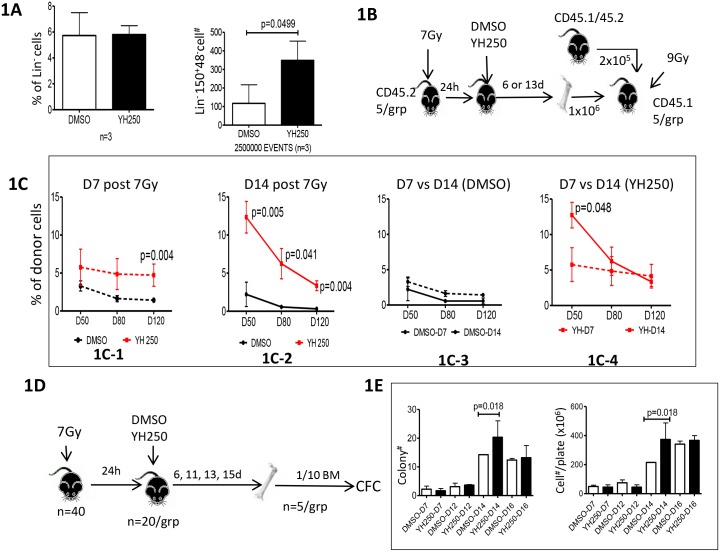
(A) Bone marrow cells from either YH250 or DMSO treated 7Gy irradiated animals were recovered and FACS analyzed, there are more Lin-CD48-CD150+ cells in YH250 treated animals. (B) At different time post radiation, bone marrow cells were recovered for competitive repopulation or (D) CFC assays. (C) Bone marrow cells recovered at day 14 post radiation from YH250 treated animals give significantly better long-term engraftment in competitive repopulation and (E) more colonies in CFC assay.
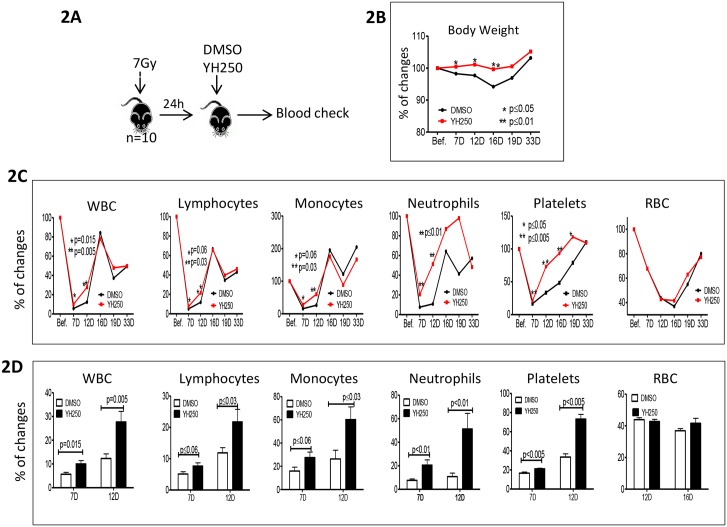
(A) The experimental procedure to test YH250 effect to peripheral blood recovery in 7Gy irradiated animals is depicted. (B) The body weight change of the animals is shown. (C) Peripheral blood counts were monitored. (D) The blood counts at nadir points are presented. *: p<0.05; **: p<0.01. n = 10.
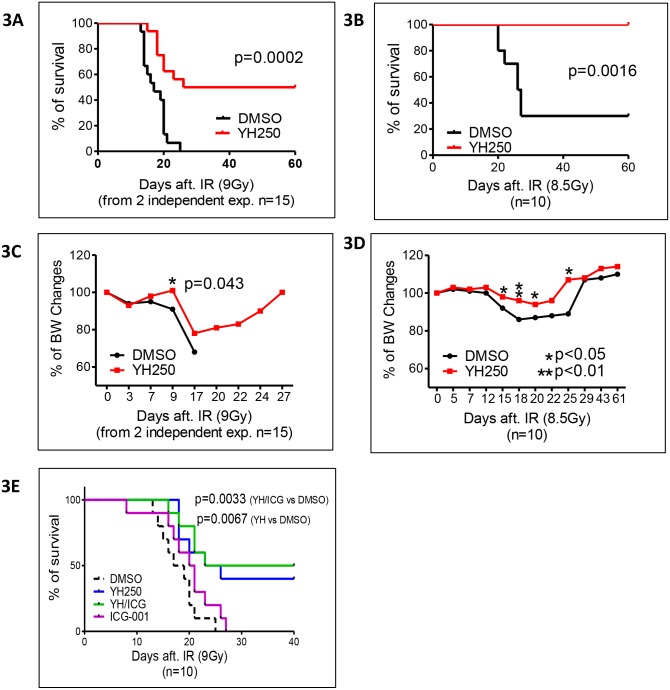
(A and B) After lethal dose radiation (either 9Gy or 8.5Gy), animal survival and body weight (C, D) were monitored. (E) The combination effect of YH250 with ICG-001 to lethally irradiated animals. *: p<0.05; **: p<0.01.
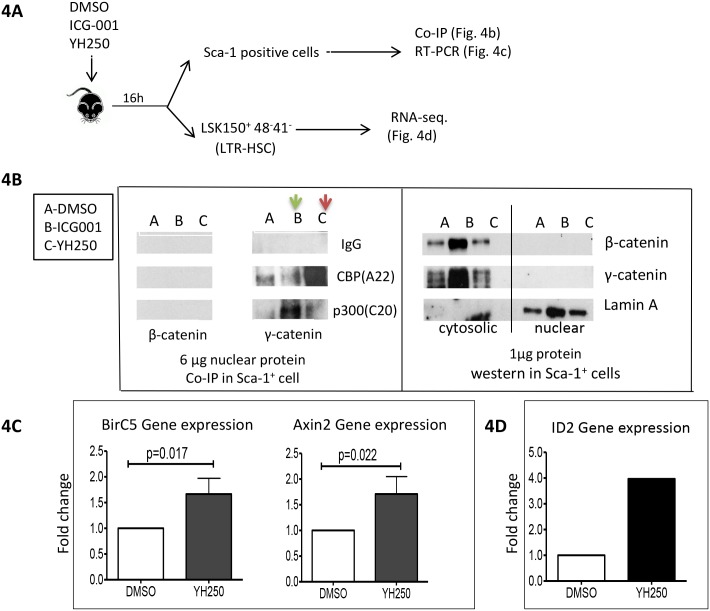
(A) The procedures to isolate Sca-1+ cells (for assays in 4B and 4C) or LSK150+41-48- cells (for assay in fig 4D) are depicted. (B) Left panel: CO-IP analysis to detect the interaction of catenin with CBP or p300 were depicted: the green arrow shows the sample from ICG-001 treated animals, the red arrow shows the sample from YH250 treated animals. Right panel: western blot analysis of β- and γ-catenin in Sca-1+ cells. (C) qPCR analysis results were summary of 3 independent experiments. (D) Id2 gene up-regulation from YH250 treated animal LSK150+ 41-48- cells from RNA—seq analysis.
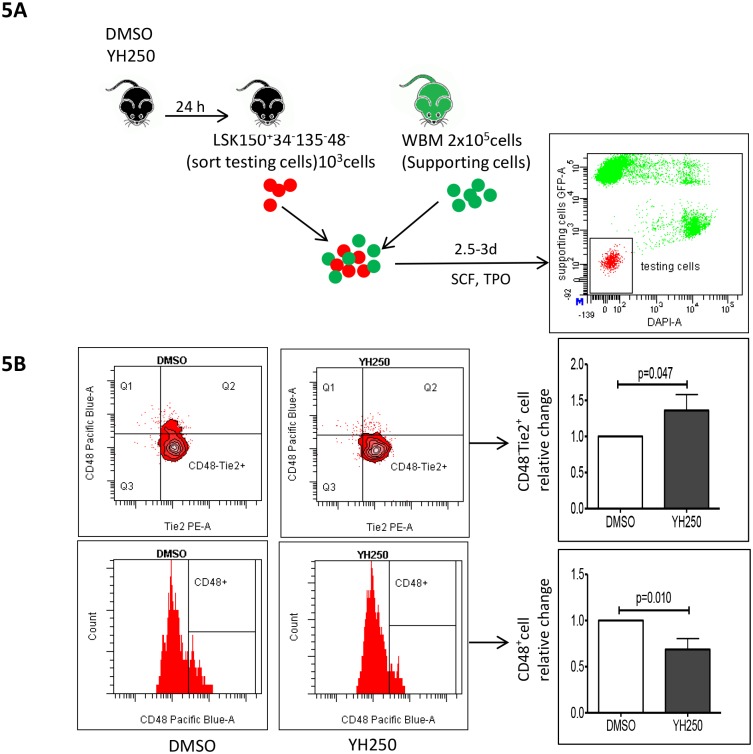
(A) LSK34-135-150+ 48- cell preparation is depicted. (B) Cell surface marker changes from DMSO or YH250 treated animals in in vitro culture. Results are summary of 3 independent experiments.
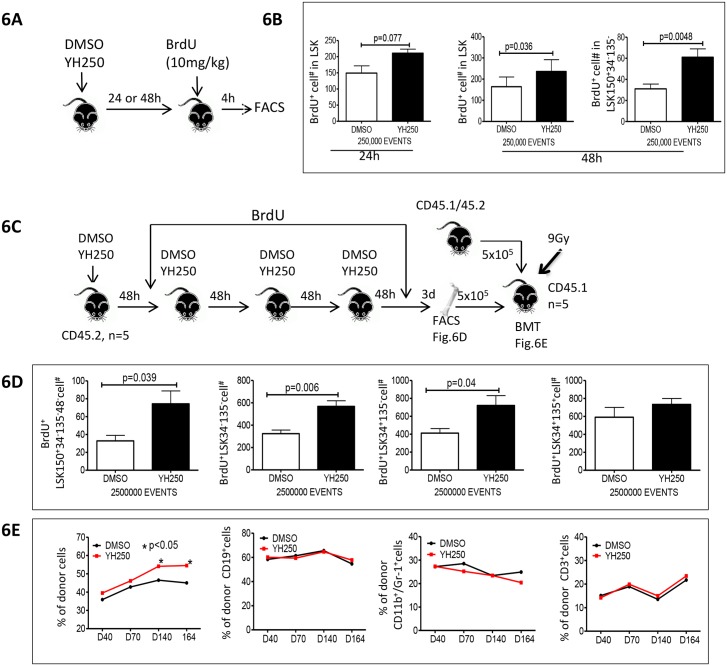
(A) BrdU incorporation studies were performed as depicted with 3 mice in each group and two independent experiments. (B) BrdU+ cells in BM subsets. (C) Experimental procedure to study repeated YH250 administration effects on HSPC in steady status was depicted. (D) At the end of last YH250 or DMSO administration, bone marrow cells FACS analysis and (E) competitive repopulation assay.
References
MeSH terms
Substances
Grants and funding
LinkOut - more resources
Full Text Sources
Other Literature Sources
Miscellaneous
