


Online mindfulness as a promising method to improve exercise capacity in heart disease: 12-month follow-up of a randomized controlled trial
- PMID: 28486559
- PMCID: PMC5423609
- DOI: 10.1371/journal.pone.0175923
Online mindfulness as a promising method to improve exercise capacity in heart disease: 12-month follow-up of a randomized controlled trial
Abstract
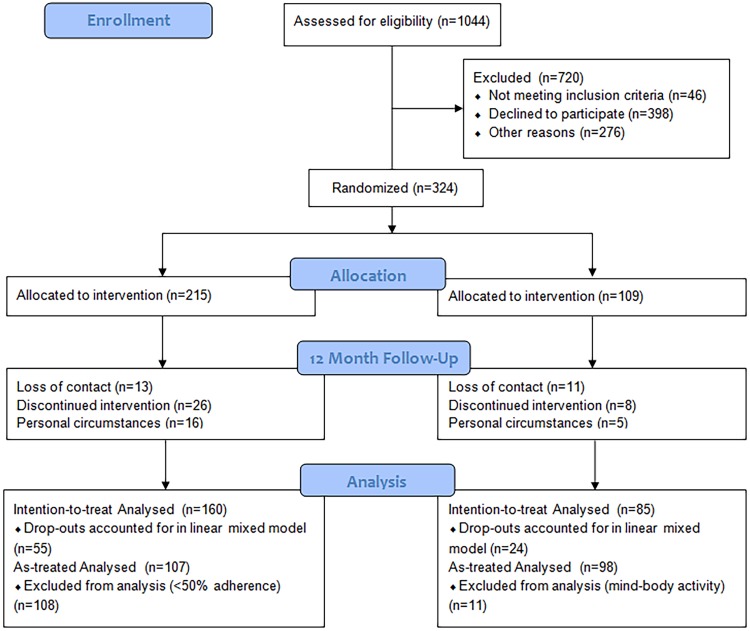
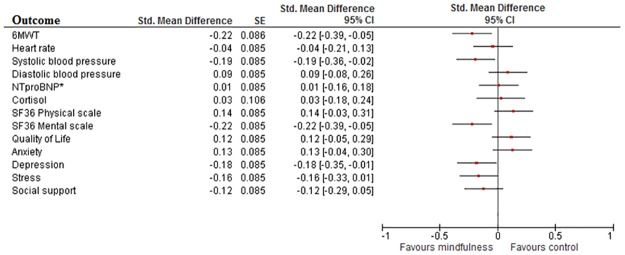
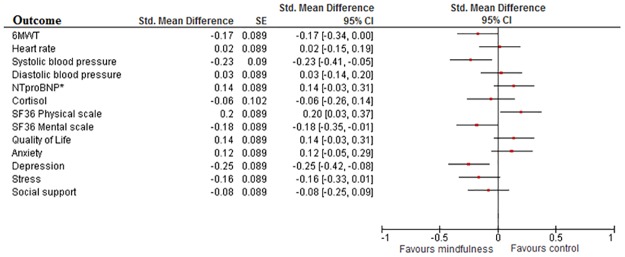
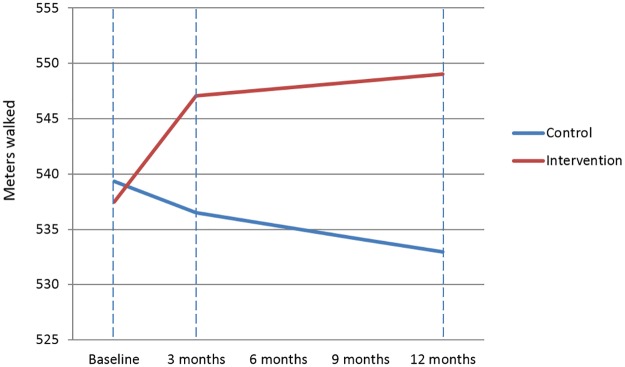
There is increasing evidence that mindfulness can reduce stress, and thereby affect other psychological and physiological outcomes as well. Earlier, we reported the direct 3-month results of an online modified mindfulness-based stress reduction training in patients with heart disease, and now we evaluate the effect at 12-month follow-up. 324 patients (mean age 43.2 years, 53.7% male) were randomized in a 2:1 ratio to additional 3-month online mindfulness training or to usual care alone. The primary outcome was exercise capacity measured with the 6 minute walk test (6MWT). Secondary outcomes were blood pressure, heart rate, respiratory rate, NT-proBNP, cortisol levels (scalp hair sample), mental and physical functioning (SF-36), anxiety and depression (HADS), perceived stress (PSS), and social support (PSSS12). Differences between groups on the repeated outcome measures were analyzed with linear mixed models. At 12-months follow-up, participants showed a trend significant improvement exercise capacity (6MWT: 17.9 meters, p = 0.055) compared to UC. Cohen's D showed significant but small improvement on exercise capacity (d = 0.22; 95%CI 0.05 to 0.39), systolic blood pressure (d = 0.19; 95%CI 0.03 to 0.36), mental functioning (d = 0.22; 95%CI 0.05 to 0.38) and depressive symptomatology (d = 0.18; 95%CI 0.02 to 0.35). All other outcome measures did not change statistically significantly. In the as-treated analysis, systolic blood pressure decreased significantly with 5.5 mmHg (p = 0.045; d = 0.23 (95%CI 0.05-0.41)). Online mindfulness training shows favorable albeit small long-term effects on exercise capacity, systolic blood pressure, mental functioning, and depressive symptomatology in patients with heart disease and might therefore be a beneficial addition to current clinical care.
Trial registration: www.trialregister.nl NTR3453.
Conflict of interest statement
Figures
References
-
- Kabat-Zinn J. An outpatient program in behavioral medicine for chronic pain patients based on the practice of mindfulness meditation: theoretical considerations and preliminary results. Gen Hosp Psychiatry 1982;4(1):33–47. - PubMed
-
- Kabat-Zinn J, Hanh TN. Full catastrophe living: Using the wisdom of your body and mind to face stress, pain, and illness: Delta; 2009.
-
- Bishop SR, Lau M, Shapiro S, Carlson L, Anderson ND, Carmody J, et al. Mindfulness: A proposed operational definition. Clin Psychol-Sci Pr 2004;11(3):230–241.
Publication types
MeSH terms
Substances
LinkOut - more resources
Full Text Sources
Other Literature Sources
Medical
Research Materials
