


Risk of diabetes according to male factor infertility: a register-based cohort study
- PMID: 28486688
- PMCID: PMC5850522
- DOI: 10.1093/humrep/dex097
Risk of diabetes according to male factor infertility: a register-based cohort study
Abstract
Study question: Is male factor infertility associated with an increased risk of developing diabetes?
Summary answer: The study provides evidence that male factor infertility may predict later occurrence of diabetes mellitus with the risk being related to the severity of the underlying fertility problem.
What is known already: Previous cross-sectional studies have shown an increased prevalence of comorbidities among infertile men when compared to controls.
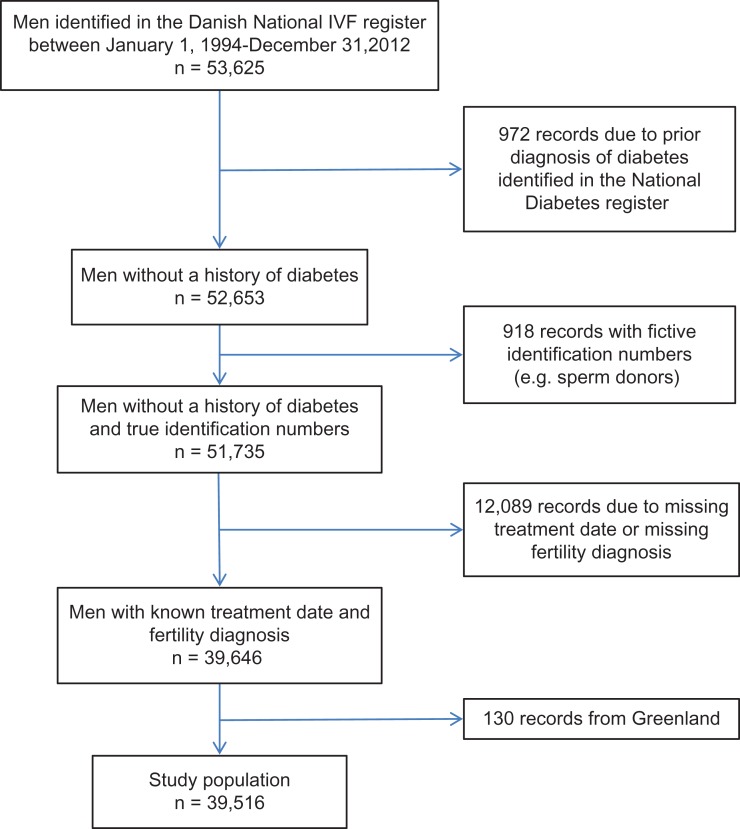
Study design, size, duration: In this prospective cohort study, 39 516 men who had since 1994 undergone fertility treatment with their female partner were identified from the Danish national IVF register, which includes data on assumed cause of couple infertility (male/female factor, mixed and unexplained infertility) and type of fertility treatment. With a median follow-up time of 5.6 years, each man was followed for diabetes occurrence from enrollment until 31 December 2012 using the National Diabetes Register (NDR). Men with a history of diabetes prior to their fertility diagnosis were excluded. Hazard ratios (HR) were estimated by Cox proportional hazard models with age as the underlying time scale. In addition to analyzing the data for the entire IVF registration period (1994-2012), separate analyses were performed for men identified from the first (1994-2005) and second (2006-2012) IVF registration period owing to heterogeneity in the reporting of male factor infertility in these two time periods, because the reason for male factor infertility was not available from the first register.
Participants/materials, setting, methods: Male factor infertility was identified from the variable 'yes' or 'no' from the first IVF register and through a diagnosis code (e.g. oligospermia, azoospermia) from the second IVF register. The reference group was men with male factor infertility (='no') and those with normal semen quality or sterilized men. Of the included men, 18 499 (46.8%) had male factor infertility and 21 017 (53.2%) made up the reference group.
Main results and the role of chance: A total of 651 (1.6%) diabetes cases were identified during the follow-up period. The adjusted HR's for diabetes risk among men with male factor infertility when compared to the reference group were HR = 1.08 (95% CI: 0.89, 1.31) and HR = 1.45 (95% CI: 1.06, 1.97) for the first and second IVF registration period, respectively. When assessing the effects of individual causes of male factor infertility, the adjusted HR's for men with oligospermia, azoospermia and aspermia were HR = 1.44 (95% CI: 1.01, 2.06), HR = 2.10 (95% 1.25, 3.56) and HR = 3.20 (95% CI 1.00, 10.31), respectively.
Limitations, reasons for caution: We found no increased risk among men identified from the first IVF register, which may be related to exposure misclassification as the reason for male factor infertility was not available from this time period. The NDR does not distinguish between type 1 and type 2 diabetes.
Wider implications of the findings: These findings support previous studies that a man's reproductive and somatic health are closely intertwined and highlight the importance for further monitoring of these men. Further, implementation of diabetes screening may be especially relevant among aspermic and azoospermic men.
Study funding/competing interests: This article is part of the ReproUnion collaborative study, co-financed by the European Union, Intereg V Öresund-Kattegat-Skagerrak. None of the authors declare any conflict of interest.
Trial registration number: None.
Keywords: azoospermia; comorbidity; diabetes; male infertility; oligospermia; register-based cohort study.
© The Author 2017. Published by Oxford University Press on behalf of the European Society of Human Reproduction and Embryology.
Figures
Comment in
-
Re: Risk of Diabetes According to Male Factor Infertility: A Register-Based Cohort Study.J Urol. 2018 Feb;199(2):330. doi: 10.1016/j.juro.2017.11.029. Epub 2017 Nov 9. J Urol. 2018. PMID: 29357541 No abstract available.
References
Publication types
MeSH terms
LinkOut - more resources
Full Text Sources
Other Literature Sources
Medical
Research Materials
