


Survival after initial lung metastasectomy for metastatic colorectal cancer in the modern chemotherapeutic era
- PMID: 28486937
- PMCID: PMC5424358
- DOI: 10.1186/s12893-017-0252-8
Survival after initial lung metastasectomy for metastatic colorectal cancer in the modern chemotherapeutic era
Abstract
Background: A clear survival benefit has been reported for lung metastasectomy for colorectal cancer, and several clinicopathological prognostic factors have been proposed in the past. However, clinical advances, such as chemotherapy and radiographic imaging, should have improved patient outcome and may have altered prognosticators. This study aimed to assess patient survival and determine prognostic factors for survival and recurrence in patients who underwent initial lung metastasectomy for colorectal cancer in the modern clinical era.
Methods: Clinicopathological data and outcomes of 59 patients who underwent curative initial lung metastasectomy for colorectal cancer from 2004 to 2012 at a single institution in Japan were retrospectively investigated. Survival was estimated using the Kaplan - Meier method, and Cox proportional hazards regression models were used to estimate the prognostic impacts of each variable in univariate and multivariate analysis.
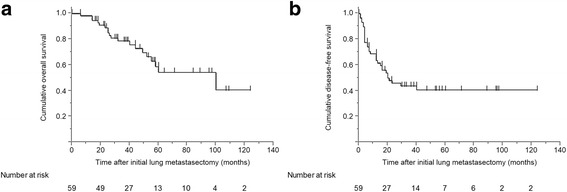
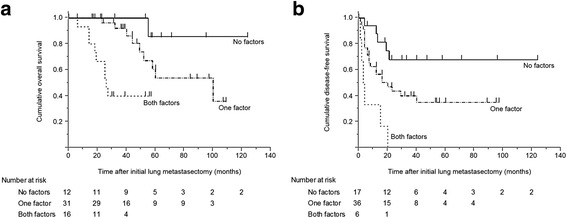
Results: The 5-years overall and disease-free survival rates were 54.3 and 40.6%, respectively. A disease-free interval < 24 months after colorectal cancer resection (P = 0.004) and a serum carcinoembryonic antigen ≥ 5.0 ng/mL before initial lung metastasectomy (P = 0.015) were independent predictors for poor overall survival. Moreover, the disease-free interval after colorectal cancer resection < 24 months (P = 0.010) and a colorectal cancer with N2 stage disease (P = 0.018) were independently associated with poor disease-free survival. On the other hand, the number of lung metastasis was not identified as a poor prognostic factor for both overall and disease-free survival.
Conclusions: Our findings demonstrated similar or slightly better overall survival, and substantially favorable disease-free survival as compared with past reports. Poor prognostic factors for overall survival appeared not to differ from those of past studies, although this modern series did not determine the number of lung metastasis as a poor prognostic factor, which should be investigated in future studies. Moreover, initial lung metastasectomy is not expected to be a curable treatment for patients with both a short disease-free survival after colorectal cancer resection and colorectal cancers with N2 stage disease.
Keywords: Colorectal cancer; Lung metastasectomy; Prognostic factor; Recurrence; Survival.
Figures
References
-
- McCormack PM, Ginsberg RJ. Current management of colorectal metastases to lung. Chest Surg Clin N Am. 1998;8:119–126. - PubMed
MeSH terms
LinkOut - more resources
Full Text Sources
Other Literature Sources
Medical
Miscellaneous
