


The antifungal Aureobasidin A and an analogue are active against the protozoan parasite Toxoplasma gondii but do not inhibit sphingolipid biosynthesis
- PMID: 28486997
- PMCID: PMC5964465
- DOI: 10.1017/S0031182017000506
The antifungal Aureobasidin A and an analogue are active against the protozoan parasite Toxoplasma gondii but do not inhibit sphingolipid biosynthesis
Erratum in
-
The antifungal Aureobasidin A and an analogue are active against the protozoan parasite Toxoplasma gondii but do not inhibit sphingolipid biosynthesis - Corrigendum.Parasitology. 2018 Feb;145(2):156. doi: 10.1017/S0031182017000877. Epub 2017 Jun 9. Parasitology. 2018. PMID: 28595661 Free PMC article. No abstract available.
Abstract
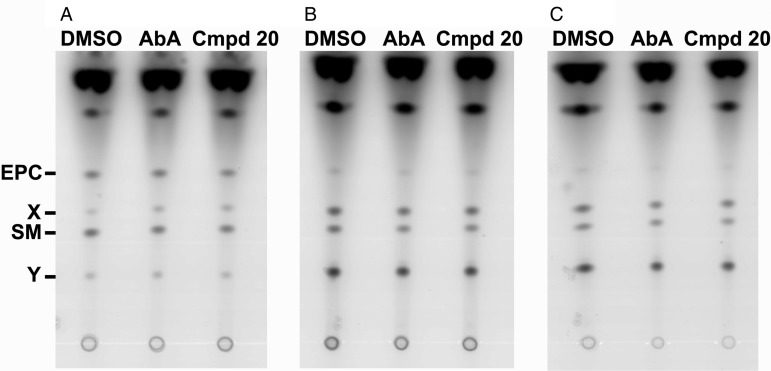
Toxoplasma gondii is an obligate intracellular protozoan parasite of the phylum Apicomplexa, and toxoplasmosis is an important disease of both humans and economically important animals. With a limited array of drugs available there is a need to identify new therapeutic compounds. Aureobasidin A (AbA) is an antifungal that targets the essential inositol phosphorylceramide (IPC, sphingolipid) synthase in pathogenic fungi. This natural cyclic depsipeptide also inhibits Toxoplasma proliforation, with the protozoan IPC synthase orthologue proposed as the target. The data presented here show that neither AbA nor an analogue (Compound 20), target the protozoan IPC synthase orthologue or total parasite sphingolipid synthesis. However, further analyses confirm that AbA exhibits significant activity against the proliferative tachyzoite form of Toxoplasma, and Compound 20, whilst effective, has reduced efficacy. This difference was more evident on analyses of the direct effect of these compounds against isolated Toxoplasma, indicating that AbA is rapidly microbicidal. Importantly, the possibility of targeting the encysted, bradyzoite, form of the parasite with AbA and Compound 20 was demonstrated, indicating that this class of compounds may provide the basis for the first effective treatment for chronic toxoplasmosis.
Keywords: Toxoplasma; Aureobasidin A; bradyzoite; sphingolipid biosynthesis.
Figures



References
-
- Antczak M., Dzitko K. and Dlugonska H. (2016). Human toxoplasmosis-Searching for novel chemotherapeutics. Biomedicine and Pharmacotherapy 82, 677–684. - PubMed
-
- Azzouz N., Rauscher B., Gerold P., Cesbron-Delauw M. F., Dubremetz J. F. and Schwarz R. T. (2002). Evidence for de novo sphingolipid biosynthesis in Toxoplasma gondii. International Journal for Parasitology 32, 677–684. - PubMed
-
- Cerantola V., Guillas I., Roubaty C., Vionnet C., Uldry D., Knudsen J. and Conzelmann A. (2009). Aureobasidin A arrests growth of yeast cells through both ceramide intoxication and deprivation of essential inositolphosphorylceramides. Molecular Microbiology 71, 1523–1537. - PubMed
-
- Chowdhury M. N. (1986). Toxoplasmosis: a review. Journal of Medicine 17, 373–396. - PubMed
Publication types
MeSH terms
Substances
LinkOut - more resources
Full Text Sources
Other Literature Sources
Molecular Biology Databases
