A Systematic Review of the Prevalence and Associations of Limited Health Literacy in CKD
- PMID: 28487346
- PMCID: PMC5498363
- DOI: 10.2215/CJN.12921216
A Systematic Review of the Prevalence and Associations of Limited Health Literacy in CKD
Abstract
Background and objectives: The self-management and decision-making skills required to manage CKD successfully may be diminished in those with low health literacy. A 2012 review identified five papers reporting the prevalence of limited health literacy in CKD, largely from United States dialysis populations. The literature has expanded considerably since.
Design, setting, participants, & measurements: We used systematic review, pooled prevalence analysis, metaregression, and exploration of heterogeneity in studies of patients with CKD (all stages).
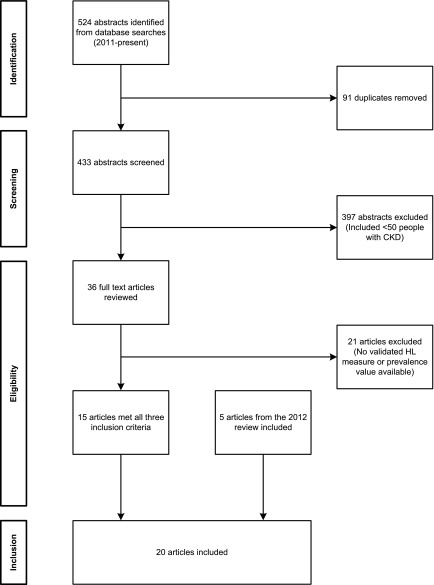
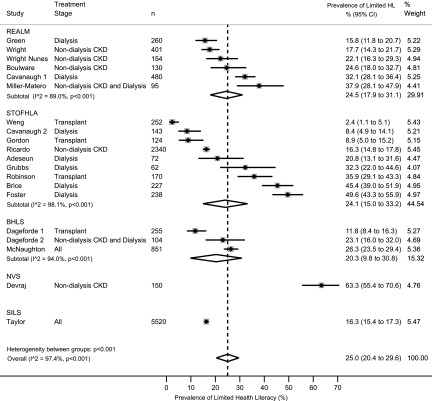
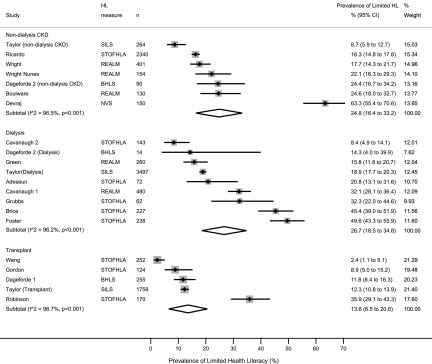
Results: From 433 studies, 15 new studies met the inclusion criteria and were analyzed together with five studies from the 2012 review. These included 13 cross-sectional surveys, five cohort studies (using baseline data), and two using baseline clinical trial data. Most (19 of 20) were from the United States. In total, 12,324 patients were studied (3529 nondialysis CKD, 5289 dialysis, 2560 transplant, and 946 with unspecified CKD; median =198.5; IQR, 128.5-260 per study). Median prevalence of limited health literacy within studies was 23% (IQR, 16%-33%), and pooled prevalence was 25% (95% confidence interval, 20% to 30%) with significant between-study heterogeneity (I2=97%). Pooled prevalence of limited health literacy was 25% (95% confidence interval, 16% to 33%; I2=97%) among patients with CKD not on dialysis, 27% (95% confidence interval, 19% to 35%; I2=96%) among patients on dialysis, and 14% (95% confidence interval, 7% to 21%; I2=97%) among patients with transplants. A higher proportion of nonwhite participants was associated with increased limited health literacy prevalence (P=0.04), but participant age was not (P=0.40). Within studies, nonwhite ethnicity and low socioeconomic status were consistently and independently associated with limited health literacy. Studies were of low or moderate quality. Within-study participant selection criteria had potential to introduce bias.
Conclusions: Limited health literacy is common in CKD, especially among individuals with low socioeconomic status and nonwhite ethnicity. This has implications for the design of self-management and decision-making initiatives to promote equity of care and improve quality. Lower prevalence among patients with transplants may reflect selection of patients with higher health literacy for transplantation either because of less comorbidity in this group or as a direct effect of health literacy on access to transplantation.
Keywords: Cohort Studies; Cross-Sectional Studies; Disease Management; Ethnic Groups; Health Literacy; Humans; Patient Selection; Prevalence; Renal Insufficiency, Chronic; Self Care; Social Class; Surveys and Questionnaires; chronic kidney disease; ethnicity; renal dialysis; transplantation.
Copyright © 2017 by the American Society of Nephrology.
Figures
References
-
- Couser WG, Remuzzi G, Mendis S, Tonelli M: The contribution of chronic kidney disease to the global burden of major noncommunicable diseases. Kidney Int 80: 1258–1270, 2011 - PubMed
-
- Go AS, Chertow GM, Fan D, McCulloch CE, Hsu CY: Chronic kidney disease and the risks of death, cardiovascular events, and hospitalization. N Engl J Med 351: 1296–1305, 2004 - PubMed
-
- Turin TC, Coresh J, Tonelli M, Stevens PE, de Jong PE, Farmer CKT, Matsushita K, Hemmelgarn BR: Short-term change in kidney function and risk of end-stage renal disease. Nephrol Dial Transplant 27: 3835–3843, 2012 - PubMed
-
- Roderick P, Rayner H, Tonkin-Crine S, Okamoto I, Eyles C, Leydon G, Santer M, Klein J, Yao GL, Murtagh F, Farrington K, Caskey F, Tomson C, Loud F, Murphy E, Elias R, Greenwood R, O’Donoghue D: A National Study of Practice Patterns in UK Renal Units in the Use of Dialysis and Conservative Kidney Management to Treat People Aged 75 Years and Over with Chronic Kidney Failure, Southampton, United Kingdom, Health Services and Delivery Research, 2015 - PubMed
-
- Shafir A, Rosenthal J: Shared Decision Making: Advancing Patient-Centered Care through State and Federal Implementation, Portland, ME, National Academy for State Health Policy, 2012
Publication types
MeSH terms
Grants and funding
LinkOut - more resources
Full Text Sources
Other Literature Sources
Medical
Molecular Biology Databases
Miscellaneous