


Heart Rate Recovery and Risk of Cardiovascular Events and All-Cause Mortality: A Meta-Analysis of Prospective Cohort Studies
- PMID: 28487388
- PMCID: PMC5524096
- DOI: 10.1161/JAHA.117.005505
Heart Rate Recovery and Risk of Cardiovascular Events and All-Cause Mortality: A Meta-Analysis of Prospective Cohort Studies
Abstract
Background: Heart rate recovery (HRR) is a noninvasive assessment of autonomic dysfunction and has been implicated with risk of cardiovascular events and all-cause mortality. However, evidence has not been systematically assessed. We performed a meta-analysis of prospective cohort studies to quantify these associations in the general population.
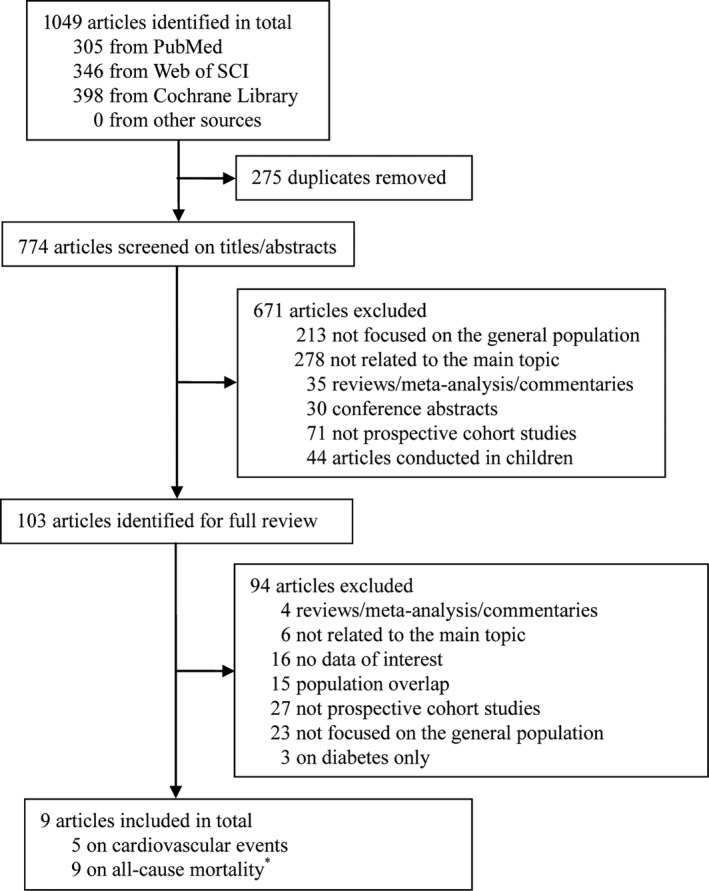
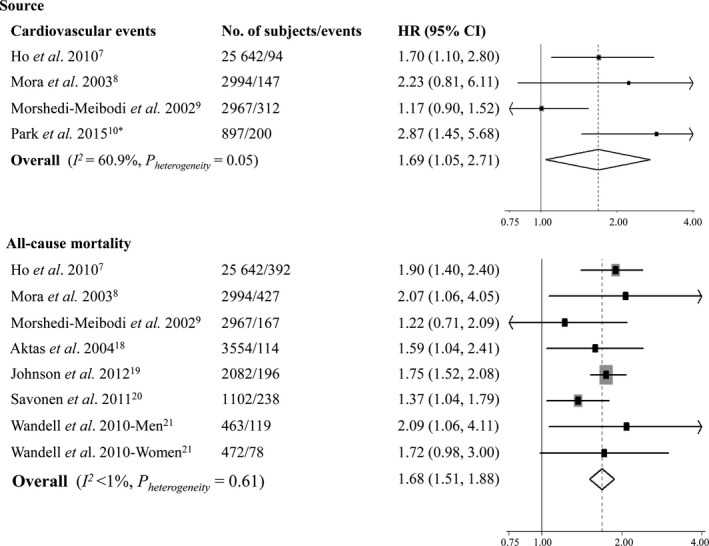
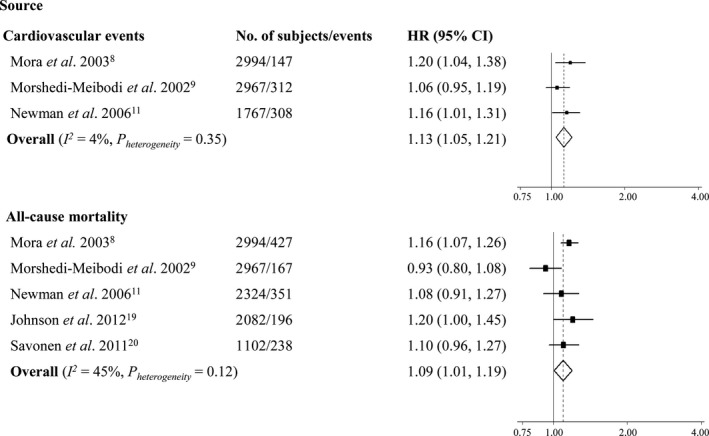
Methods and results: A literature search using 3 databases up to August 2016 was conducted for studies that reported hazard ratios with 95% CIs for the association between baseline HRR and outcomes of interest. The overall hazard ratios were calculated using a random-effects model. There were 9 eligible studies in total, with 5 for cardiovascular events enrolling 1061 cases from 34 267 participants, and 9 for all-cause mortality enrolling 2082 cases from 41 600 participants. The pooled hazard ratios associated with attenuated HRR versus fast HRR that served as the referent were 1.69 (95% CI 1.05-2.71) for cardiovascular events and 1.68 (95% CI 1.51-1.88) for all-cause mortality. For every 10 beats per minute decrements in HRR, the hazard ratios were 1.13 (95% CI 1.05-1.21) and 1.09 (95% CI 1.01-1.19), respectively. Further analyses suggested that the associations observed between attenuated HRR and risk of fatal cardiovascular events and all-cause mortality were independent of traditional metabolic factors for cardiovascular disease (all P<0.05).
Conclusions: Attenuated HRR is associated with increased risk of cardiovascular events and all-cause mortality, which supports the recommendation of recording HRR for risk assessment in clinical practice as a routine.
Keywords: cardiovascular events; heart rate recovery; mortality.
© 2017 The Authors. Published on behalf of the American Heart Association, Inc., by Wiley.
Figures
References
-
- Cole CR, Blackstone EH, Pashkow FJ, Snader CE, Lauer MS. Heart‐rate recovery immediately after exercise as a predictor of mortality. N Engl J Med. 1999;341:1351–1357. - PubMed
-
- Peçanha T, Silva‐Junior ND, Forjaz CL. Heart rate recovery: autonomic determinants, methods of assessment and association with mortality and cardiovascular diseases. Clin Physiol Funct Imaging. 2014;34:327–339. - PubMed
-
- Coote JH. Recovery of heart rate following intense dynamic exercise. Exp Physiol. 2010;95:431–440. - PubMed
-
- Borresen J, Lambert MI. Autonomic control of heart rate during and after exercise: measurements and implications for monitoring training status. Sports Med. 2008;38:633–646. - PubMed
-
- Bellenger CR, Fuller JT, Thomson RL, Davison K, Robertson EY, Buckley JD. Monitoring athletic training status through autonomic heart rate regulation: a systematic review and meta‐analysis. Sports Med. 2016;46:1461–1486. - PubMed
Publication types
MeSH terms
LinkOut - more resources
Full Text Sources
Other Literature Sources
