


Infant Feeding and Risk of Type 1 Diabetes in Two Large Scandinavian Birth Cohorts
- PMID: 28487451
- PMCID: PMC5481976
- DOI: 10.2337/dc17-0016
Infant Feeding and Risk of Type 1 Diabetes in Two Large Scandinavian Birth Cohorts
Abstract
Objective: Our aim was to study the relation between the duration of full and any breastfeeding and risk of type 1 diabetes.
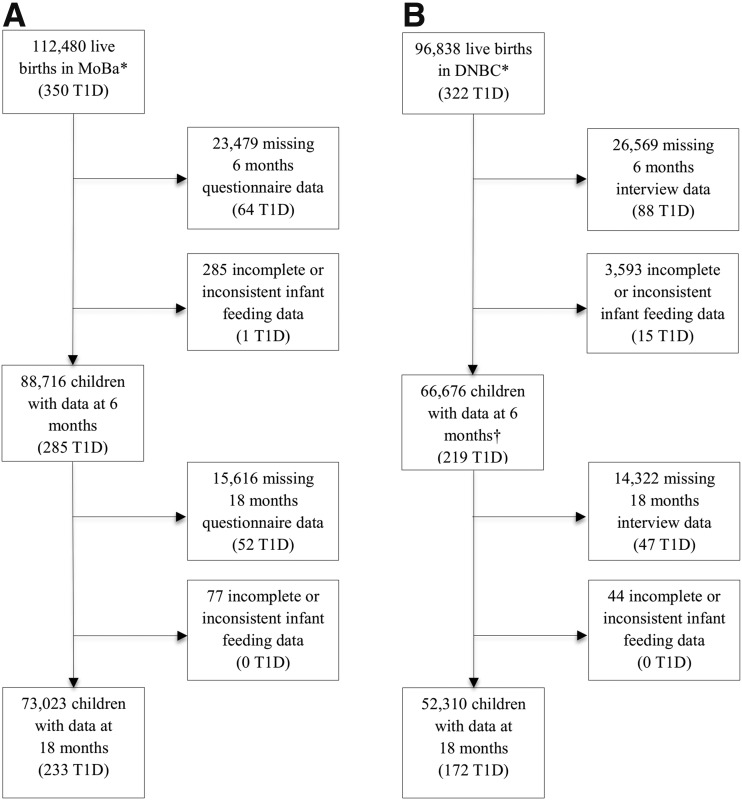
Research design and methods: We included two population-based cohorts of children followed from birth (1996-2009) to 2014 (Denmark) or 2015 (Norway). We analyzed data from a total of 155,392 children participating in the Norwegian Mother and Child Cohort Study (MoBa) and the Danish National Birth Cohort (DNBC). Parents reported infant dietary practices when their child was 6 and 18 months old. The outcome was clinical type 1 diabetes, ascertained from nationwide childhood diabetes registries. Hazard ratios (HRs) were estimated using Cox regression.
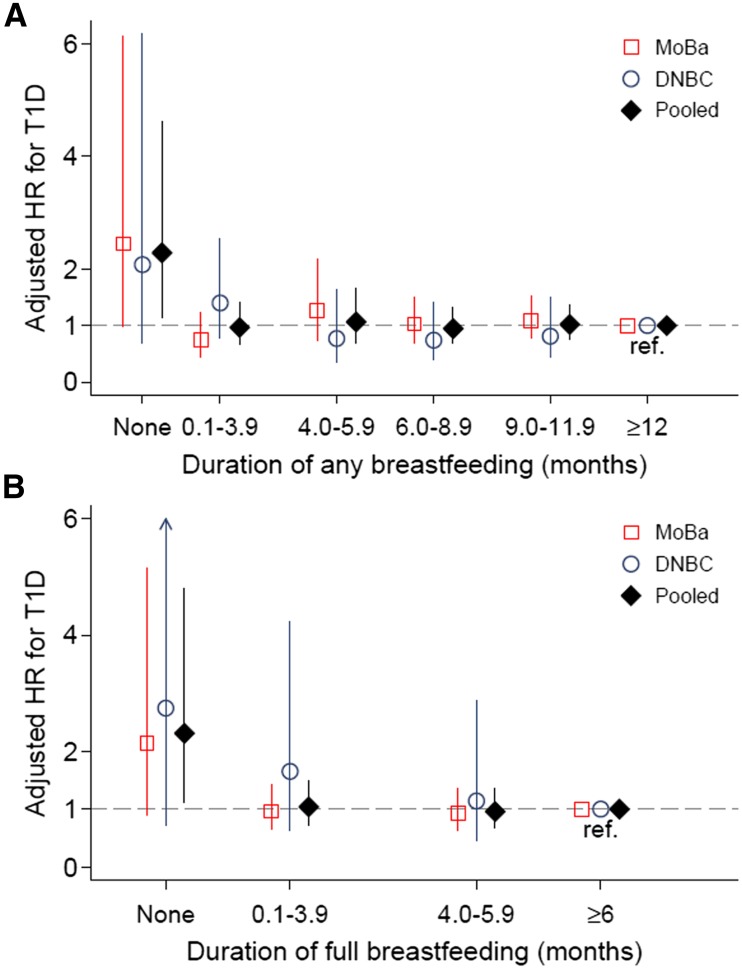
Results: Type 1 diabetes was identified in 504 children during follow-up, and the incidence of type 1 diabetes per 100,000 person-years was 30.5 in the Norwegian cohort and 23.5 in the Danish cohort. Children who were never breastfed had a twofold increased risk of type 1 diabetes compared with those who were breastfed (HR 2.29 [95% CI 1.14-4.61] for no breastfeeding vs. any breastfeeding for ≥12 months). Among those who were breastfed, however, the incidence of type 1 diabetes was independent of duration of both full breastfeeding (HR per month 0.99 [95% CI 0.97-1.01]) and any breastfeeding (0.97 [0.92-1.03]).
Conclusions: Suggestive evidence supports the contention that breastfeeding reduces the risk of type 1 diabetes. Among those who were breastfed, however, no evidence indicated that prolonging full or any breastfeeding was associated with a reduced risk of type 1 diabetes.
© 2017 by the American Diabetes Association.
Figures
References
-
- Patterson CC, Gyürüs E, Rosenbauer J, et al. Trends in childhood type 1 diabetes incidence in Europe during 1989–2008: evidence of non-uniformity over time in rates of increase. Diabetologia 2012;55:2142–2147 - PubMed
-
- Harjutsalo V, Sund R, Knip M, Groop PH. Incidence of type 1 diabetes in Finland. JAMA 2013;310:427–428 - PubMed
-
- Skrivarhaug T, Stene LC, Drivvoll AK, Strøm H, Joner G; Norwegian Childhood Diabetes Study Group . Incidence of type 1 diabetes in Norway among children aged 0–14 years between 1989 and 2012: has the incidence stopped rising? Results from the Norwegian Childhood Diabetes Registry. Diabetologia 2014;57:57–62 - PubMed
-
- Borch-Johnsen K, Joner G, Mandrup-Poulsen T, et al. Relation between breast-feeding and incidence rates of insulin-dependent diabetes mellitus. A hypothesis. Lancet 1984;2:1083–1086 - PubMed
MeSH terms
Grants and funding
LinkOut - more resources
Full Text Sources
Other Literature Sources
Medical
