. 2017 May 9;7(1):1598.
doi: 10.1038/s41598-017-01714-3.

Efficient Antibacterial Membrane based on Two-Dimensional Ti3C2Tx (MXene) Nanosheets

Affiliations

Efficient Antibacterial Membrane based on Two-Dimensional Ti3C2Tx (MXene) Nanosheets

Kashif Rasool et al. Sci Rep. .

Abstract

Advanced membranes that enable ultrafast water flux while demonstrating anti-biofouling characteristics can facilitate sustainable water/wastewater treatment processes. MXenes, two-dimensional (2D) metal carbides and nitrides, have attracted attention for applications in water/wastewater treatment. In this work, we reported the antibacterial properties of micrometer-thick titanium carbide (Ti3C2Tx) MXene membranes prepared by filtration on a polyvinylidene fluoride (PVDF) support. The bactericidal properties of Ti3C2Tx modified membranes were tested against Escherichia coli (E. coli) and Bacillus subtilis (B. subtilis) by bacterial growth on the membrane surface and its exposure to bacterial suspensions. The antibacterial rate of fresh Ti3C2Tx MXene membranes reaches more than 73% against B. subtilis and 67% against E. coli as compared with that of control PVDF, while aged Ti3C2Tx membrane showed over 99% growth inhibition of both bacteria under same conditions. Flow cytometry showed about 70% population of dead and compromised cells after 24 h of exposure of both bacterial strains. The damage of the cell surfaces was also revealed by scanning electron microscopy (SEM) and atomic force microscopy (AFM) analysis, respectively. The demonstrated antibacterial activity of MXene coated membranes against common waterborne bacteria, promotes their potential application as anti-biofouling membrane in water and wastewater treatment processes.


Conflict of interest statement

The authors declare that they have no competing interests.

Figures
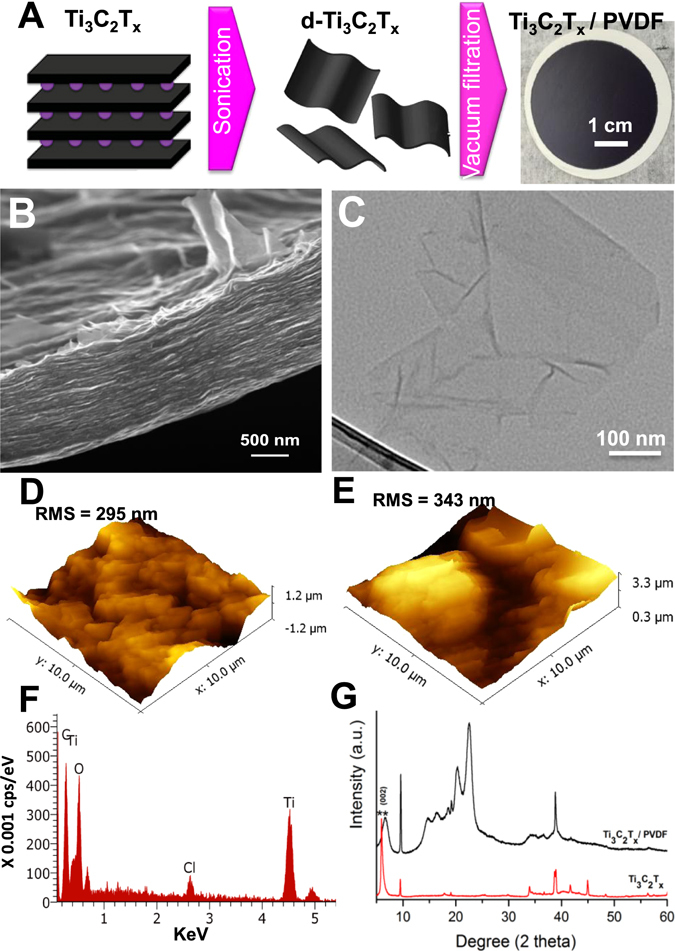
Figure 1
Figure 1
(A) Schematic of the Ti3C2Tx membrane fabrication on a PVDF support; (B) Cross-sectional SEM image of a Ti3C2Tx film; (C) TEM image of a pristine Ti3C2Tx flake; (D and E) 3D AFM images of a PVDF membrane and a Ti3C2Tx/PVDF film, respectively; (F) EDX spectrum of Ti3C2Tx/PVDF; (G) XRD patterns of Ti3C2Tx and a Ti3C2Tx/PVDF membrane.
Figure 2
Figure 2
Antibacterial activity of Ti3C2Tx MXene. (A) Photographs of E. coli and B. subtilis growth on unmodified PVDF (control), and fresh and aged Ti3C2Tx MXene coated PVDF membranes incubated at 35 °C for 24 h. (B) Cell viability measurements of E. coli and B. subtilis grown on fresh and aged Ti3C2Tx MXene coated PVDF membranes for 24 h. Survival rates were obtained by the colony forming count method. Error bars represent the standard deviation of triplicate experiments.
Figure 3
Figure 3
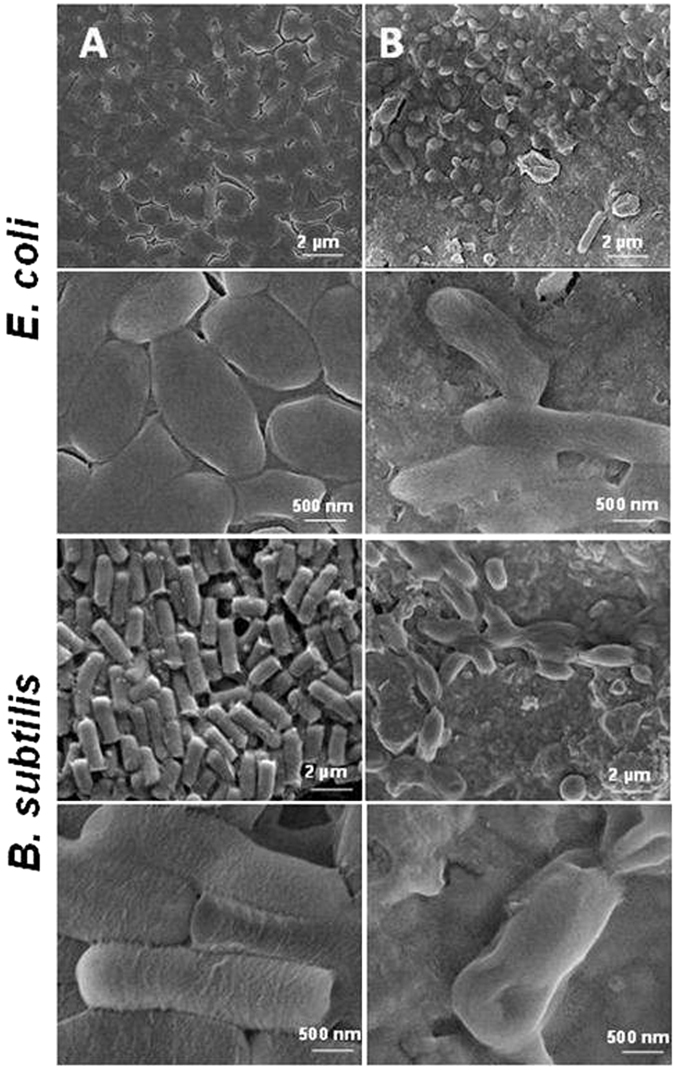
SEM images of the E. coli (top panels) and B. subtilis (bottom panels) colonies grown on (A) PVDF and (B) Ti3C2Tx modified membranes, at low and high magnifications. Control bacterial cells were viable with no observed membrane damage or cell death, and the higher magnification images show that the bacteria were protected by intact cytoplasmic membrane.
Figure 4
Figure 4
AFM images of E. coli and B. subtilis colonies grown on PVDF and Ti3C2Tx modified PVDF membranes. The black square areas indicate where a 0.5 × 0.5 μm zoom scan has been performed (right hand of each panel); showing fine detail of the bacterial capsule surfaces.
Figure 5
Figure 5
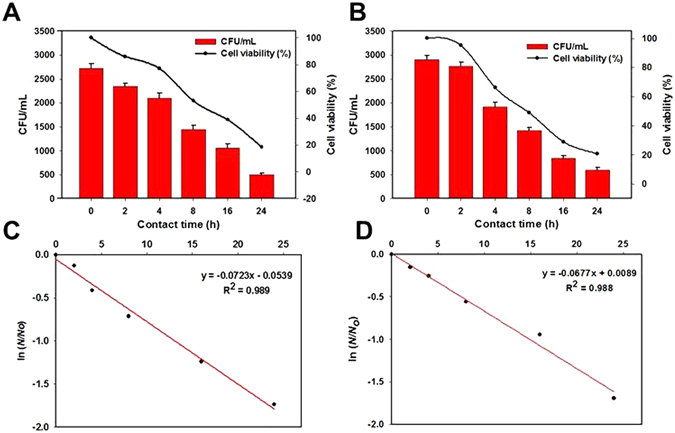
Cell viability measurements of (A) E. coli and (B) B. subtilis exposed to MXene membranes at different time intervals during 24 h of contact time. Survival rates were obtained by the colony forming count method as compared to that of control PVDF membrane. Error bars represent the standard deviation. First order rate plot for the inactivation of (C) E. coli and (D) B. subtilis.
Figure 6
Figure 6
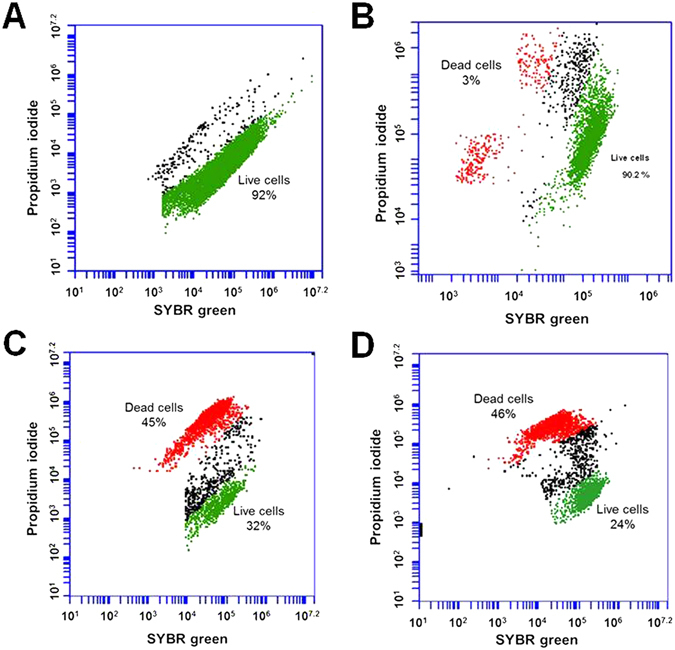
Cell viability measurement of E. coli and B. subtilis exposed to PVDF and Ti3C2Tx. Flow cytometry dot plots of E. coli (A,C) and B. subtilis (B,D) bacterial cells exposed to control PVDF (A and B) and MXene films (C,D) for 24 h.

References

    1. Hajipour MJ, et al. Antibacterial properties of nanoparticles. Trends Biotechnol. 2012;30:499–511. doi: 10.1016/j.tibtech.2012.06.004. - DOI - PubMed
    1. Li Q, et al. Antimicrobial nanomaterials for water disinfection and microbial control: Potential applications and implications. Water Res. 2008;42:4591–4602. doi: 10.1016/j.watres.2008.08.015. - DOI - PubMed
    1. Rasool K, Lee DS. Effect of ZnO nanoparticles on biodegradation and biotransformation of co-substrate and sulphonated azo dye in anaerobic biological sulfate reduction processes. Int Biodeterior Biodegradation. 2016;109:150–156. doi: 10.1016/j.ibiod.2016.01.015. - DOI
    1. Yin W, et al. Functionalized nano-MoS2 with peroxidase catalytic and near-infrared photothermal activities for safe and synergetic wound antibacterial applications. ACS Nano. 2016;10:11000–11011. doi: 10.1021/acsnano.6b05810. - DOI - PubMed
    1. Rasool K, et al. Antibacterial activity of Ti3C2Tx MXene. ACS Nano. 2016;10:3674–3684. doi: 10.1021/acsnano.6b00181. - DOI - PubMed

Publication types

MeSH terms