


Natural Killer Cells in Graft-versus-Host-Disease after Allogeneic Hematopoietic Cell Transplantation
- PMID: 28487696
- PMCID: PMC5403889
- DOI: 10.3389/fimmu.2017.00465
Natural Killer Cells in Graft-versus-Host-Disease after Allogeneic Hematopoietic Cell Transplantation
Abstract
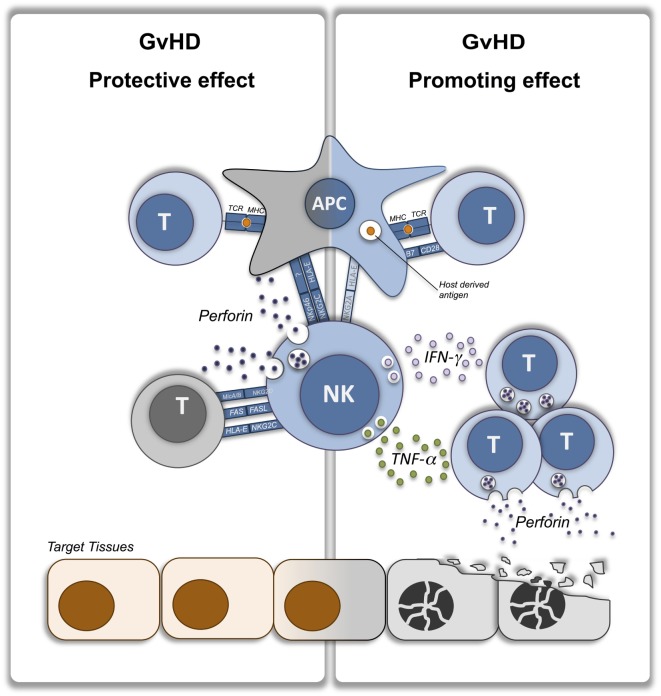
Allogeneic hematopoietic cell transplantation (HCT) is a well-established therapeutic modality effective for a variety of hematological malignancies but, unfortunately, is associated with significant morbidity and mortality related to cancer relapse as well as to transplant-related complications including graft-versus-host-disease (GvHD). Natural killer (NK) cells are the first donor-derived lymphocyte subset to recover after HCT, and their crucial role in protection against cancer relapse and infections is well established. Conversely, the role played by NK cells in GvHD is still controversial. Early studies suggested a participation of NK cells in GvHD induction or exacerbation. Subsequently, experimental evidence obtained in mice as well observational studies performed in humans led to a model in which NK cells play a regulatory role in GvHD by repressing alloreactive T cell responses. This widely accepted model has been recently challenged by clinical evidence indicating that NK cells can in some cases promote GvHD. In this review, we summarize available knowledge about the role of NK cells in GVHD pathogenesis. We review studies uncovering cellular mechanisms through which NK cells interact with other immune cell subsets during GvHD leading to a model in which NK cells naturally suppress GvHD through their cytotoxic ability to inhibit T cell activation unless exogenous hyperactivation lead them to produce proinflammatory cytokines that can conversely sustain T cell-mediated GvHD induction.
Keywords: HSCT; bone marrow transplantation; graft-versus-host-disease; natural killer cells; tolerance.
Figures
References
-
- Murphy WJ, Bennett M, Kumar V, Longo DL. Donor-type activated natural killer cells promote marrow engraftment and B cell development during allogeneic bone marrow transplantation. J Immunol (1992) 148(9):2953–60. - PubMed
-
- Ruggeri L, Mancusi A, Capanni M, Urbani E, Carotti A, Aloisi T, et al. Donor natural killer cell allorecognition of missing self in haploidentical hematopoietic transplantation for acute myeloid leukemia: challenging its predictive value. Blood (2007) 110(1):433–40. 10.1182/blood-2006-07-038687 - DOI - PMC - PubMed
-
- Hill GR, Ferrara JL. The primacy of the gastrointestinal tract as a target organ of acute graft-versus-host disease: rationale for the use of cytokine shields in allogeneic bone marrow transplantation. Blood (2000) 95(9):2754–9. - PubMed
Publication types
Grants and funding
LinkOut - more resources
Full Text Sources
Other Literature Sources
