. 2017 Apr 25:8:488.
doi: 10.3389/fpls.2017.00488. eCollection 2017.

Genome-Wide Identification, Characterization, and Expression Analysis of Small RNA Biogenesis Purveyors Reveal Their Role in Regulation of Biotic Stress Responses in Three Legume Crops

Affiliations

Genome-Wide Identification, Characterization, and Expression Analysis of Small RNA Biogenesis Purveyors Reveal Their Role in Regulation of Biotic Stress Responses in Three Legume Crops

Vanika Garg et al. Front Plant Sci. .

Abstract

Biotic stress in legume crops is one of the major threats to crop yield and productivity. Being sessile organisms, plants have evolved a myriad of mechanisms to combat different stresses imposed on them. One such mechanism, deciphered in the last decade, is small RNA (sRNA) mediated defense in plants. Small RNAs (sRNAs) have emerged as one of the major players in gene expression regulation in plants during developmental stages and under stress conditions. They are known to act both at transcriptional and post-transcriptional levels. Dicer-like (DCL), Argonaute (AGO), and RNA dependent RNA polymerase (RDR) constitute the major components of sRNA biogenesis machinery and are known to play a significant role in combating biotic and abiotic stresses. This study is, therefore, focused on identification and characterization of sRNA biogenesis proteins in three important legume crops, namely chickpea, pigeonpea, and groundnut. Phylogenetic analysis of these proteins between legume species classified them into distinct clades and suggests the evolutionary conservation of these genes across the members of Papillionidoids subfamily. Variable expression of sRNA biogenesis genes in response to the biotic stresses among the three legumes indicate the possible existence of specialized regulatory mechanisms in different legumes. This is the first ever study to understand the role of sRNA biogenesis genes in response to pathogen attacks in the studied legumes.

Keywords: AGO; DCL; Papillionidoids; RDR; biotic stress; gene expression.


Figures
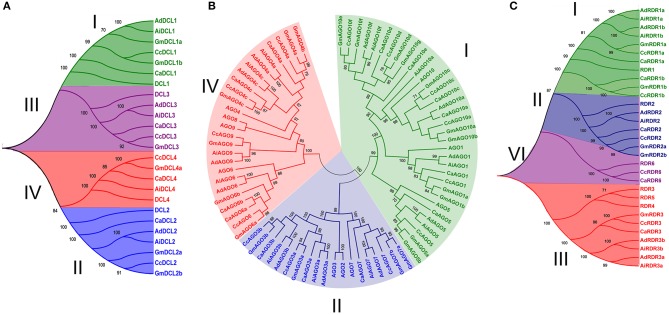
Figure 1
Figure 1
Phylogenetic analysis of DCL, AGO, and RDR proteins in chickpea, pigeonpea, and groundnut. The tree was constructed by Neighbor-joining method using orthologs from Arabidopsis and soybean for (A) DCL with four; (B) AGO with three; and (C) RDR with four clades. Bootstrap values ≥70 are indicated in the figure. Ca, Cc, Ad, and Ai represent chickpea, pigeonpea, A. duranensis, and A. ipaensis, respectively.
Figure 2
Figure 2
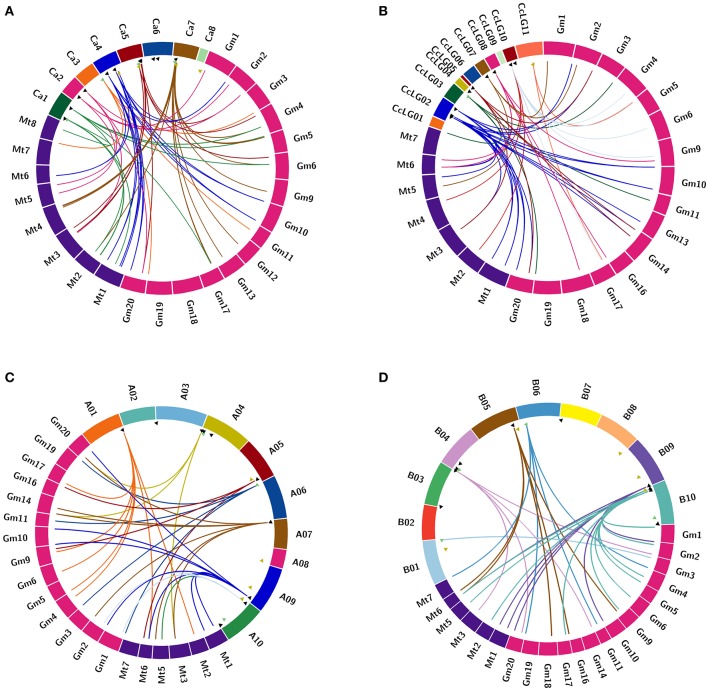
Comparative analysis of orthologus relationship of sRNA biogenesis genes in (A) chickpea; (B) pigeonpea; (C) A. duranensis; and (D) A. ipaensis with Medicago and soybean. Orthology among genes is depicted using circos. The triangles represent the chromosomal location of the respective genes. Triangles in green, black and yellow denote DCL, AGO, and RDR, respectively. Strokes originating from these triangles represent the orthologous genes present in Medicago and soybean.
Figure 3
Figure 3
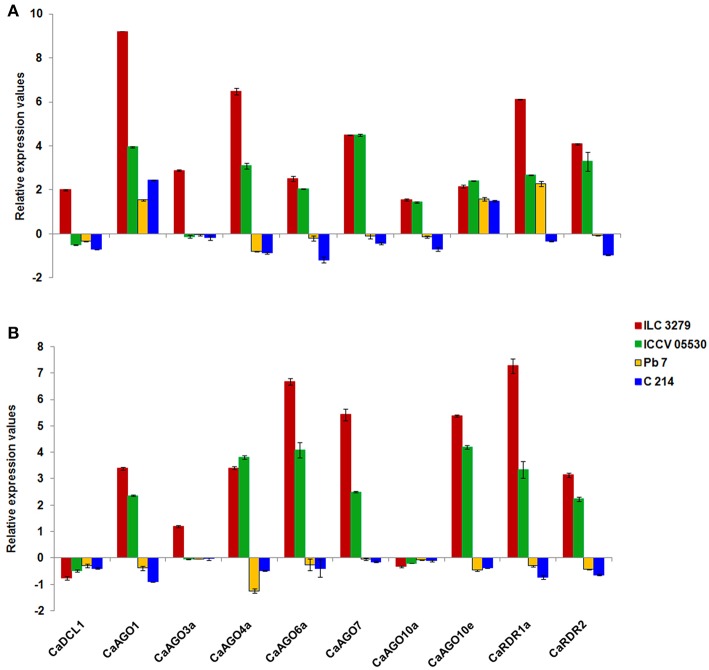
Expression profiling of DCL, AGO, and RDR genes in leaf tissues of chickpea in response to AB with respect to its control at (A) 7th dpi; (B) 11th dpi.
Figure 4
Figure 4
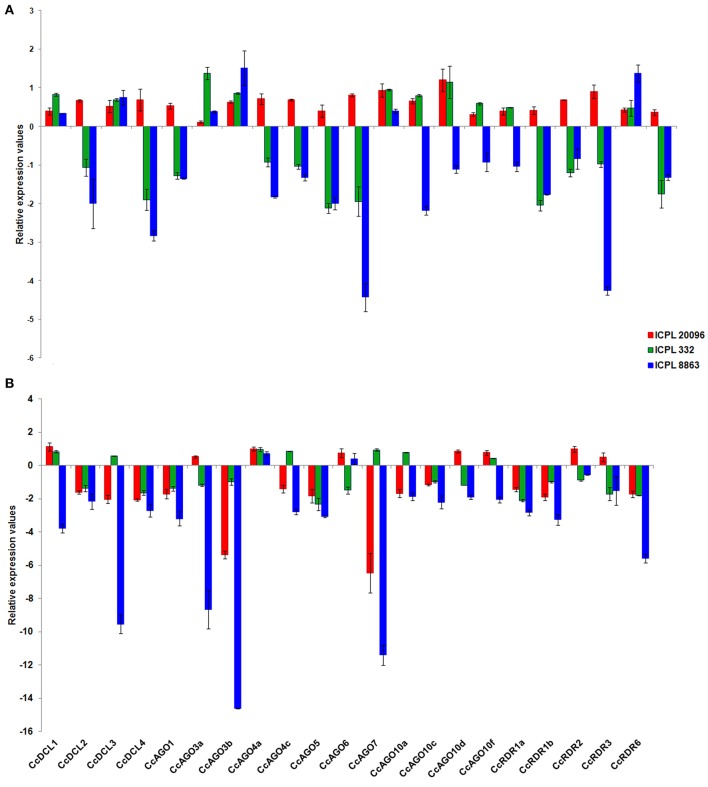
Expression profiling of DCL, AGO, and RDR genes in leaf tissues of pigeonpea in response to SMD with respect to its control at (A) 7th dpi; (B) 14th dpi.
Figure 5
Figure 5
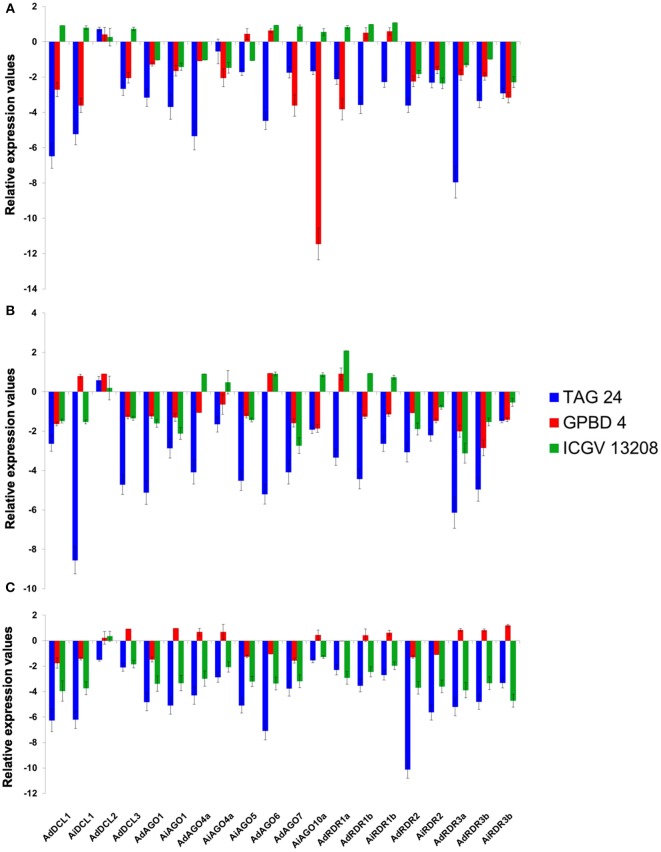
Expression profiling of DCL, AGO, and RDR genes in leaf tissues of groundnut in response to Rust and LLS with respect to its control at (A) 21st dpi; (B) 35th dpi; and (C) 50th dpi.

References

    1. Bailey T. L., Boden M., Buske F. A., Frith M., Grant C. E., Clementi L., et al. (2009). MEME SUITE: tools for motif discovery and searching. Nucleic Acids Res. 37, W202–W208. 10.1093/nar/gkp335 - DOI - PMC - PubMed
    1. Bartel D. P. (2004). MicroRNAs: genomics, biogenesis, mechanism, and function. Cell 116, 281–297. 10.1016/S0092-8674(04)00045-5 - DOI - PubMed
    1. Baumberger N., Baulcombe D. (2005). Arabidopsis ARGONAUTE1 is an RNA Slicer that selectively recruits microRNAs and short interfering RNAs. Proc. Natl. Acad. Sci. U.S.A. 102, 11928–11933. 10.1073/pnas.0505461102 - DOI - PMC - PubMed
    1. Bertioli D. J., Cannon S. B., Froenicke L., Huang G. D., Farmer A. D., Cannon E. K. S., et al. (2016). The genome sequences of Arachis duranensis and Arachis ipaensis, the diploid ancestors of cultivated peanut. Nat. Genet. 48, 438–446. 10.1038/ng.3517 - DOI - PubMed
    1. Capitao C., Paiva J. A., Santos D. M., Fevereiro P. (2011). in Medicago truncatula, water deficit modulates the transcript accumulation of components of small RNA pathways. BMC Plant Biol. 11:79. 10.1186/1471-2229-11-79 - DOI - PMC - PubMed

LinkOut - more resources