Review
. 2017 Mar 30:13:625-638.
doi: 10.3762/bjoc.13.61. eCollection 2017.

N- Propargylamines: versatile building blocks in the construction of thiazole cores

Affiliations
Review

N- Propargylamines: versatile building blocks in the construction of thiazole cores

S Arshadi et al. Beilstein J Org Chem. .

Abstract

Thiazoles and their hydrogenated analogues are not only key structural units in a wide variety of natural products but they also constitute important building blocks in medicinal chemistry. Therefore, the synthesis of these compounds using new protocols is always interesting. It is well known that N-propargylamines can undergo a number of cyclization reactions to produce various nitrogen-containing heterocycles. In this review, we highlight the most important developments on the synthesis of thiazole and its derivatives starting from N-propargylamines. This review will be helpful in the development of improved methods for the synthesis of natural and biologically important compounds.

Keywords: 5-exo-dig cyclization; 6-endo-dig cyclization; N-heterocycles; N-propargylamines; thiazoles.


Figures
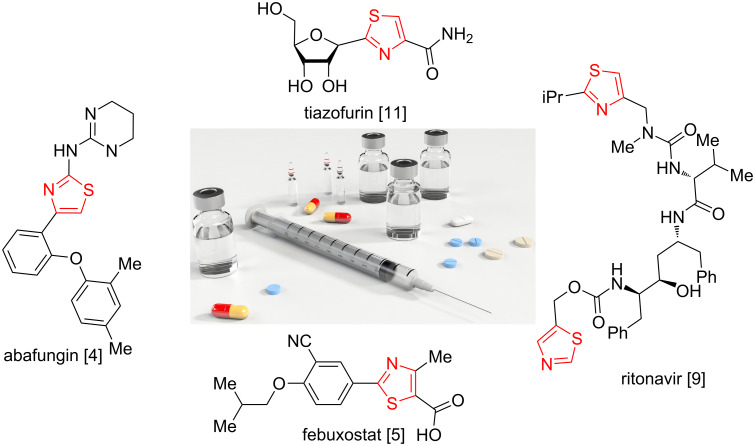
Figure 1
Figure 1
Selected examples of bioactive thiazole derivatives.
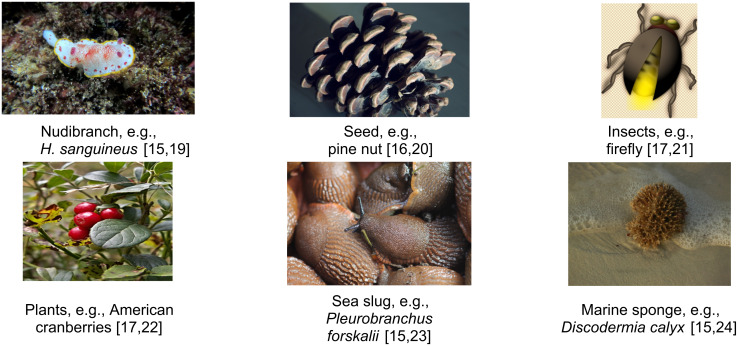
Figure 2
Figure 2
Some natural sources of thiazoles.
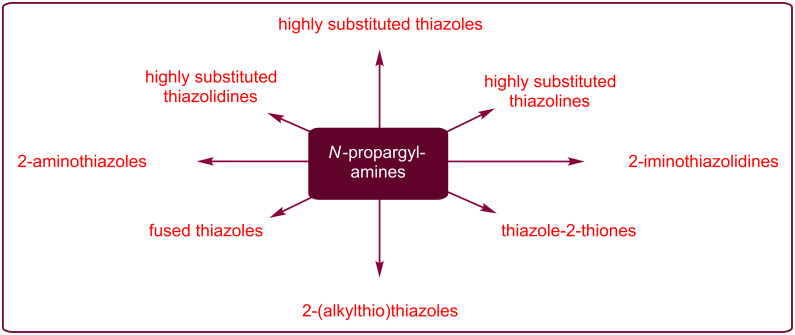
Figure 3
Figure 3
Some important thiazole-based compounds derived from N-propargylamines.
Scheme 1
Scheme 1
The synthesis of thiazole-2-thiones 3 through the thermal cyclocondensation of N-propargylamines 1 with carbon disulfide as developed by Batty and Weedon [75].
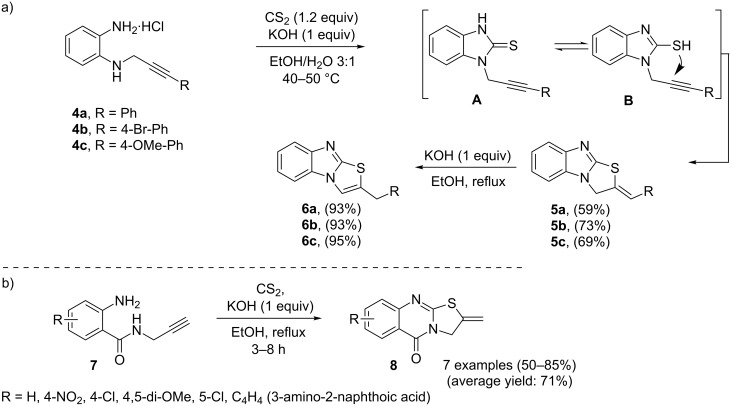
Scheme 2
Scheme 2
(a) One-pot synthesis of 2-benzylthiazolo[3,2-a]benzimidazoles 6 through a base-catalyzed cascade reaction of internal N-propargylamines 4 and CS2. (b) Synthesis of 2-methylene-thiazolo[2,3-b]quinazolinones 8 using 2-amino-propargylbenzamides 7 as substrates.
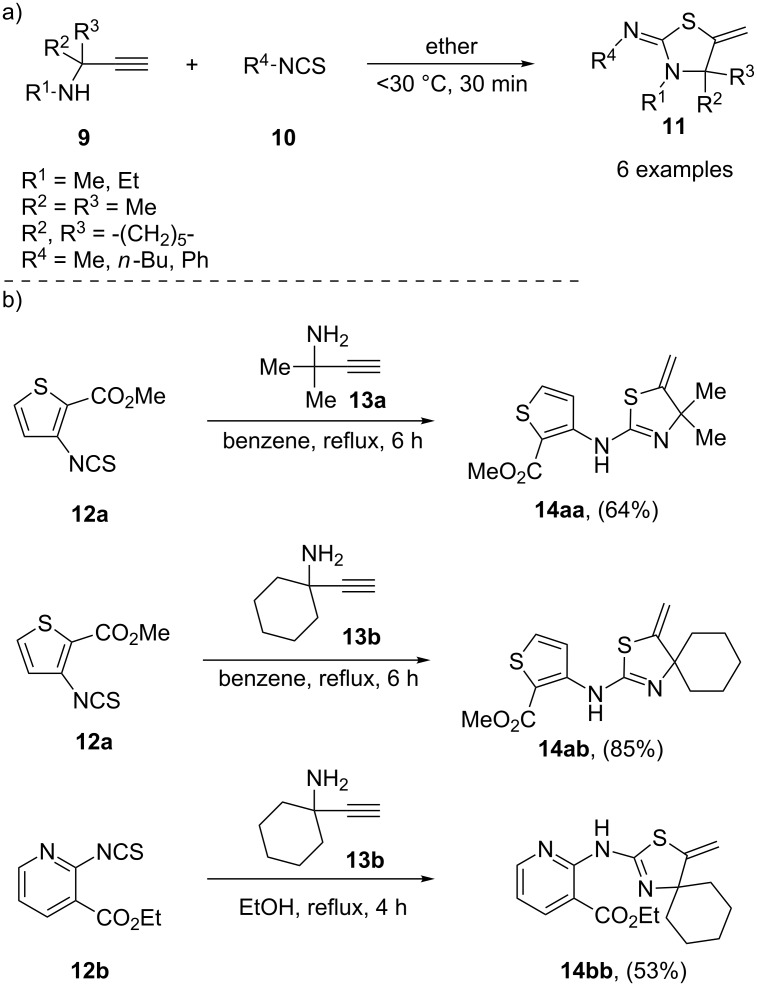
Scheme 3
Scheme 3
(a) Synthesis of 2-iminothiazolidines 11 from N-propargylamines 9 and isothiocyanates 10. (b) Synthesis of 4,4-disubstituted-5-methylenethiazoles 14 using heterocyclic isothiocyanates 12 and α,α-disubstituted N-propargylamines 13 as substrates.
Scheme 4
Scheme 4
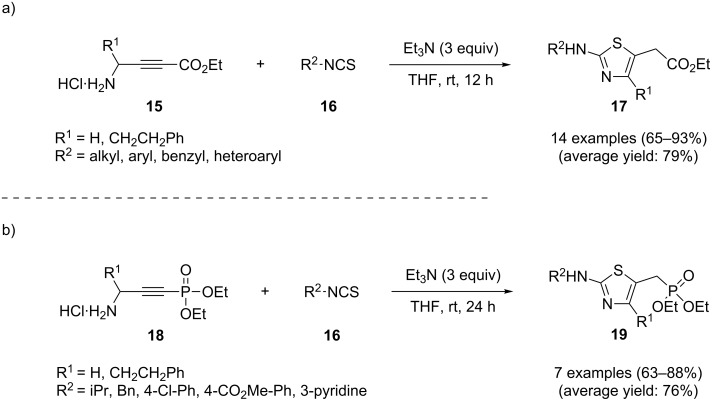
(a) Synthesis of 2-aminothiazoles 17 through the reaction of ethyl 4-aminobut-2-ynoate salts 15 with isothiocyanates 16. (b) Synthesis of 5-diethyl methylphosphonate-substituted 2-aminothiazoles 19 through reaction of diethyl 3-aminoprop-1-ynylphosphonate salts 18 with 16.
Scheme 5
Scheme 5
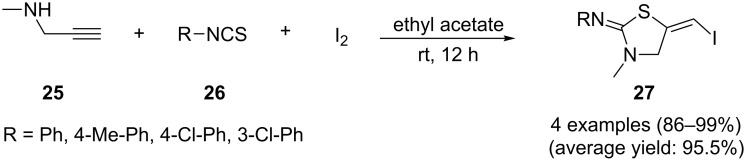
Synthesis of 5-(iodomethylene)-3-methylthiazolidines 27 described by Zhou.
Scheme 6
Scheme 6
Mechanism that accounts for the formation of 27.
Scheme 7
Scheme 7
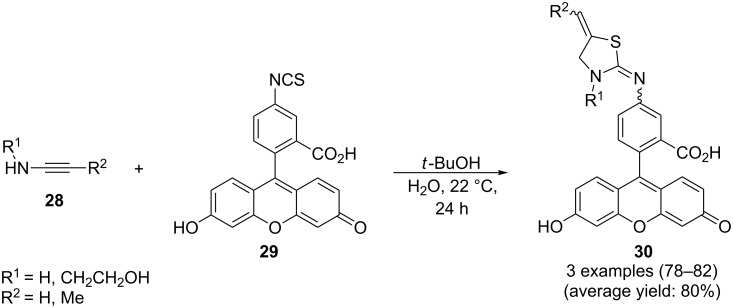
Clausen’s synthesis of fluorescein thiazolidines 30.
Scheme 8
Scheme 8
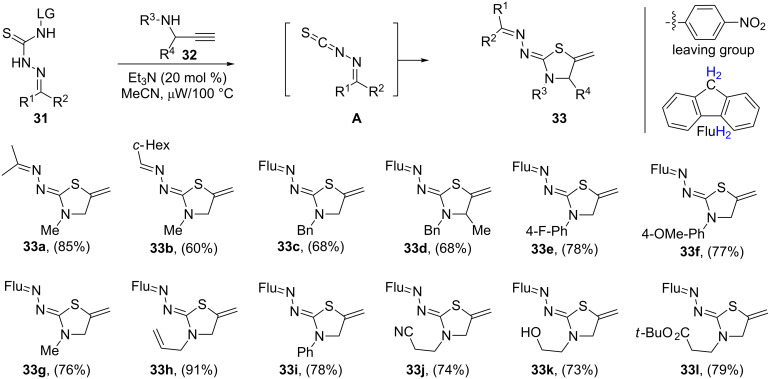
Synthesis of multiply substituted thiazolidines 33 from N-propargylamines 32 and blocked N-isothiocyanate precursors 31.
Scheme 9
Scheme 9
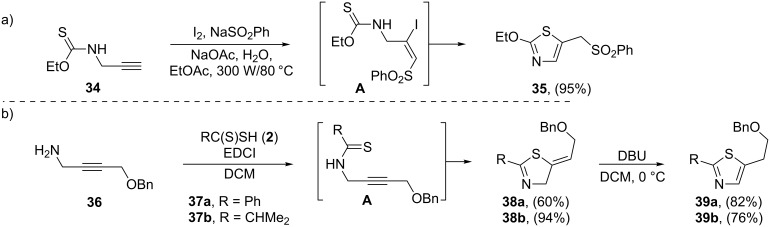
(a) Microwave-assisted cyclization of N-propargyl thiocarbamate 34. (b) Synthesis of thiazoles 39 through a tandem coupling–cyclization–isomerization sequential process.
Scheme 10
Scheme 10
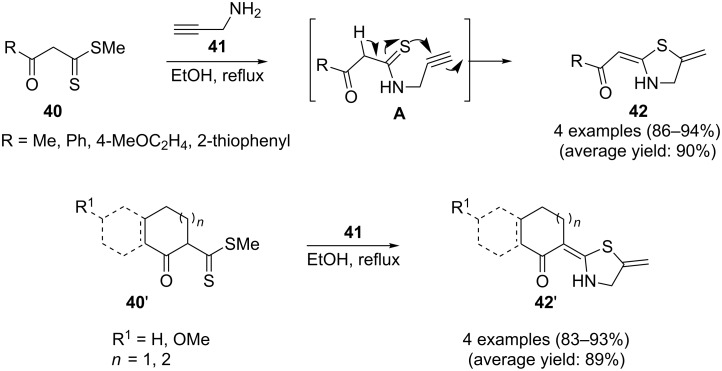
Synthesis of thiazolidines 42 (42’) from the reaction of β-oxodithioesters 40 (40’) with N-propargylamine (41) through an N-propargylthioamide intermediate A.
Scheme 11
Scheme 11
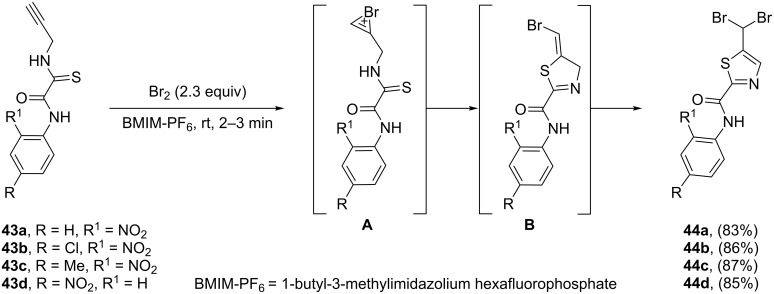
Synthesis of 5-(dibromomethyl)thiazoles 44 via halocyclization of N-propargylamines 43 described by Yarovenko.
Scheme 12
Scheme 12
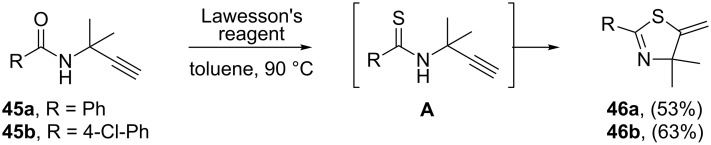
Synthesis of dihydrothiazoles 46 through the treatment of N-propargylamides 45 with Lawesson’s reagent.
Scheme 13
Scheme 13
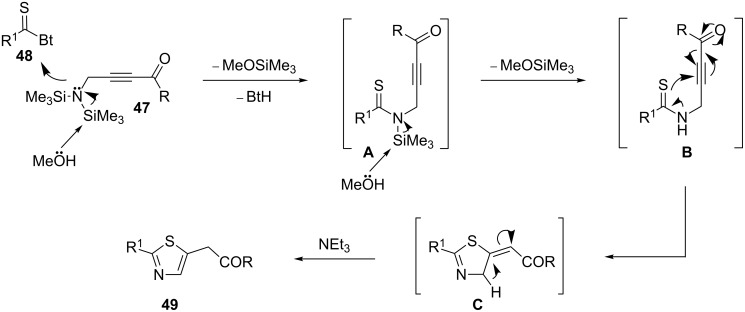
Synthesis of thiazoles 49 by treatment of silyl-protected N-propargylamines 47 with benzotriazolylthiones 48.
Scheme 14
Scheme 14
Mechanism proposed to explain the synthesis of 2,5-disubstituted thiazoles 49 developed by Sasmal.
Scheme 15
Scheme 15
Mo-catalyzed cyclization of N-propargylthiocarbamate 50.
Scheme 16
Scheme 16
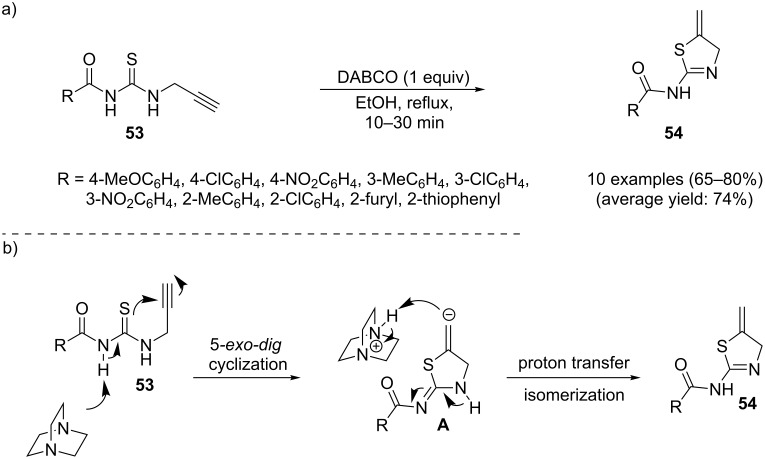
(a) DABCO-mediated intramolecular cyclization of N-(propargylcarbamothioyl)amides 53 to the corresponding dihydrothiazol-2-ylamides 54. (b) Possible reaction pathway for the generation of product 54.
Scheme 17
Scheme 17
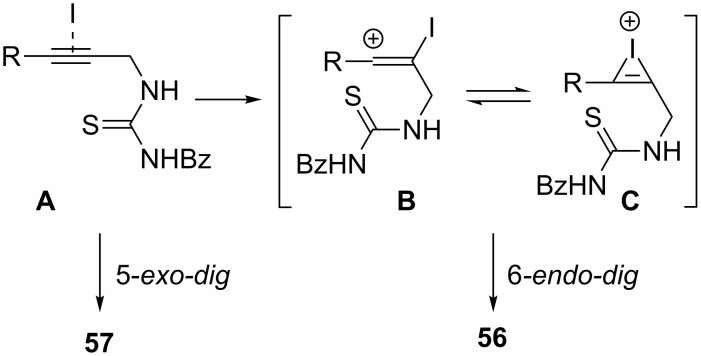
Proposed mechanism for the generation of the iodine-substituted 4H-1,3-thiazines 56 and 4,5-dihydrothiazoles 57.
Scheme 18
Scheme 18
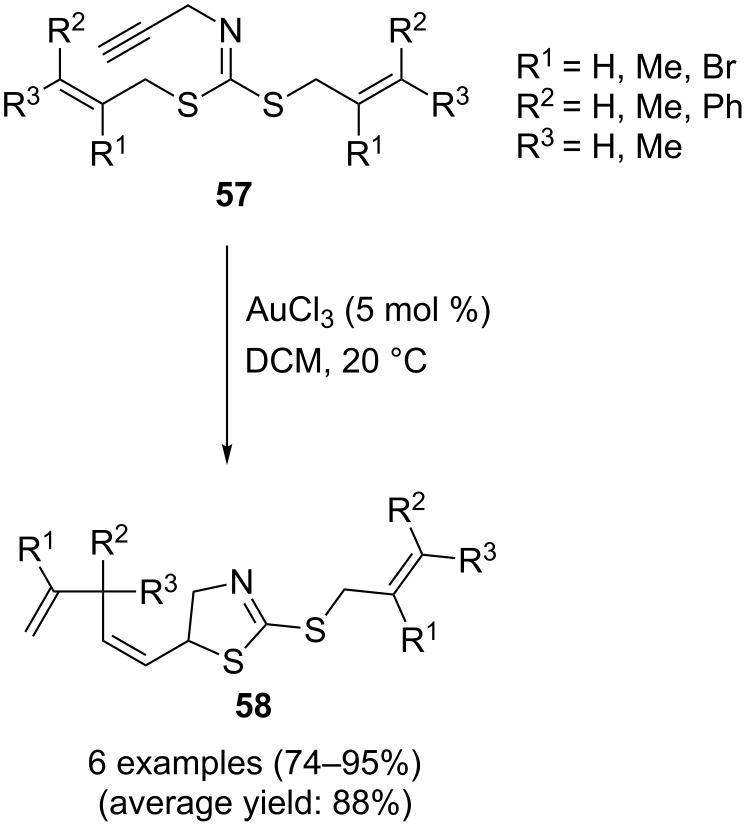
Au(III)-catalyzed synthesis of 5-alkylidenedihydrothiazoles 58 developed by Stevens.

References

    1. Villars V, Jones T C. Clin Exp Dermatol. 1989;14:124–127. doi: 10.1111/j.1365-2230.1989.tb00908.x.. - DOI - PubMed
    1. Kagawa S. Clin Exp Dermatol. 1989;14:114–115. doi: 10.1111/j.1365-2230.1989.tb00905.x. - DOI - PubMed
    1. Tamura T, Asahara M, Yamamoto M, Yamaura M, Matsumura M, Goto K, Rezaei-Matehkolaei A, Mirhendi H, Makimura M, Makimura K. Microbiol Immunol. 2014;58:1–8. doi: 10.1111/1348-0421.12109. - DOI - PubMed
    1. Borelli C, Schaller M, Niewerth M, Nocker K, Baasner B, Berg D, Tiemann R, Tietjen K, Fugmann B, Lang-Fugmann S, et al. Chemotherapy. 2008;54:245–259. doi: 10.1159/000142334. - DOI - PMC - PubMed
    1. Takano Y, Hase-Aoki K, Horiuchi H, Zhao L, Kasahara Y, Kondo S, Becker M A. Life Sci. 2005;76:1835–1847. doi: 10.1016/j.lfs.2004.10.031. - DOI - PubMed

LinkOut - more resources