Clinical Trial
. 2017 Aug 15;23(16):4651-4661.
doi: 10.1158/1078-0432.CCR-17-0152. Epub 2017 May 10.

Perioperative COX-2 and β-Adrenergic Blockade Improves Metastatic Biomarkers in Breast Cancer Patients in a Phase-II Randomized Trial

Affiliations
Clinical Trial

Perioperative COX-2 and β-Adrenergic Blockade Improves Metastatic Biomarkers in Breast Cancer Patients in a Phase-II Randomized Trial

Lee Shaashua et al. Clin Cancer Res. .

Abstract

Purpose: Translational studies suggest that excess perioperative release of catecholamines and prostaglandins may facilitate metastasis and reduce disease-free survival. This trial tested the combined perioperative blockade of these pathways in breast cancer patients.Experimental Design: In a randomized placebo-controlled biomarker trial, 38 early-stage breast cancer patients received 11 days of perioperative treatment with a β-adrenergic antagonist (propranolol) and a COX-2 inhibitor (etodolac), beginning 5 days before surgery. Excised tumors and sequential blood samples were assessed for prometastatic biomarkers.Results: Drugs were well tolerated with adverse event rates comparable with placebo. Transcriptome profiling of the primary tumor tested a priori hypotheses and indicated that drug treatment significantly (i) decreased epithelial-to-mesenchymal transition, (ii) reduced activity of prometastatic/proinflammatory transcription factors (GATA-1, GATA-2, early-growth-response-3/EGR3, signal transducer and activator of transcription-3/STAT-3), and (iii) decreased tumor-infiltrating monocytes while increasing tumor-infiltrating B cells. Drug treatment also significantly abrogated presurgical increases in serum IL6 and C-reactive protein levels, abrogated perioperative declines in stimulated IL12 and IFNγ production, abrogated postoperative mobilization of CD16- "classical" monocytes, and enhanced expression of CD11a on circulating natural killer cells.Conclusions: Perioperative inhibition of COX-2 and β-adrenergic signaling provides a safe and effective strategy for inhibiting multiple cellular and molecular pathways related to metastasis and disease recurrence in early-stage breast cancer. Clin Cancer Res; 23(16); 4651-61. ©2017 AACR.


Conflict of interest statement

AUTHORS’ DISCLOSURES OF POTENTIAL CONFLICTS OF INTEREST

Disclosures provided by the authors are available with this article at www.jco.org

Figures

Fig. 1A
Fig. 1A
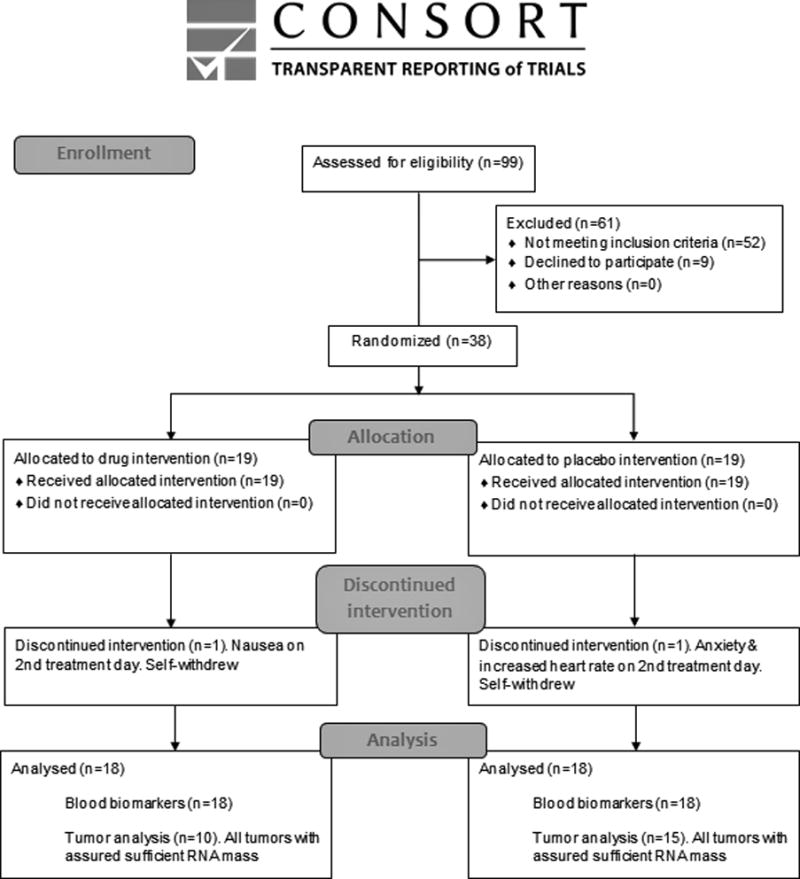
CONSORT diagram of clinical trial enrollment and treatment.
Fig. 1B
Fig. 1B. Schematic presentation of the design and time schedule of the study
A double-blind placebo-controlled biomarker trial was conducted in early stage breast cancer patients, treating patients with placebo or with propranolol and etodolac for 11 consecutive days, starting 5 days before surgery. Propranolol doses were increased on the day of surgery. Of the 38 patients recruited, one from each group self-withdraw before surgery. Blood samples were collected before drug initiation (T1), on the morning before surgery (T2), on the morning after surgery (T3), and several days after cessation of drug treatment (T4). Tumor tissue was collected during surgery.
Fig. 2
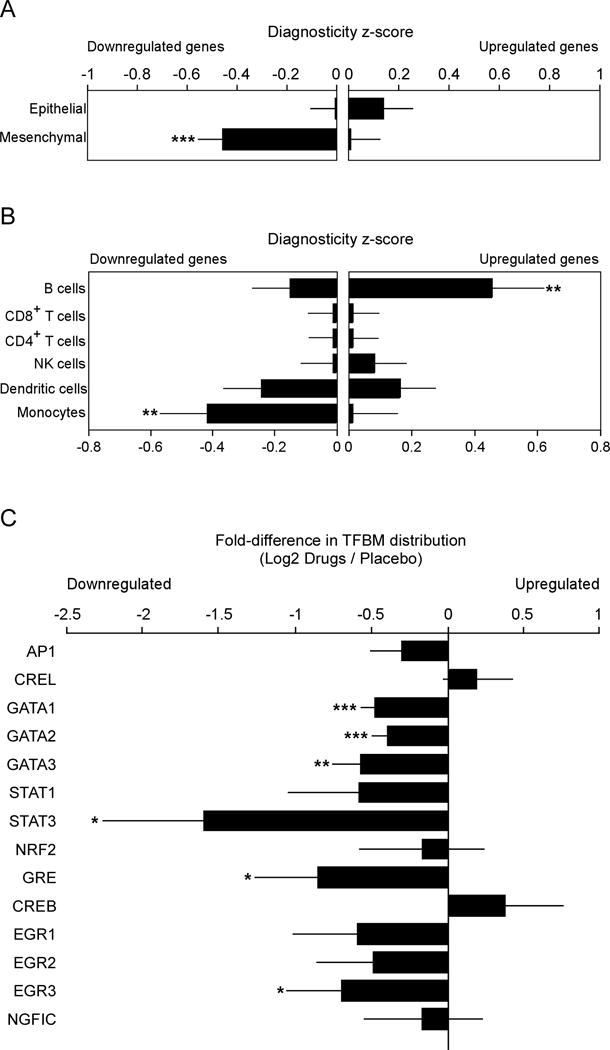
Fig. 2. Effect of drug treatment on primary tumor transcriptome indicators of EMT, tumor-associated leukocytes, and pro-metastatic transcription factors
Twenty-five tumors yielded RNA of sufficient quality for transcriptome profiling (10 drug-treated and 15 placebo). (A) Effects of drug treatment on primary tumor EMT gene expression were quantified by Transcript Origin Analysis (58) of 163 genes showing > 1.25-fold up-regulation and 141 genes showing equivalent down-regulation in tumors from drug-treated patients vs. controls, using reference transcriptome profiles derived from mesenchymal- vs. epithelial-polarized breast cancer cells (59). (B) Transcript Origin Analysis also assessed the effects of drug treatment on expression of genes derived from monocytes, dendritic cells, CD4+ and CD8+ T cells, B cells and NK cells, using reference data derived from isolated samples of each cell type (22). (C) Effect of drug treatment on transcription control pathways as indicated by bioinformatics analysis of transcription factor-binding motifs in promoters of differentially expressed genes. Data is presented as mean ± SEM. Group differences are indicated by * (p < 0.05), ** (p < 0.01), or *** (p < 0.001).
Fig. 3
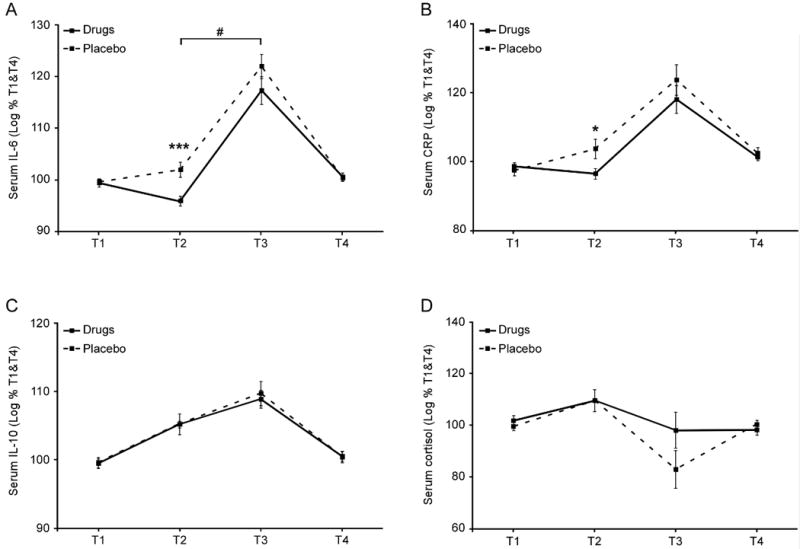
Fig. 3. Effect of drug treatment on circulating levels of IL-6, CRP, IL-10 and cortisol levels (n=18 per group)
Serum levels of IL-6 (A), C-reactive protein (B), cortisol (C), and IL-10 (D) were assessed by commercial enzyme-linked immunosorbent assay (high-sensitivity ELISA kits for IL-6 and IL-10). Data represent mean ± SEM. Group differences at a specific time point are indicated by * (p<.05), *** (p<.001). A significant contrast between drug and placebo conditions during treatment (T2+T3) [vs off treatment (T1+T4)] is indicated by #.
Fig. 4
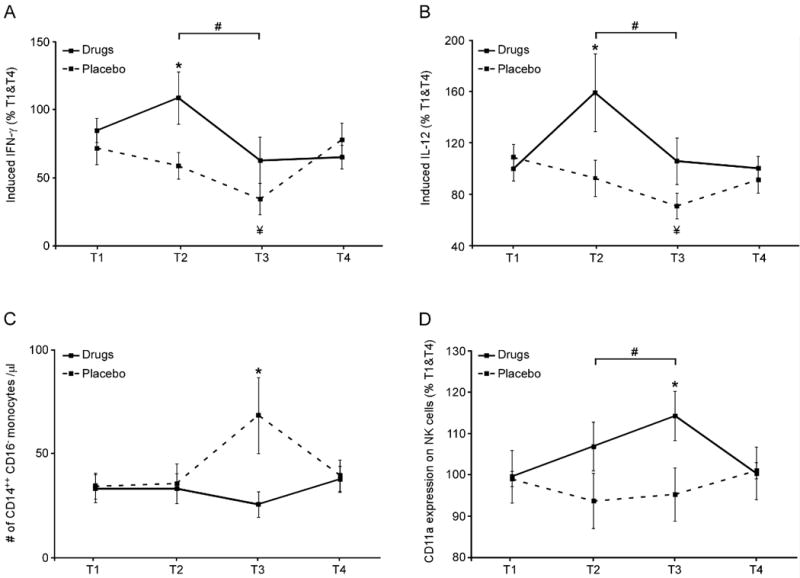
Fig. 4. Effect of drug treatment on ex vivo stimulated production of IL-12 and IFN-γ, on numbers of circulating CD16 monocytes, and on CD11a (LFA-1) expression levels on NK cells (n=18 per group)
Venipuncture blood samples were assayed for: (A and B) Induced cytokine levels following 21-hrs LPS & PHA-stimulation, assessed in culture supernatant by enzyme-linked immunosorbent assay (ELISA); (C) circulating frequency of CD14++CD16 “classical” monocytes, and (D) expression levels of the activation marker CD11a on NK cells (CD3CD56+CD16+ lymphocytes), assessed by flow cytometry. Data represent mean ± SEM. Group differences at a specific time point are indicated by * (p < 0.05). A significant contrast between drug and placebo treatments at T2+T3 [vs off treatment (T1+T4)] is indicated by #. A significant decrease from T1 to T3 within the placebo group is indicated by ¥.

References

    1. Motz GT, Coukos G. Deciphering and reversing tumor immune suppression. Immunity. 2013;39(1):61–73. doi: 10.1016/j.immuni.2013.07.005. S1074-7613(13)00289-6 [pii] - DOI - PMC - PubMed
    1. Neeman E, Ben-Eliyahu S. Surgery and stress promote cancer metastasis: new outlooks on perioperative mediating mechanisms and immune involvement. Brain, behavior, and immunity. 2013;30(Suppl):S32–40. doi: 10.1016/j.bbi.2012.03.006. - DOI - PMC - PubMed
    1. Shakhar G, Ben-Eliyahu S. Potential prophylactic measures against postoperative immunosuppression: could they reduce recurrence rates in oncological patients? Annals of surgical oncology. 2003;10(8):972–92. - PubMed
    1. Horowitz M, Neeman E, Sharon E, Ben-Eliyahu S. Exploiting the critical perioperative period to improve long-term cancer outcomes. Nat Rev Clin Oncol. 2015;12(4):213–26. doi: 10.1038/nrclinonc.2014.224. nrclinonc.2014.224 [pii] - DOI - PMC - PubMed
    1. Armaiz-Pena GN, Gonzalez-Villasana V, Nagaraja AS, Rodriguez-Aguayo C, Sadaoui NC, Stone RL, et al. Adrenergic regulation of monocyte chemotactic protein 1 leads to enhanced macrophage recruitment and ovarian carcinoma growth. Oncotarget. 2015;6(6):4266–73. doi: 10.18632/oncotarget.2887. - DOI - PMC - PubMed

Publication types

MeSH terms