


Vitamin D and calcium intake and risk of early menopause
- PMID: 28490509
- PMCID: PMC5445672
- DOI: 10.3945/ajcn.116.145607
Vitamin D and calcium intake and risk of early menopause
Abstract
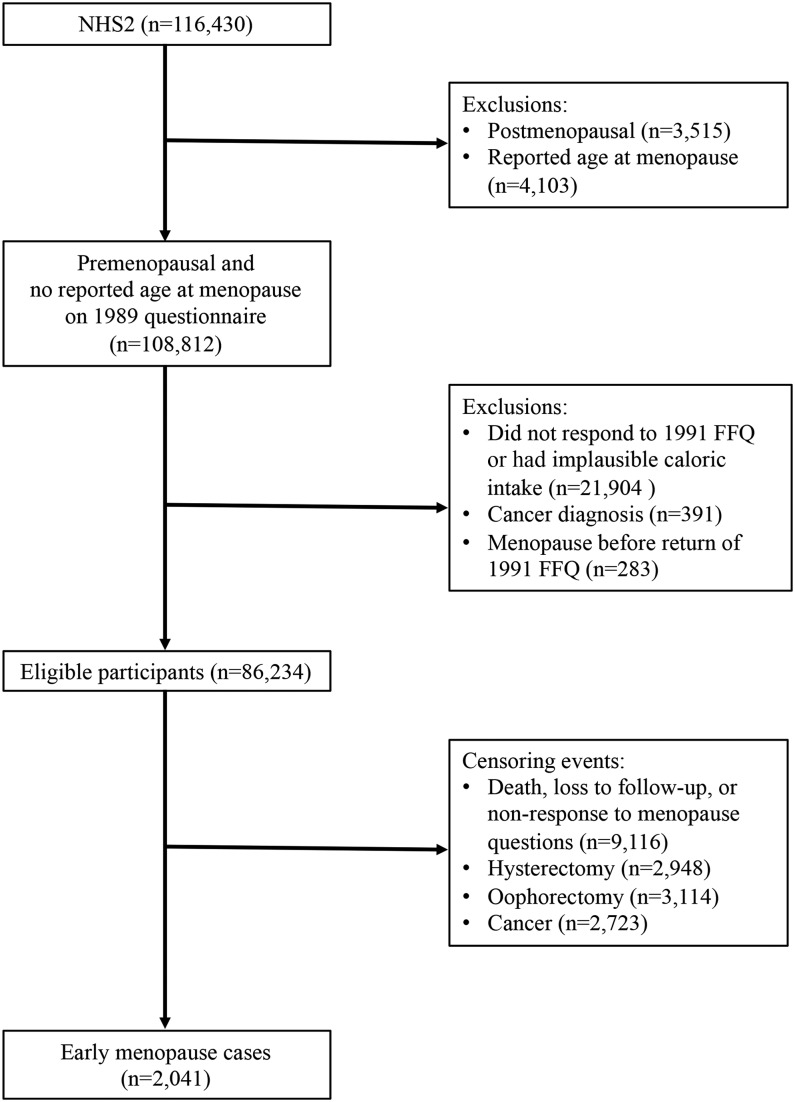
Background: Early menopause, defined as the cessation of ovarian function before the age of 45 y, affects ∼10% of women and is associated with higher risk of cardiovascular disease, osteoporosis, and other conditions. Few modifiable risk factors for early menopause have been identified, but emerging data suggest that high vitamin D intake may reduce risk.Objective: We evaluated how intakes of vitamin D and calcium are associated with the incidence of early menopause in the prospective Nurses' Health Study II (NHS2).Design: Intakes of vitamin D and calcium from foods and supplements were measured every 4 y with the use of a food-frequency questionnaire. Cases of incident early menopause were identified from all participants who were premenopausal at baseline in 1991; over 1.13 million person-years, 2041 women reported having natural menopause before the age of 45 y. We used Cox proportional hazards regression to evaluate relations between intakes of vitamin D and calcium and incident early menopause while accounting for potential confounding factors.Results: After adjustment for age, smoking, and other factors, women with the highest intake of dietary vitamin D (quintile median: 528 IU/d) had a significant 17% lower risk of early menopause than women with the lowest intake [quintile median: 148 IU/d; HR: 0.83 (95% CI: 0.72, 0.95); P-trend = 0.03]. Dietary calcium intake in the highest quintile (median: 1246 mg/d) compared with the lowest (median: 556 mg/d) was associated with a borderline significantly lower risk of early menopause (HR: 0.87; 95% CI: 0.76, 1.00; P-trend = 0.03). Associations were stronger for vitamin D and calcium from dairy sources than from nondairy dietary sources, whereas high supplement use was not associated with lower risk.Conclusions: Findings suggest that high intakes of dietary vitamin D and calcium may be modestly associated with a lower risk of early menopause. Further studies evaluating 25-hydroxyvitamin D concentrations, other dairy constituents, and early menopause are warranted.
Keywords: 25-hydroxyvitamin D; anovulation; calcium; dairy; menopause; menstrual cycle; ovarian function; vitamin D.
© 2017 American Society for Nutrition.
Figures
References
-
- van Der Voort DJ, van Der Weijer PH, Barentsen R. Early menopause: increased fracture risk at older age. Osteoporos Int 2003;14:525–30. - PubMed
-
- Fauser BC. Trilogy 8: premature ovarian failure and perimenopause. Female health implications of premature ovarian insufficiency. In: Tarlatzis BC, Bulun SE, editors. Proceedings of the International Federation of Fertility Societies 21st World Congress on Fertility and Sterility and the 69th Annual Meeting of the American Society for Reproductive Medicine. Boston (MA): American Society for Reproductive Medicine; 2013. p. 137–8.
Publication types
MeSH terms
Substances
Grants and funding
LinkOut - more resources
Full Text Sources
Other Literature Sources
Medical
