


Lifestyle and Risk of Screening-Detected Abdominal Aortic Aneurysm in Men
- PMID: 28490522
- PMCID: PMC5524061
- DOI: 10.1161/JAHA.116.004725
Lifestyle and Risk of Screening-Detected Abdominal Aortic Aneurysm in Men
Abstract
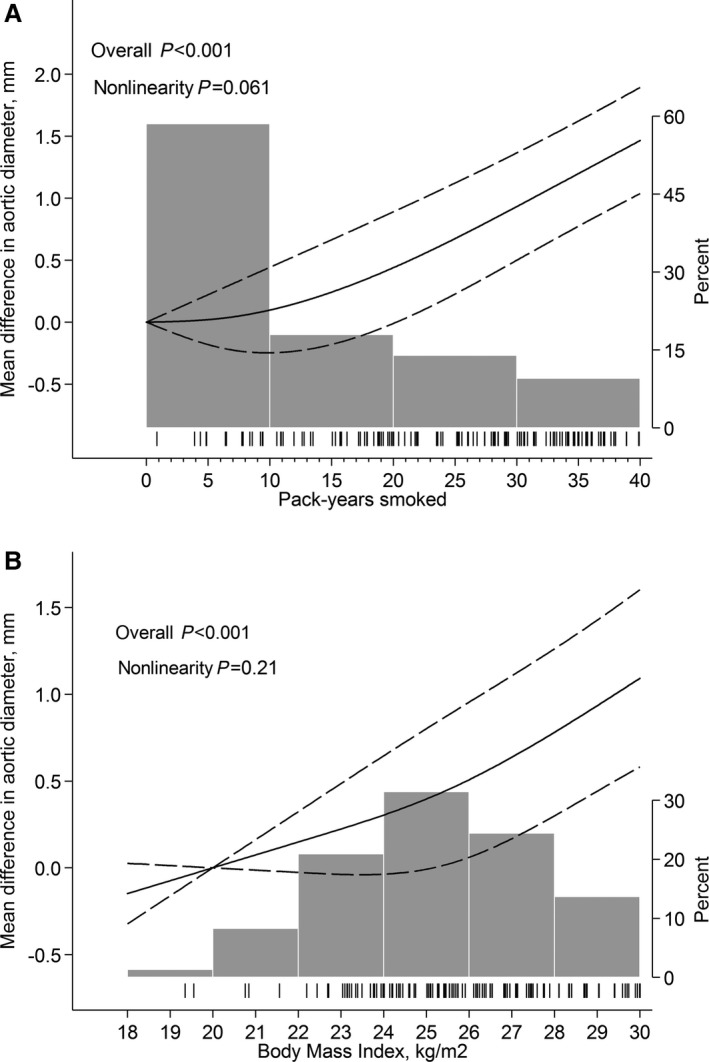
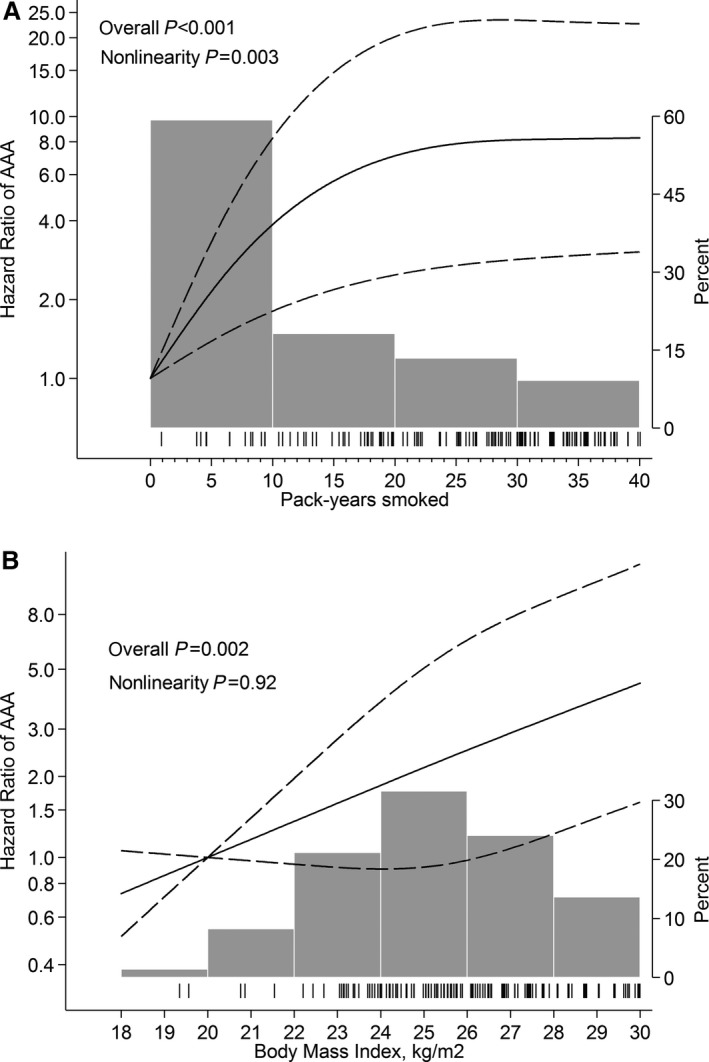
Background: Modifiable lifestyle-related factors associated with risk of abdominal aortic aneurysm (AAA) are rarely investigated with a prospective design. We aimed to study possible associations among such factors and comorbidities with mean abdominal aortic diameter (AAD) and with risk of AAA among men screened for the disease.
Methods and results: Self-reported lifestyle-related exposures were assessed at baseline (January 1, 1998) among 14 249 men from the population-based Cohort of Swedish Men, screened for AAA between 65 and 75 years of age (mean 13 years after baseline). Multivariable prediction of mean AAD was estimated with linear regression, and hazard ratios (HRs) of AAA (AAD ≥30 mm) with Cox proportional hazard regression. The AAA prevalence was 1.2% (n=168). Smoking, body mass index, and cardiovascular disease were associated with a larger mean AAD, whereas consumption of alcohol and diabetes mellitus were associated with a smaller mean AAD. The HR of AAA was increased among participants who were current smokers with ≥25 pack-years smoked compared with never smokers (HR 15.59, 95% CI 8.96-27.15), those with a body mass index ≥25 versus <25 (HR 1.89, 95% CI, 1.22-2.93), and those with cardiovascular disease (HR 1.77, 95% CI, 1.13-2.77), and hypercholesterolemia (HR 1.59, 95% CI 1.08-2.34). Walking or bicycling for >40 minutes/day (versus almost never) was associated with lower AAA hazard (HR 0.59, 95% CI 0.36-0.97) compared with almost never walking or bicycling.
Conclusions: This prospective study confirms that modifiable lifestyle-related factors are associated with AAD and with AAA disease.
Keywords: abdominal aortic aneurysm; cohort study; epidemiology; lifestyle; risk factor.
© 2017 The Authors. Published on behalf of the American Heart Association, Inc., by Wiley.
Figures
References
-
- Mani K, Lees T, Beiles B, Jensen LP, Venermo M, Simo G, Palombo D, Halbakken E, Troeng T, Wigger P, Bjorck M. Treatment of abdominal aortic aneurysm in nine countries 2005–2009: a vascunet report. Eur J Vasc Endovasc Surg. 2011;42:598–607. - PubMed
-
- Svensjo S, Bjorck M, Gurtelschmid M, Djavani Gidlund K, Hellberg A, Wanhainen A. Low prevalence of abdominal aortic aneurysm among 65‐year‐old Swedish men indicates a change in the epidemiology of the disease. Circulation. 2011;124:1118–1123. - PubMed
-
- Kuivaniemi H, Elmore JR. Opportunities in abdominal aortic aneurysm research: epidemiology, genetics, and pathophysiology. Ann Vasc Surg. 2012;26:862–870. - PubMed
-
- Lederle FA, Johnson GR, Wilson SE, Chute EP, Hye RJ, Makaroun MS, Barone GW, Bandyk D, Moneta GL, Makhoul RG. The aneurysm detection and management study screening program: validation cohort and final results. Aneurysm Detection and Management Veterans Affairs Cooperative Study Investigators. Arch Intern Med. 2000;160:1425–1430. - PubMed
MeSH terms
LinkOut - more resources
Full Text Sources
Other Literature Sources
