Review
. 2018 Jun 1;8(6):a029769.
doi: 10.1101/cshperspect.a029769.

Adaptations to Endurance and Strength Training

Affiliations
Review

Adaptations to Endurance and Strength Training

David C Hughes et al. Cold Spring Harb Perspect Med. .

Abstract

The capacity for human exercise performance can be enhanced with prolonged exercise training, whether it is endurance- or strength-based. The ability to adapt through exercise training allows individuals to perform at the height of their sporting event and/or maintain peak physical condition throughout the life span. Our continued drive to understand how to prescribe exercise to maximize health and/or performance outcomes means that our knowledge of the adaptations that occur as a result of exercise continues to evolve. This review will focus on current and new insights into endurance and strength-training adaptations and will highlight important questions that remain as far as how we adapt to training.


Figures

Figure 1.
Figure 1.
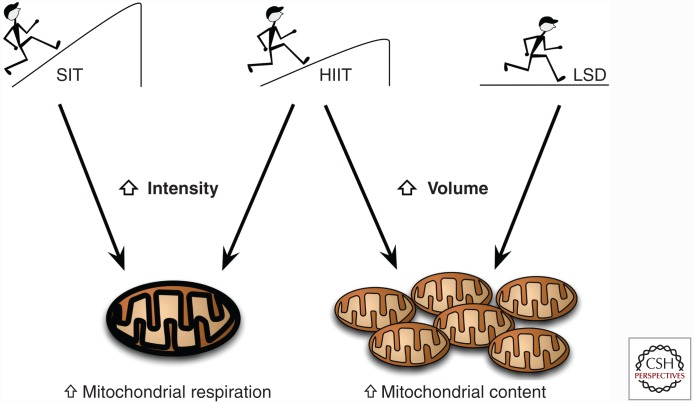
Schematic diagram of training intensity and volume on mitochondrial respiration versus content adaptations through endurance training. Recent evidence suggests that increases in exercise intensity (sprint interval training [SIT]; high-intensity interval training [HIIT]) lead to enhanced mitochondrial respiration and function, whereas prolonged low-intensity and high-volume (long slow-distance [LSD] training) endurance exercise appears to aid in increased mitochondrial content within skeletal muscle.
Figure 2.
Figure 2.
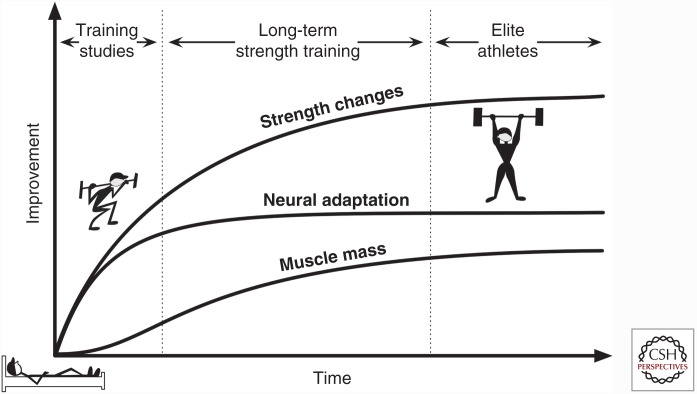
Alterations in strength, mass, and neural adaptations with resistance exercise over time. Resistance exercise studies (8 to 12 wk of training) display an early increase in strength as a result of neural adaptations. With prolonged strength training, muscle mass slowly increases and drives the later changes in strength after neural adaptations begin to plateau. Finally, at the elite level, individuals show small changes in all three core adaptations that accompany strength training. At this point, new stimuli (possibly targeting the extracellular matrix [ECM]) are needed to increase strength.
Figure 3.
Figure 3.
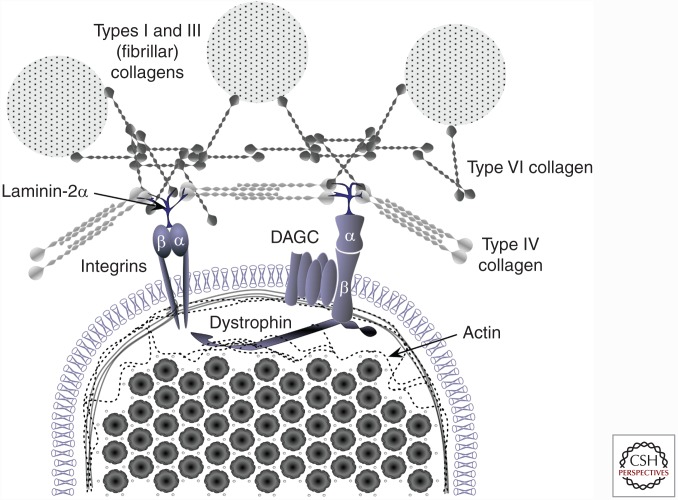
Interaction of the extracellular matrix (ECM), connective tissue, and cytoskeleton protein networks surrounding skeletal muscle myofibrils. Research on the cellular adaptations that occur with strength training have predominantly focused within skeletal muscle. Recent research has begun to highlight the role of the dystrophin-associated glycoprotein complex (DAGC) and integrin complexes in force transmission and the possible contribution of structures outside the muscle to force transfer and overall strength. Few studies have investigated the contribution of the ECM to muscle force transfer and/or how these complexes may adapt over a period of time with training. However, hyperlax individuals (with mutations in collagen VI) show slowed rates of force development, indicating that the ECM is important in muscle function.
Figure 4.
Figure 4.
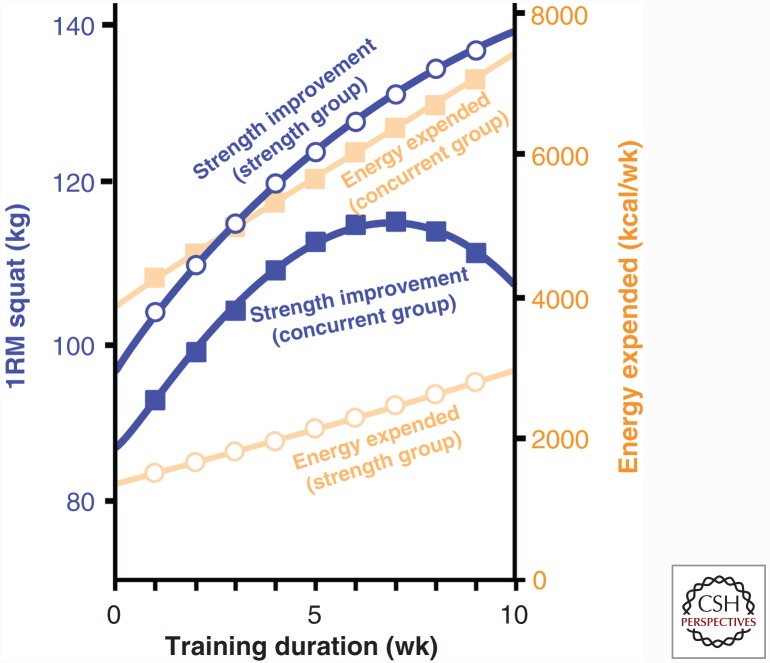
The impact of strength training and concurrent exercise on energy consumption. The classic Hickson (1980) study was the first to observe a decline in strength improvement and strength performance (1RM [repetition maximum] squat) over time with concurrent training (closed blue squares). The decline in strength adaptations occurred once the concurrent group was expending double the kcal/wk of the strength training only group (open circles). This suggests that the impairment in strength adaptations with concurrent exercise could reflect the role of negative energy balance on muscle hypertrophy.

References

    1. Aagaard P, Andersen JL. 2010. Effects of strength training on endurance capacity in top-level endurance athletes. Scand J Med Sci Sports 20: 39–47. - PubMed
    1. Aagaard P, Simonsen EB, Andersen JL, Magnusson P, Dyhre-Poulsen P. 2002. Increased rate of force development and neural drive of human skeletal muscle following resistance training. J Appl Physiol (1985) 93: 1318–1326. - PubMed
    1. Aagaard P, Magnusson PS, Larsson B, Kjær M, Krustrup P. 2007. Mechanical muscle function, morphology, and fiber type in lifelong trained elderly. Med Sci Sports Exerc 39: 1989–1996. - PubMed
    1. Aagaard P, Andersen J, Bennekou M, Larsson B, Olesen J, Crameri R, Magnusson SP, Kjaer M. 2011. Effects of resistance training on endurance capacity and muscle fiber composition in young top-level cyclists. Scand J Med Sci Sports 21: e298–e307. - PubMed
    1. Albracht K, Arampatzis A. 2013. Exercise-induced changes in triceps surae tendon stiffness and muscle strength affect running economy in humans. Eur J Appl Physiol 113: 1605–1615. - PubMed