. 2017 May 10;7(1):1673.
doi: 10.1038/s41598-017-01908-9.

Metasurface Freeform Nanophotonics

Affiliations

Metasurface Freeform Nanophotonics

Alan Zhan et al. Sci Rep. .

Abstract

Freeform optics aims to expand the toolkit of optical elements by allowing for more complex phase geometries beyond rotational symmetry. Complex, asymmetric curvatures are employed to enhance the performance of optical components while minimizing their size. Unfortunately, these high curvatures and complex forms are often difficult to manufacture with current technologies, especially at the micron scale. Metasurfaces are planar sub-wavelength structures that can control the phase, amplitude, and polarization of incident light, and can thereby mimic complex geometric curvatures on a flat, wavelength-scale thick surface. We present a methodology for designing analogues of freeform optics using a silicon nitride based metasurface platform for operation at visible wavelengths. We demonstrate a cubic phase plate with a point spread function exhibiting enhanced depth of field over 300 micron along the optical axis with potential for performing metasurface-based white light imaging, and an Alvarez lens with a tunable focal length range of over 2.5 mm corresponding to a change in optical power of ~1600 diopters with 100 micron of total mechanical displacement. The adaptation of freeform optics to a sub-wavelength metasurface platform allows for further miniaturization of optical components and offers a scalable route toward implementing near-arbitrary geometric curvatures in nanophotonics.


Conflict of interest statement

The authors declare that they have no competing interests.

Figures

Figure 1
Figure 1
Mapping a freeform surface onto a metasurface: An arbitrary freeform surface is shown in (a). The corresponding height z(x, y) is converted into a discretized phase profile using the pillar parameters shown in (b). The parameters in (b) are capable of producing a full cycle of phase shifts and also maintain large regions of continuous, near unity transmission amplitude. (c) and (d) are simple schematics of a metasurface with thickness t, periodicity p, and diameter d.
Figure 2
Figure 2
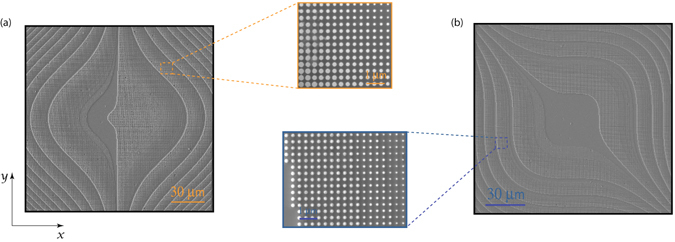
Scanning electron micrographs of fabricated devices coated in gold. Half of the Alvarez lens is shown in (a), and the cubic phase plate is shown in (b). Insets are zooms of specific locations of the metasurface showing the gradient in pillar sizes.
Figure 3
Figure 3
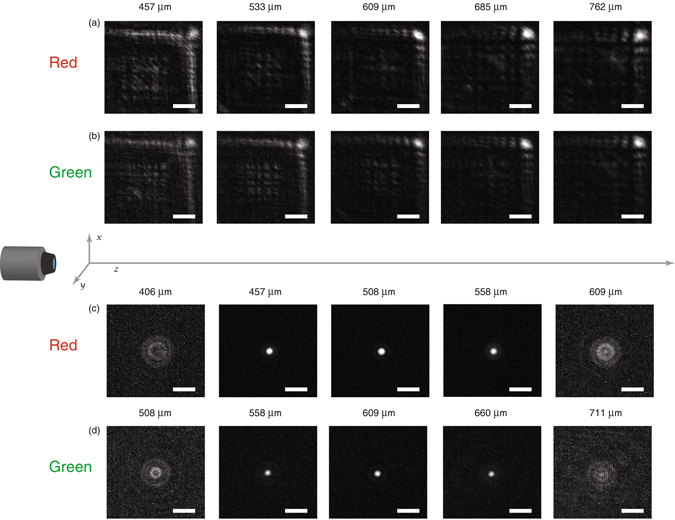
Dependence of cubic metasurface and metasurface lens point spread functions (PSF) upon displacement along the optical axis. (a) and (b) are the PSFs of the cubic element under coherent illumination by red and green light respectively. (c) and (d) are the PSFs of a 500 μm metasurface lens from ref. under red and green illumination. All figures share the same 18 μm scale bar. The differences in the intensities of the images are due to the difference in incident intensities of the red and green lasers upon exiting the pinhole.
Figure 4
Figure 4
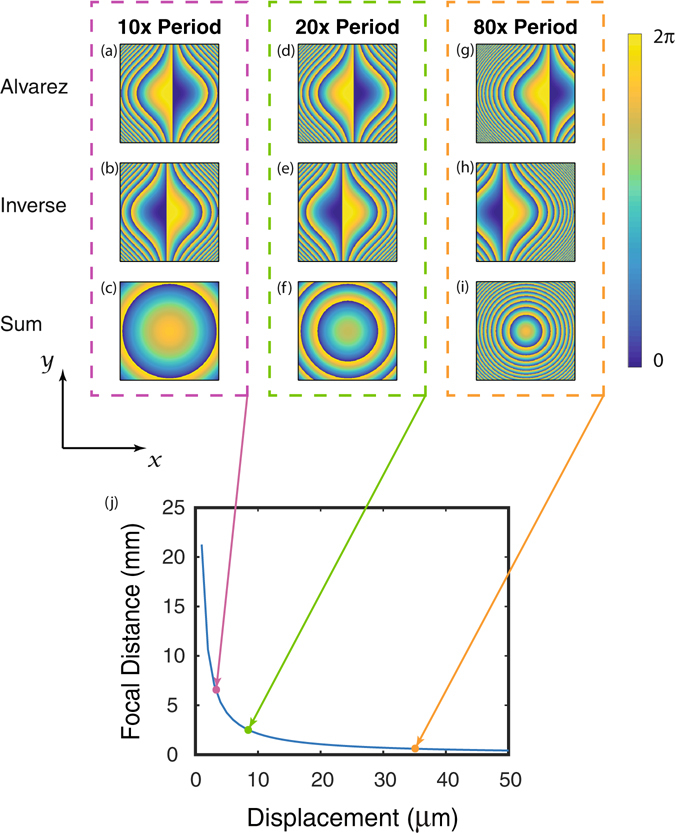
Behavior of the Alvarez lens in response to x displacement. (a,d,g) represent the phase profiles of one Alvarez element for displacements of 10p, 20p, 80p respectively, (b,e,h) represent their inverses at displacements of −10p, −20p, −80p respectively, and (c,f,i) are the sums of the displaced phase profiles. The phase profiles are displaced in units of the metasurface lattice periodicity p = 443 nm, with (ac) representing a 4.43 μm displacement, (df) representing 8.86 μm displacement, and (gi) representing a 35.4 μm displacement. (j) Plot of focal length dependence on displacement based on equation 4. Larger displacements result in a more rapidly varying phase profile, corresponding to a lens with a smaller focal length. The colored dots indicate the focal lengths of lenses shown in (c,f,i). Parameters used are the same as for the fabricated device, L = 150 μm, A = 1.17 × 107m−2.
Figure 5
Figure 5
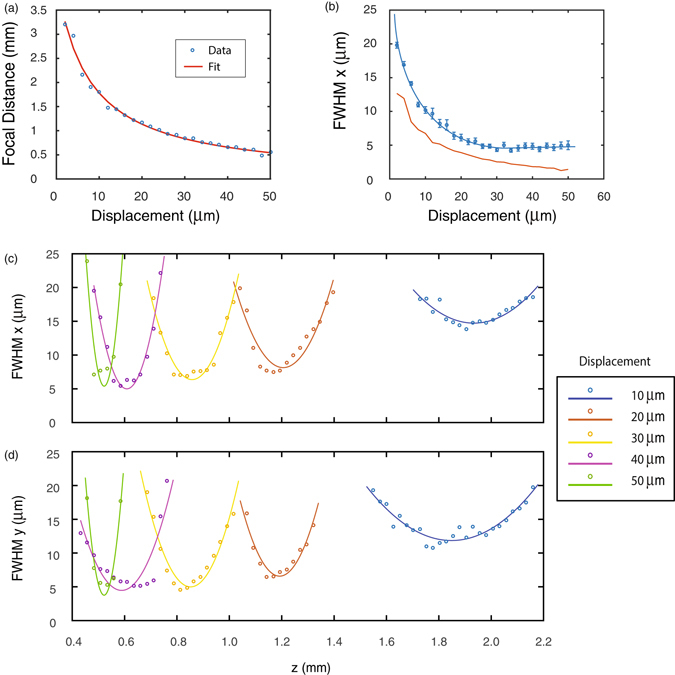
Alvarez lens performance. (a) Measured focal distance of the Alvarez lens pair plotted against x displacement. The red line is a theoretical fit to the focal length data. (b) Full width at half maximum (FWHM) measured along the x axis plotted against x displacement. The measured data are shown as blue points while the blue line is an eye guide. The diffraction-limited spot size FWHM is plotted in red. Error bars represent a 95% confidence interval of a Gaussian fit. For both (a) and (b) images were taken with a displacement step size of 2 μm. (c,d) Behavior of the Alvarez lens FWHM for five displacements along x-axis. The FWHM of the spot-size in the sensor plane is plotted as the microscope moves into and out of the focal plane. The FWHMs are measured along the (c) x and (d) y axes. FWHM data is plotted as the points, and the lines are eye guides.

References

    1. Kaya I, Thompson KP, Rolland JP. Comparative assessment of freeform polynomials as optical surface descriptions. Opt. Express. 2012;20:22683–22691. doi: 10.1364/OE.20.022683. - DOI - PubMed
    1. Thompson KP, Rolland JP. Freeform Optical Surfaces: A Revolution in Imaging Optical Design. Opt. Photon. News. 2012;23:30–35. doi: 10.1364/OPN.23.6.000030. - DOI
    1. Fuerschbach K, Rolland JP, Thompson KP. Theory of aberration fields for general optical systems with freeform surfaces. Optics Express. 2014;22:26585–26606. doi: 10.1364/OE.22.026585. - DOI - PubMed
    1. Fuerschbach K, Davis GE, Thompson KP, Rolland JP. Assembly of a freeform off-axis optical system employing three;-polynomial Zernike mirrors. Optics Letters. 2014;39:2896–2899. doi: 10.1364/OL.39.002896. - DOI - PubMed
    1. Nie Y, Duerr F, Thienpont H. Direct design approach to calculate a two-surface lens with an entrance pupil for application in wide field-of-view imaging. OPTICE. 2015;54:015102–015102. doi: 10.1117/1.OE.54.1.015102. - DOI - PubMed

Publication types