


Gender Differences in Depressive Symptoms Among HIV-Positive Concordant and Discordant Heterosexual Couples in China
- PMID: 28490832
- PMCID: PMC5421639
- DOI: 10.1177/0361684316671302
Gender Differences in Depressive Symptoms Among HIV-Positive Concordant and Discordant Heterosexual Couples in China
Abstract
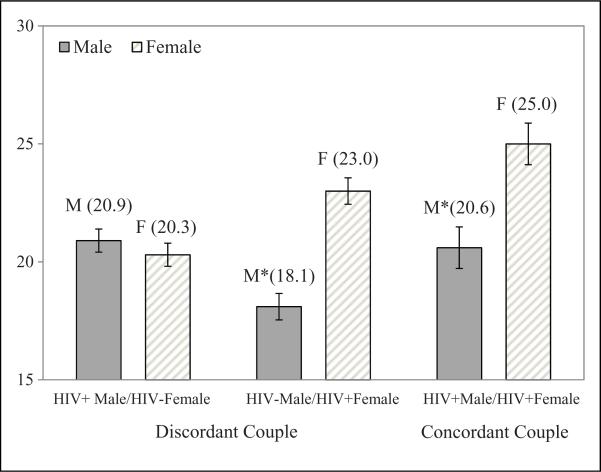
HIV seropositive individuals and their heterosexual partners/spouses, either seropositive or seronegative, are facing several mental health challenges. The objective of this study was to examine gender differences in depressive symptoms among HIV-positive concordant and HIV-discordant couples. We identified heterosexual couples from participants of a randomized controlled trial conducted in Anhui province, China. A total of 265 couples, comprising 129 HIV+ male/HIV- female couples, 98 HIV- male/HIV+ female couples, and 38 HIV-positive concordant couples, were included in the analyses. We collected data using the computer-assisted personal interview method. We used a linear mixed-effects regression model to assess whether gender differences in depressive symptoms varied across couple types. HIV-positive women reported a significantly higher level of depressive symptoms than their partners/spouses. HIV-positive women with HIV-positive partners had higher depressive symptoms than those with HIV-negative partners, whereas HIV-positive men reported similar levels of depressive symptoms regardless of their partners' serostatus. Among the concordant couples, those with the highest annual family income showed the greatest gender differences in depressive symptoms. We suggest that family interventions should be gender- and couple-type specific and that mental health counseling is warranted not only for HIV-positive women but also for HIV-negative women in an HIV-affected relationship.
Keywords: HIV; couples; depressive symptoms; gender; mental health; serostatus.
Figures
References
-
- Abramson LY, Alloy LB. Cognitive vulnerability to depression: Current status and developmental origins. In: Joiner TE, Brown JS, Kistner J, editors. The interpersonal, cognitive, and social nature of depression. Lawrence Erlbaum; Mahwah, NJ: 2006. pp. 83–100.
-
- Agresti A. Categorical data analysis. 3rd ed. Wiley; New York, NY: 2012.
-
- Aljassem K, Raboud JM, Hart TA, Benoit A, Su D, Margolese SL, Loutfy MR. Gender differences in severity and correlates of depression symptoms in people living with HIV in Ontario, Canada. Journal of the International Association of Providers of AIDS Care. 2014;15:23–35. doi:10.1177/2325957414536228. - PubMed
-
- Asiedu GB, Myers-Bowman KS. Gender differences in the experiences of HIV/AIDS-related stigma: A qualitative study in Ghana. Health Care for Women International. 2014;35:703–727. doi:10.1080/07399332.2014.895367. - PubMed
-
- Beyeza-Kashesya J, Kaharuza F, Mirembe F, Neema S, Ekstrom AM, Kulane A. The dilemma of safe sex and having children: Challenges facing HIV sero-discordant couples in Uganda. African Health Sciences. 2009;9:2–12. Retrieved from www.ncbi.nlm.nih.gov/pubmed/20842236. - PMC - PubMed
Grants and funding
LinkOut - more resources
Full Text Sources
Other Literature Sources