


Ascorbic Acid-A Potential Oxidant Scavenger and Its Role in Plant Development and Abiotic Stress Tolerance
- PMID: 28491070
- PMCID: PMC5405147
- DOI: 10.3389/fpls.2017.00613
Ascorbic Acid-A Potential Oxidant Scavenger and Its Role in Plant Development and Abiotic Stress Tolerance
Abstract
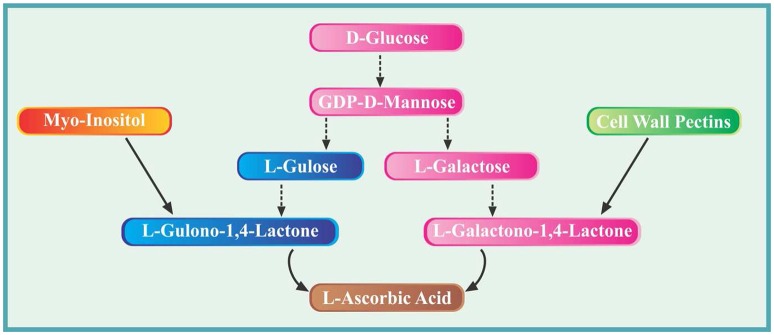
Over-production of reactive oxygen species (ROS) in plants under stress conditions is a common phenomenon. Plants tend to counter this problem through their ability to synthesize ROS neutralizing substances including non-enzymatic and enzymatic antioxidants. In this context, ascorbic acid (AsA) is one of the universal non-enzymatic antioxidants having substantial potential of not only scavenging ROS, but also modulating a number of fundamental functions in plants both under stress and non-stress conditions. In the present review, the role of AsA, its biosynthesis, and cross-talk with different hormones have been discussed comprehensively. Furthermore, the possible involvement of AsA-hormone crosstalk in the regulation of several key physiological and biochemical processes like seed germination, photosynthesis, floral induction, fruit expansion, ROS regulation and senescence has also been described. A simplified and schematic AsA biosynthetic pathway has been drawn, which reflects key intermediates involved therein. This could pave the way for future research to elucidate the modulation of plant AsA biosynthesis and subsequent responses to environmental stresses. Apart from discussing the role of different ascorbate peroxidase isoforms, the comparative role of two key enzymes, ascorbate peroxidase (APX) and ascorbate oxidase (AO) involved in AsA metabolism in plant cell apoplast is also discussed particularly focusing on oxidative stress perception and amplification. Limited progress has been made so far in terms of developing transgenics which could over-produce AsA. The prospects of generation of transgenics overexpressing AsA related genes and exogenous application of AsA have been discussed at length in the review.
Keywords: AsA and hormone crosstalk; abiotic stress tolerance; ascorbic acid; biosynthesis; exogenous application.
Figures
References
-
- Agami R. A. (2014). Applications of ascorbic acid or proline increase resistance to salt stress in barley seedlings. Biol. Plant. 58, 341–347. 10.1007/s10535-014-0392-y - DOI
-
- Ahmad I., Basra S. M. A., Wahid A. (2014). Exogeneous application of ascorbic acid, salicylic acid, hydrogen peroxide improves the productivity of hybrid maize at low temperature stress. Int. J. Agric. Biol. 16, 825–830.
-
- Ahmed F., Baloch D. M., Hassan M. J., Ahmed N. (2013). Role of plant growth regulators in improving oil quantity and quality of sunflower hybrids in drought stress. Biologia 59, 315–322.
-
- Ahmed F., Baloch D. M., Sadiq S. A., Ahmed S. S., Hanan A., Taran S. A., et al. (2014). Plant growth regulators induced drought tolerance in sunflower (Helianthus annuus L.) hybrids. J. Anim. Plant Sci. 24, 886–890.
Publication types
LinkOut - more resources
Full Text Sources
Other Literature Sources
Miscellaneous
